Introduction
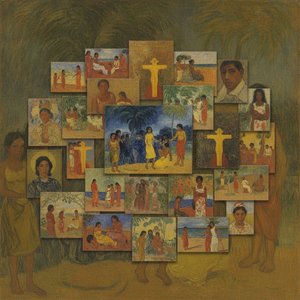
To step into the world of Eugène Henri Paul Gauguin is to abandon the safety of the familiar and surrender to a landscape of raw emotion, saturated color, and profound mystery. His work does not merely depict a scene; it evokes a temperament. As we wander through this curated selection of his top twenty-five masterpieces, we are not just observing paint on canvas, but witnessing a soul in constant, restless pursuit of the primordial. Gauguin’s journey—from the structured, high-stakes world of a Parisian stockbroker to the sun-drenched, spiritually charged terrains of Brittany and Tahiti—serves as the heartbeat of his oeuvre.
Gauguin stood at a pivotal crossroads in art history, acting as the bridge that allowed the fleeting light of Impressionism to dissolve into the bold, symbolic depths of Post-Impressionism. He rejected the mere imitation of nature, choosing instead to use cloisonnism —bold outlines and flat areas of vibrant color—to communicate truths that words often fail to capture. His canvases are heavy with the scent of tropical flora and the weight of ancient myths, inviting us to look past the surface of reality into a realm where color becomes a language of the spirit.
< 1p>Today, these works remain profoundly resonant. In an era of digital fleetingness, Gauguin’s commitment to the "primitive" and the authentic offers a sanctuary of depth. His ability to weave together personal struggle, colonial encounter, and spiritual longing continues to challenge our perceptions of beauty and civilization. Whether it is the haunting stillness of a Tahitian landscape or the rhythmic intensity of his figures, each piece in this collection invites a dialogue between the viewer and the unseen.
As you prepare to explore this definitive list, allow yourself to be guided by the rhythm of his brushstrokes. We have selected twenty-five works that represent the zenith of his creative evolution—pieces that define his legacy and continue to inspire collectors, designers, and dreamers across the globe. Prepare to encounter the colors of a revolution.
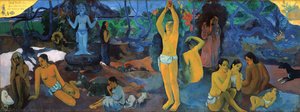
Where do we come from what are we where are we going - Eugène Henri Paul Gauguin
 Where do we come from what are we where are we going - Eugène Henri Paul Gauguin
To encounter Where do we come from, what are we, where are we going? is to stand before a profound visual poem that transcends the boundaries of mere canvas. In this monumental masterpiece, Paul Gauguin does not simply paint a Tahitian landscape; he orchestrates a cosmic cycle of existence. As you gaze upon the lush, dreamlike composition, you are guided through thirteen figures representing the entire spectrum of human life—from the vulnerability of infancy to the contemplative stillness of old age.
The atmosphere is heavy with a serene yet melancholic mystery, draped in deep, atmospheric blues and contrasted by sudden, emotive bursts of warm gold and ochre. Through his mastery of Synthetism , Gauguin rejects literal realism in favor of symbolic truth, using bold outlines and flat planes of color to evoke the soul's journey. This is not mere decoration; it is a transformative experience for the collector. To possess a reproduction of this work is to invite a gallery of the soul into your home, surrounding yourself with the very questions that define our humanity.
Two Women on the Beach - Eugène Henri Paul Gauguin
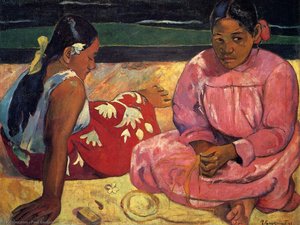 Two Women on the Beach - Eugène Henri Paul Gauguin
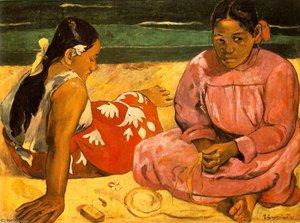
In Two Women on the Beach , Gauguin invites us into a Tahitian reverie, where the boundaries between reality and symbolism dissolve into a symphony of warmth. This masterpiece stands as a cornerstone of his top works because it perfectly encapsulates his radical departure from Impressionism toward Synthetism . Rather than capturing a fleeting light, Gauguin utilizes bold, flat planes of color and dark, Cloisonnist contours to evoke a profound sense of quietude and tropical intimacy.
The palette is a rich tapestry of ochre, deep reds, and sun-drenched pinks, creating an atmosphere that feels both ancient and immediate. For the modern collector or interior designer, this piece offers an unparalleled emotional depth; its vibrant, saturated tones and simplified forms provide a sophisticated focal point for contemporary spaces seeking a touch of exoticism and soulful character. Through the serene interaction of the two figures, Gauguin transcends mere portraiture, offering a timeless meditation on connection and the beauty of a life lived far from the constraints of Western decadence.
Yellow Christ - Eugène Henri Paul Gauguin
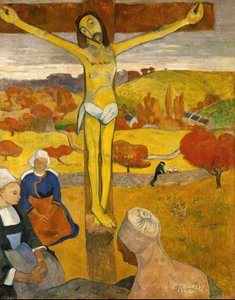 Yellow Christ - Eugène Henri Paul Gauguin
In Yellow Christ , Gauguin transcends mere religious iconography to present a profound meditation on spiritual isolation and the raw essence of human suffering. As one of the most arresting entries in our collection of the top 25 artworks of Eugène Henri Paul Gauguin , this 1889 masterpiece defies traditional piety through its radical use of Synthetism . The figure of Christ, rendered in haunting ochre and sickly yellows, emerges from a flattened, dreamlike landscape of Brittany, stripped of anatomical realism to favor pure emotional truth.
The painting’s visual language—characterized by bold, Cloisonnist outlines and unblended planes of color—resonates deeply with contemporary minimalist aesthetics that value symbolic impact over literal representation. The heavy, tactile impasto and the stark contrast between the vibrant yellow figure and the somber, muted landscape create a sensory tension that remains a powerful cultural talking point. For the discerning collector, this work serves as a window into Gauguin’s rejection of Impressionism, offering a primitive, soulful intensity that continues to anchor modern curated spaces with its timeless, enigmatic gravity.
The Loss of Virginity (also known as The Awakening of Spring) - Eugène Henri Paul Gauguin
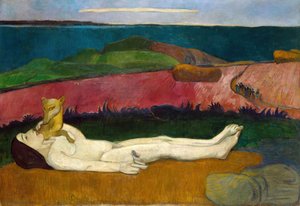 The Loss of Virginity (also known as The Awakening of Spring) - Eugène Henri Paul Gauguin
In The Loss of Virginity (also known as The Awakening of Spring) , Gauguin invites us into a liminal space where the boundaries between the human soul and the primal wild dissolve. There is a profound, quiet melancholy in this scene; a reclining figure rests upon a sun-drenched shore, while a watchful fox perches atop his chest, acting as a silent sentinel of nature’s instinct. This masterpiece earns its place among the top 25 artworks of Eugène Henri Paul Gauguin through its masterful use of Symbolism, where flattened perspectives and bold, rhythmic lines evoke a dreamlike, almost hallucinatory atmosphere.
The palette—a sophisticated interplay of deep blues, earthy pinks, and vibrant ochres—captures the heavy, humid air of his Tahitian inspirations. At ArtsDot, we understand that such evocative works are more than mere decor; they are windows into a different consciousness. Our hand-painted oil reproductions are meticulously crafted to preserve this very essence, ensuring that the visible brushstrokes and rich, impasto textures of Gauguin’s original vision bring a sense of historical depth and soulful tranquility to your private collection.
Mahana no atua (Day of God) - Eugène Henri Paul Gauguin
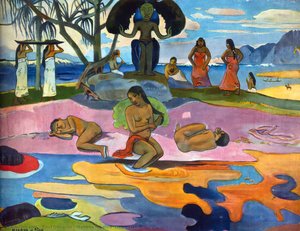 Mahana no atua (Day of God) - Eugène Henri Paul Gauguin
To stand before Mahana no atua (Day of God) is to be transported into a realm where the veil between the earthly and the divine becomes beautifully translucent. One does not merely observe this scene; one feels the humid, sacred air of a Tahitian ritual, heavy with the scent of tropical flora and the weight of ancestral reverence. Gauguin captures a profound moment of communal devotion, where figures move through a landscape of vibrant pinks, deep oranges, and lush greens, enacting ceremonies that honor the eternal cycles of life and spirituality.
This masterpiece earns its place among the top 25 artworks of Eugène Henri Paul Gauguin through its masterful use of Post-Impressionist symbolism and bold, flattened perspectives. It is a visual bridge to a lost world, embodying the artist's quest for primitive purity. In our modern, often fragmented lives, bringing such a powerful exploration of harmony and cultural identity into one's home offers more than mere decoration; it provides a window into a soulful, rhythmic existence, inviting a sense of profound peace and spiritual connection to every space it inhabits.
Self Portrait with Hat - Eugène Henri Paul Gauguin
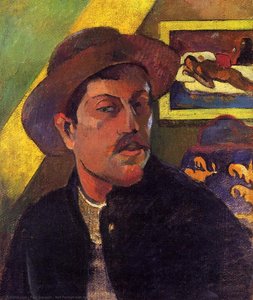 Self Portrait with Hat - Eugène Henri Paul Gauguin
There is a gaze in Self Portrait with Hat by Eugène Henri Paul Gauguin that follows you—not with judgment, but with understanding . This isn’t merely a portrait; it is a mirror reflecting the profound introspection of the Post-Impressionist era. In this 1893 masterpiece, Gauguin moves beyond the fleeting light of his predecessors to embrace Synthetism , using bold, non-naturalistic colors and thick, tactile impasto brushstrokes to convey a deep, psychological truth.
The composition presents a serious, melancholic figure set against a muted backdrop, where the stark black of his shirt and the earthy tones of his hat create a sense of grounded isolation. The vibrant blues and ochres do not just represent reality; they evoke an atmosphere of soulful contemplation. Its inclusion in our collection of the top 25 artworks of Eugène Henri Paul Gauguin is a testament to its power to make the invisible visible. Now, imagine that gaze in your space. Not watching you, but reminding you : you are seen. You are part of the story.
Tahitian Women Bathing - Eugène Henri Paul Gauguin
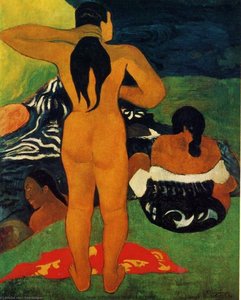 Tahitian Women Bathing - Eugène Henri Paul Gauguin
What if I told you that "Tahitian Women Bathing" by Eugène Henri Paul Gauguin was born from a moment of rebellion—a stroke of defiance against the ordinary? This masterpiece is not merely a depiction of tropical repose; it is a sensory manifesto. In this 1892 work, Gauguin abandons the fleeting light of Impressionism to embrace Synthetism , utilizing a riotous palette of fiery oranges, deep blues, and lush greens that pulse with life. The way the bold, saturated hues interact creates an almost hallucinatory intensity, inviting the viewer into a world where nature and spirit are inseparable.
Its inclusion in our selection of the top 25 artworks of Eugène Henri Paul Gauguin is essential, as it represents the very moment he redefined beauty through symbolic color and raw emotion. At ArtsDot.com, we believe such profound energy should not be confined to museum archives. Imagine this vibrant symphony of color hanging in your private sanctuary or a sophisticated office, transforming a mere wall into a window to the exotic. It is more than decor; it is a statement of soul and a timeless connection to the avant-garde.
Three Tahitians - Eugène Henri Paul Gauguin
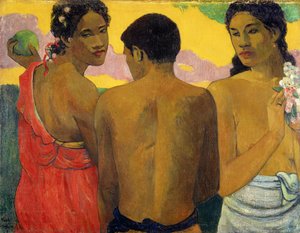 Three Tahitians - Eugène Henri Paul Gauguin
In Three Tahitians , Gauguin does not merely capture a scene; he composes a visual sonata of color and soul. To gaze upon this 1899 masterpiece is to feel the warmth of the Polynesian sun through thick, vibrant pigments. The light here is not an external force but an internal language, woven into the bold, flattened planes of yellow, red, and deep verdant greens that define his revolutionary Post-Impressionist style.
As you wander through this canvas, you encounter three figures standing in a lush landscape, their presence rendered with a sculptural weight that defies mere representation. Through his meticulous use of cloisonné techniques—layering washes of color and defining them with heavy outlines—Gauguin invites us into a world of quiet contemplation and spiritual depth. This work is essential to the top 25 artworks of Eugène Henri Paul Gauguin because it transcends the physical; it is a portal to an imagined paradise, where every brushstroke breathes with the rhythm of the Pacific. It is a piece designed not just to decorate a wall, but to transform a room into a sanctuary of exotic mystery.
Little Girls (Landscape with Two Breton Girls) - Eugène Henri Paul Gauguin
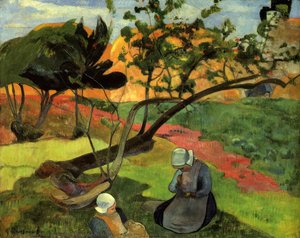 Little Girls (Landscape with Two Breton Girls) - Eugène Henri Paul Gauguin
Before he sought the sun-drenched mysteries of Tahiti, Gauguin found a profound, spiritual sanctuary in the rugged landscapes of Brittany. In his 1889 masterpiece, Little Girls (Landscape with Two Breton Girls) , we witness the precise moment the artist began to shed the fleeting light of Impressionism in favor of something far more permanent and symbolic. This work is a cornerstone among the top 25 artworks of Eugène Henri Paul Gauguin because it showcases his pioneering use of Cloisonnism —the technique of using bold, flattened planes of color bounded by dark, rhythmic outlines.
The canvas breathes with a serene, pastoral energy; two young girls in traditional Breton attire rest beneath the lush canopy of a protective tree, their quiet companionship mirrored by the vibrant reds and deep greens of the landscape. A distant ship on the horizon hints at the vastness of the world beyond this tranquil enclave. The disciplined focus and emotional depth required to compose such a harmonious vision make this piece an exquisite choice for a sophisticated study or home office, providing a window into a world of contemplative strength and enduring peace.
Vairumati - Eugène Henri Paul Gauguin
 Vairumati - Eugène Henri Paul Gauguin
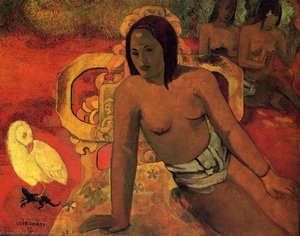
Step into the sun-drenched, soulful atmosphere of 1892 Tahiti with Gauguin’s Vairumati . This masterpiece does not merely depict a scene; it invites you into a sacred, communal intimacy where the boundaries between humanity and the natural world dissolve. The central figure sits with an arresting, dignified grace, her presence anchored by a palette of audacious cerulean blues and fiery, earthen tones that seem to pulse with life. A delicate bird perched upon her chair serves as a quiet, symbolic whisper of the harmony Gauguin sought to capture through his revolutionary Synthetism.
The painting’s flattened forms and bold, graphic lines move beyond mere observation, offering a profound emotional depth that transcends time. For the discerning collector or interior designer, bringing a reproduction of Vairumati into a curated space provides more than just color; it introduces a sense of exotic prestige and contemplative calm. Its vibrant energy acts as a focal point for modern living, inspiring a spirit of adventure and a deep appreciation for the raw, beautiful textures of the Post-Impressionist soul.
The White Horse - Eugène Henri Paul Gauguin
 The White Horse - Eugène Henri Paul Gauguin
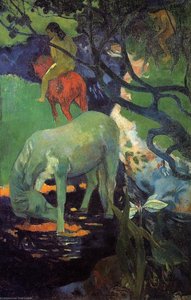
To encounter The White Horse by Eugène Henri Paul Gauguin is to step directly into the heart of Post-Impressionist myth. Created in 1898 during his transformative second voyage to Tahiti, this masterpiece transcends mere landscape painting; it is a profound meditation on purity and the spiritual pulse of the natural world. Gauguin utilizes his signature Synthetist technique, eschewing the fleeting light of Impressionism for flattened planes of vibrant color and bold, emotive forms that demand your attention.
The composition centers on a magnificent white horse, a symbol of nobility and grace, drinking from a crystalline stream beneath a lush, verdant canopy. As you observe the figures moving through this sun-drenched Tahitian vista, you feel the rhythmic harmony between humanity and the divine. Owning such a piece from the top 25 artworks of Eugène Henri Paul Gauguin isn’t merely a purchase; it is an inheritance of taste. Through ArtsDot, this legendary lineage is brought to your private collection, allowing the textured impasto and symbolic depth of Gauguin’s vision to reside permanently upon your walls.
Les Alyschamps - Eugène Henri Paul Gauguin
 Les Alyschamps - Eugène Henri Paul Gauguin
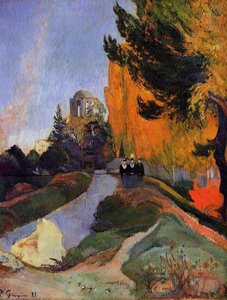
In Les Alyschamps , Eugène Henri Paul Gauguin achieves a breathtaking structural harmony that secures its place among the top 25 artworks of Eugène Henri Paul Gauguin . The composition is masterfully anchored by the rhythmic placement of riders on horseback, whose silhouettes create a balanced, geometric flow across the sun-drenched landscape. These figures are not merely subjects but essential elements of a larger, calculated geometry; their positioning guides the eye through a tapestry of deep blues and vibrant ochres, establishing a sense of timeless perfection.
There is a profound, quiet strength in this arrangement that resonates with the principles of modern minimalist design . By reducing the scene to its essential shapes and flattened planes—a hallmark of his Synthetist style—Gauguin creates a work that feels remarkably contemporary. This deliberate simplification offers a grounding, sophisticated aesthetic, making the piece an ideal focal point for a clean, curated interior. The soaring bird above adds a singular note of movement, ensuring that while the composition is structurally stable, it remains imbued with a restless, poetic soul.
Still Life with Teapot and Fruit - Eugène Henri Paul Gauguin
 Still Life with Teapot and Fruit - Eugène Henri Paul Gauguin
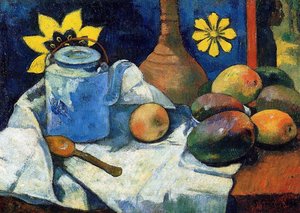
In Still Life with Teapot and Fruit , Gauguin moves away from the fleeting light of Impressionism to embrace a more profound, structural illumination. Rather than capturing a passing moment, he uses light to sculpt the weight of the teapot and the lushness of the fruit, creating a rhythmic interplay between shadow and saturated pigment. The way light rests upon the curve of an orange or the surface of the ceramic vessel provides a sense of permanence and tactile presence that is central to his Post-Impressionist legacy.
This masterful command of tonal depth and color saturation is precisely why this work remains a cornerstone in our collection of the top 25 artworks of Eugène Henri Paul Gauguin . When rendered as a hand-painted oil reproduction , the visible impasto and the rich, heavy shadows bring an unparalleled sense of luxury to a contemporary interior. The interplay of light within the painting creates a multidimensional effect on your wall, offering a sophisticated focal point that breathes life, warmth, and historical prestige into any curated space.
Woman Holding a Fruit - Eugène Henri Paul Gauguin
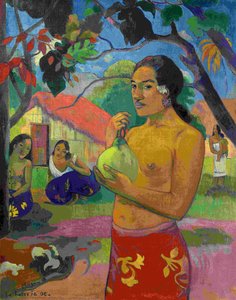 Woman Holding a Fruit - Eugène Henri Paul Gauguin
In Woman Holding a Fruit , Paul Gauguin captures more than a mere moment; he invites us into a profound, intimate encounter with the soul of Tahiti. There is a breathtaking stillness in the way the central figure gazes at the viewer, her vibrant red skirt and the simple weight of the fruit in her hand serving as anchors to an earthly paradise. This masterpiece earns its place among the top 25 artworks of Eugène Henri Paul Gauguin through its masterful use of Synthetism—where bold, non-naturalistic colors and flattened perspectives transcend reality to touch upon something deeply symbolic and eternal.
The painting breathes with the lush, dreamlike atmosphere of the South Pacific, utilizing heavy brushstrokes that convey a sense of primal abundance. At ArtsDot.com, we honor this legacy of texture and emotion. Our hand-painted oil reproductions are meticulously crafted on 100% cotton canvas, ensuring that the palpable depth of Gauguin’s impasto and his revolutionary color palette are preserved, allowing you to host this piece of art history within your own private sanctuary.
Sunken Path, Wooded Rise - Eugène Henri Paul Gauguin
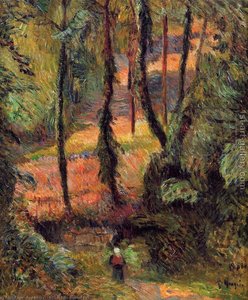 Sunken Path, Wooded Rise - Eugène Henri Paul Gauguin
In Sunken Path, Wooded Rise , Gauguin achieves a profound structural harmony that serves as a cornerstone among the top 25 artworks of Eugène Henri Paul Gauguin . The composition is anchored by the rhythmic, winding geometry of the path, which acts as a visual guide, leading the eye through a sophisticated arrangement of vertical tree trunks and layered foliage. This deliberate use of receding lines creates a sense of depth that feels both infinite and perfectly balanced, embodying a timeless perfection that has captivated collectors for generations.
There is a striking parallel to be found between this 1884 masterpiece and the principles of modern minimalist design ; the way Gauguin distills the forest into essential shapes and bold color planes provides a grounding element for contemporary interiors. The interplay of earthy ochres and deep, verdant greens offers a serene, organic texture that complements a clean, sophisticated aesthetic. It is not merely a landscape, but a masterclass in using balanced form to evoke a tranquil, meditative atmosphere.
Marahi Metua no Tehamana (also known as Tehamana Has Many Ancestors) - Eugène Henri Paul Gauguin
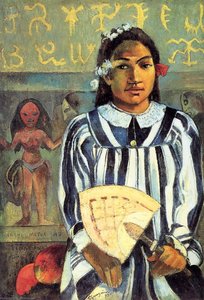 Marahi Metua no Tehamana (also known as Tehamana Has Many Ancestors) - Eugène Henri Paul Gauguin
In Marahi Metua no Tehamana (Tehamana Has Many Ancestors) , Gauguin achieves a breathtaking structural harmony that secures its place among the top 25 artworks of Eugène Henri Paul Gauguin . The composition is anchored by a masterful use of geometric balance; the central figure of Tehamana provides a vertical stability that is elegantly offset by the strategic placement of symbolic elements, such as the two apples positioned in the corners. This careful arrangement of shapes and lines creates a sense of timeless perfection, guiding the eye through a lush, symbolic landscape of deep blues and earthy ochres.
There is a profound, quiet strength in this work's internal equilibrium, drawing a striking parallel to the principles of modern minimalist design . The way Gauguin uses bold, flat planes of color to ground his complex subject matter allows the painting to integrate seamlessly into a clean, contemporary aesthetic. For the discerning collector, this piece offers more than just a window into Tahitian culture; it provides a sophisticated focal point where historical depth meets a streamlined, modern elegance.
Night Cafe in Arles (Madame Ginoux) - Eugène Henri Paul Gauguin
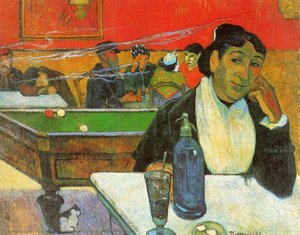 Night Cafe in Arles (Madame Ginoux) - Eugène Henri Paul Gauguin
In the flickering amber glow of Night Cafe in Arles (Madame Ginoux) , time seems to suspend itself within a moment of profound, nocturnal stillness. This masterpiece stands as a cornerstone among the top 25 artworks of Eugène Henri Paul Gauguin because it captures the raw, psychological pulse of Post-Impressionism. Through a daring palette of striking reds and deep, verdant greens, Gauguin transcends mere depiction to evoke the heavy, atmospheric mood of a late-night sanctuary.
The composition centers on the contemplative Madame Ginoux, whose presence anchors the vibrant chaos of the café. As your eyes wander from the blue bottle on her table to the rhythmic movement of the billiards players in the background, you feel the textured energy of Gauguin’s expressive brushwork. For the discerning collector or interior designer, this piece offers more than historical significance; its bold color contrasts and emotive depth provide a sophisticated focal point, bringing a sense of storied character and avant-garde elegance to any modern architectural space.
Vase of Peonies I - Eugène Henri Paul Gauguin
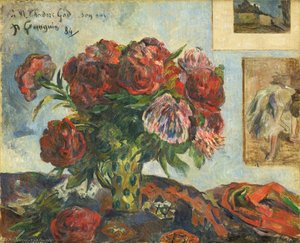 Vase of Peonies I - Eugène Henri Paul Gauguin
In Vase of Peonies I , Eugène Henri Paul Gauguin invites us into a sanctuary of sensory memory, where the boundaries between still life and soul stir deeply. This 1884 masterpiece serves as a profound testament to his transition toward Post-Impressionism, moving beyond mere observation to capture an emotional resonance that remains captivating in modern curated interiors. The painting centers on a vessel overflowing with crimson blooms, their deep, velvety reds acting as a pulse of vitality against the composition.
As you observe the woman poised near the arrangement, there is a quiet prestige in her contemplative presence, embodying a sense of timeless femininity. Gauguin’s use of bold, flattened planes and a striking interplay of complementary greens and reds creates a rhythmic visual language that feels remarkably contemporary. In today's design landscape, where collectors seek pieces with narrative depth, this work stands as a cultural talking point—a bridge between the fleeting light of Impressionism and the symbolic intensity of a true master. It is not merely a depiction of flowers, but an exploration of passion and remembrance through the lens of a revolutionary spirit.
Jeanne d'Arc, or Breton girl spinning - Eugène Henri Paul Gauguin
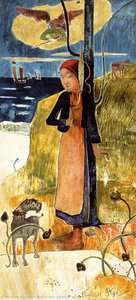 Jeanne d'Arc, or Breton girl spinning - Eugène Henri Paul Gauguin
In Jeanne d'Arc, or Breton girl spinning , Gauguin achieves a profound structural harmony that secures its place among the top 25 artworks of Eugène Henri Paul Gauguin . The composition is anchored by a masterful triangular arrangement, where the figure of the young woman provides a stable, central focus amidst the rhythmic elements of the coastal landscape. This geometric precision, paired with the deliberate use of Cloisonnism, creates a sense of timeless perfection; the bold, flat planes of ochre and crimson act as structural anchors that guide the eye through the serene maritime scene.
There is an undeniable parallel between this 1889 masterpiece and the principles of modern minimalist design. The way Gauguin simplifies form and utilizes a balanced, uncluttered arrangement allows the painting to ground a clean, contemporary aesthetic in any sophisticated interior. By stripping away unnecessary detail to focus on symbolic weight and color, he creates a work that feels both historically significant and strikingly modern, offering an enduring emotional depth that resonates with the discerning collector.
Christ in the Garden of Olives - Eugène Henri Paul Gauguin
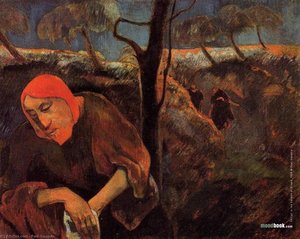 Christ in the Garden of Olives - Eugène Henri Paul Gauguin
In Christ in the Garden of Olives , Gauguin transcends traditional biblical narrative to offer a profound meditation on solitude and spiritual introspection. This 1889 masterpiece stands as a cornerstone among the top 25 artworks of Eugène Henri Paul Gauguin , moving away from mere religious illustration toward a deeply personal Symbolist language. The painting captures a moment of quietude; Christ, draped in a striking red hooded robe, sits amidst a muted landscape of earthy greens and deep blues, lost in thought with a scroll in hand.
Gauguin’s rejection of academic realism is palpable here through his use of flattened perspectives and bold, simplified forms—techniques heavily influenced by Japanese aesthetics. This stylistic departure creates a heavy, atmospheric tension that resonates powerfully in modern curated spaces. Today, the work remains a cultural talking point for its ability to blend the sacred with the natural world, reflecting a contemporary yearning for mindfulness and connection to the earth. It is not merely a depiction of a historical event, but a timeless exploration of the human psyche caught between divine revelation and earthly isolation.
The Universe Is Created - Eugène Henri Paul Gauguin
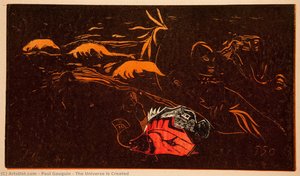 The Universe Is Created - Eugène Henri Paul Gauguin
In The Universe Is Created by Eugène Henri Paul Gauguin, we encounter a masterclass in structural symbolism and compositional equilibrium. The painting’s geometry is anchored by the profound tension between the kneeling figure and the unconscious form, creating a focal point that radiates a quiet, spiritual gravity. Gauguin utilizes the sweeping, rugged lines of the coastal landscape and the distant mountains to frame this intimate human drama, establishing a sense of timeless perfection that secures its place among the top 25 artworks of Eugène Henri Paul Gauguin .
The balance achieved here—the interplay between the heavy, grounded figures and the ethereal, soaring birds—mirrors the principles of modern minimalist design. This internal harmony, characterized by bold color planes and a deliberate lack of cluttered detail, allows the piece to ground a clean, contemporary aesthetic in any sophisticated interior. As you observe the saturated blues and warm earth tones, you feel the same emotional depth that has captivated collectors for decades, making this work an essential cornerstone for any serious gallery collection.
Children in the Pasture (also known as Orchard below Bihorel Church) - Eugène Henri Paul Gauguin
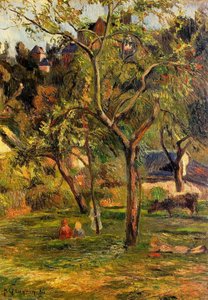 Children in the Pasture (also known as Orchard below Bihorel Church) - Eugène Henri Paul Gauguin
In Children in the Pasture (also known as Orchard below Bihorel Church ), Gauguin does not merely capture a sunny afternoon in Brittany; he composes light as if it were a visceral, living language. Painted in 1884, this masterpiece stands within his top 25 works because of its profound ability to invent atmosphere rather than simply reflect it. As you gaze upon the scene, the dappled shadows beneath the apple tree feel less like pigment and more like a rhythmic pulse of warmth and shade.
The artist employs a dazzling palette—vibrant greens, intense blues, and sun-drenched ochres—to transform a simple rural moment into a Post-Impressionist symphony. The thick, expressive impasto of the foliage creates a tactile depth that invites the eye to wander through the lush landscape. There is a soulful, symbolic weight to the children’s innocence, rendered with the bold, flattened perspectives inspired by Japanese ukiyo-e . To possess such a piece is to invite a portal of pure, nostalgic light into your collection, turning a quiet wall into an evocative window onto the soul of French pastoral life.
Title in Swedish: Landskap från Bretagne - Eugène Henri Paul Gauguin
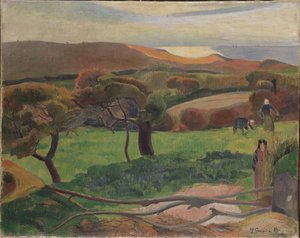 Title in Swedish: Landskap från Bretagne - Eugène Henri Paul Gauguin
To experience Landskap från Bretagne by Eugène Henri Paul Gauguin is to witness the very moment Impressionism surrendered to the raw, emotive power of Post-Impressionism. One cannot help but be captivated by the tactile vitality of his brushwork; the thick, rhythmic impasto strokes create a sculptural surface where ochre, crimson, and turquoise collide with profound energy. This is not merely a depiction of a Breton vista, but a visceral exploration of texture and light that defines Gauguin's place among the top 25 artworks of his legendary career.
In this 1889 masterpiece, the artist eschews delicate blending for a bold, symbolic language, using heavy pigment to breathe life into the sprawling fields and resilient trees. At ArtsDot.com, our mission is to honor this magnificent materiality. Our master artists meticulously recreate these visible brushstrokes on 100% cotton canvas, ensuring that the three-dimensional soul and spiritual depth of Gauguin’s vision are preserved for your private collection. We bring the museum-grade texture of the Nationalmuseum directly to your walls, allowing you to touch the history of modern art.
Haystack, near Arles - Eugène Henri Paul Gauguin
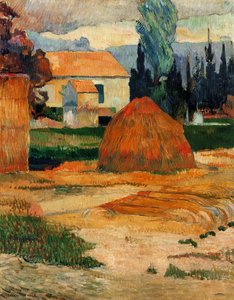 Haystack, near Arles - Eugène Henri Paul Gauguin
In Haystack, near Arles , the golden warmth of the Provençal sun feels eternally suspended, capturing a moment of profound rural tranquility. This masterpiece holds its place among the top 25 artworks of Eugène Henri Paul Gauguin because it represents a pivotal intersection of Post-Impressionist innovation and raw, emotive power. The painting radiates with a luminous, buttery yellow that breathes life into the haystack, acting as a vibrant symbol of fertility and the rhythmic cycle of nature. Through Gauguin’s masterful use of interlocking planes—a subtle nod to Cézanne—and the expressive energy reminiscent of his contemporary Van Gogh, the landscape transcends mere scenery to become a spiritual meditation.
For the discerning collector or interior designer, this work offers more than historical significance; it brings a sophisticated sense of calm and organic warmth to a modern space. The interplay of earthy greens, deep oranges, and the crisp white of the distant farmhouse creates a harmonious palette that anchors a room with prestige. To possess such a piece is to invite the soulful, sun-drenched essence of Arles into one's private sanctuary.
Christmas night - Eugène Henri Paul Gauguin
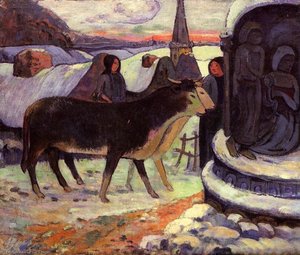 Christmas night - Eugène Henri Paul Gauguin
In the pantheon of the top 25 artworks of Eugène Henri Paul Gauguin , Christmas Night (1894) stands as a profound testament to the artist's ability to weave the sacred with the terrestrial. This masterpiece, born from his time in Pont-Aven, transcends a simple seasonal depiction to become a symphony of Symbolist depth. Through bold, flattened planes of color and heavy outlines inspired by Japanese aesthetics, Gauguin invites us into a twilight world where the spiritual and the primal converge.
The painting’s placement among his most significant works is earned through its masterful use of deep purples and nocturnal blues, creating an atmosphere of hushed reverence. The central presence of the ox, bathed in ethereal light, serves as a powerful symbol of fertility and earthbound mysticism, juxtaposed against the solemnity of the Breton landscape. For the discerning collector or interior designer, this work offers more than mere decoration; it provides a soulful focal point that brings a sense of historical weight and contemplative beauty to any curated space. It is a timeless dialogue between the mystery of the past and the sophisticated elegance of modern living.
Conclusion
As the light fades on this retrospective journey through Gauguin’s vibrant soul, we are left with more than just a collection of images; we carry away the lingering warmth of Tahitian suns and the profound, rhythmic pulse of a man who dared to seek the sacred in the primitive. These twenty-five masterpieces do not belong solely to the quiet halls of museums or the dusty pages of art history books. Instead, they exist as living, breathing forces—vivid echoes of rebellion and beauty that continue to pulse through our modern world, finding new life within the walls of our homes and the intimate corners of our private sanctuaries.
To gaze upon his work is to participate in a timeless human dialogue about longing, color, and the search for authenticity. Whether it is the bold, flat planes of color that redefined the boundaries of perception or the deep, symbolic textures that whisper of hidden truths, Gauguin’s legacy remains an inexhaustible wellspring of inspiration. His canvases invite us to look beyond the surface, reminding us that art is not merely a reflection of what we see, but a profound expression of what we feel.
We invite you to continue this exploration and bring a piece of this evocative history into your own space. Whether you are seeking a singular, transformative statement or a curated series of works to anchor an interior design project, you may discover your next inspiration within our full collection . Let the colors of Gauguin continue to move you, long after the museum doors have closed and the sun has set.