The Architects of a Monument: Agence D'architecture Du Grand Palais / Emoc
The story of the Grand Palais is, in many ways, the story of France at the turn of the 20th century—a nation eager to showcase its industrial prowess and artistic brilliance on the world stage. While often remembered as a stunning example of Belle Époque architecture, the building itself wasn’t born from the vision of a single architect but rather a collaborative effort embodied by Agence D'architecture Du Grand Palais / Emoc. This agency represents not just individuals, but a collective of skilled engineers and architects tasked with realizing an ambitious dream: to create a palace for the Universal Exhibition of 1900. Their work transcends mere construction; it’s a testament to innovation, precision, and a deep understanding of both aesthetic beauty and structural possibility.
A Collective Vision Takes Shape
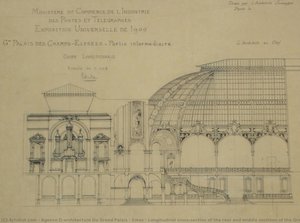
The origins of the agency lie in the need for specialized expertise to manage the complex undertaking that was the Grand Palais. The project demanded not only architectural design but also advanced engineering solutions to create a vast, light-filled space capable of hosting diverse exhibitions and events. While several figures contributed significantly—including Albert Thomas, whose studies for the rear section façade are particularly noteworthy—the agency functioned as a unified body responsible for translating the overarching vision into reality. The team skillfully blended ironwork with stone masonry, creating a structure that was both monumental in scale and remarkably elegant in its detailing.
Technical Mastery and Artistic Integration
The Grand Palais wasn’t conceived as a purely functional building; it was intended to be a celebration of art itself. The agency's drawings—such as the detailed longitudinal cross-section of the rear and middle sections—reveal a meticulous attention to detail, demonstrating a profound understanding of structural mechanics. The use of iron allowed for expansive interior spaces free from obstructive columns, creating an unprecedented sense of openness. This innovative approach was coupled with elaborate ornamentation, including sculptures, mosaics, and painted ceilings, transforming the building into a veritable art gallery. The agency successfully integrated technical mastery with artistic expression, resulting in a harmonious blend of form and function.
Legacy and Historical Significance
Since its inauguration in 1901, the Grand Palais has served as a dynamic cultural hub, hosting everything from art exhibitions and fashion shows to sporting events and political rallies. It has witnessed pivotal moments in French history and continues to be a symbol of national pride. The agency’s work laid the foundation for modern exhibition spaces, influencing architectural design worldwide. Their ability to create a building that was both structurally innovative and aesthetically captivating remains an enduring legacy. Today, the Grand Palais stands as a powerful reminder of France's artistic heritage and its commitment to pushing the boundaries of architectural possibility.
Continuing Influence
The work of Agence D’architecture Du Grand Palais / Emoc continues to inspire architects and engineers today. Their drawings, preserved in archives and collections around the world, offer valuable insights into the design process and the challenges of large-scale construction. The agency's commitment to integrating art and technology remains a relevant principle for contemporary architectural practice. By studying their achievements, we can gain a deeper appreciation for the power of collaboration, innovation, and the enduring beauty of well-crafted architecture.