The Soul of Abstraction: The Life and Legacy of Aldo Galli
In the quiet landscapes of Lombardy, where the mist often clings to the edges of nature, a profound artistic vision began to take shape. Aldo Galli, born in 1906 in Como, was an artist whose life journey mirrored the transformative shifts of twentieth-century European art. While his early years were marked by a deep, almost primal connection to the natural world surrounding his Italian roots, his path was far from linear. Though he initially pursued a degree in Agricultural Sciences in 1928, the pull of the canvas proved irresistible. This tension between the structured science of the earth and the fluid expression of the spirit would later define the very essence of his work, blending a grounded understanding of form with an ethereal approach to abstraction.
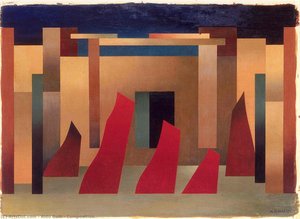
Galli’s formal artistic evolution was ignited by his intensive studies under the guidance of Giuseppe Ceschi. It was through this rigorous immersion in oil painting that he mastered the delicate dance of color theory and composition, tools that would eventually allow him to dismantle the boundaries of representational art. By the 1930s, Galli had begun to drift away from the literal depiction of his surroundings, finding a new language in geometric abstraction. Influenced by the rhythmic energy of Futurism and the fragmented perspectives of Cubism, he sought to capture not just the appearance of objects, but their underlying structural truth. His membership in the "Astrattisti Comaschi" group further solidified his place within a community of innovators dedicated to pushing the frontiers of the abstract movement in Italy.
A Symphony of Form and Material
The brilliance of Galli’s oeuvre lies in its remarkable versatility, spanning the tactile weight of sculpture to the delicate precision of illustration. As a sculptor, he possessed an uncanny ability to translate organic essence into permanent form, utilizing bronze and marble to create shapes that felt both ancient and avant-garde. His sculptures were not merely objects in space but explorations of materiality and simplicity, stripping away the superfluous to reveal the skeletal beauty of natural motifs. This same pursuit of essentialism flowed seamlessly into his paintings, where bold hues and striking geometric arrangements invited the viewer to experience emotion through pure visual rhythm.
Perhaps his most enduring contribution to the cultural landscape was his ability to marry fine art with narrative storytelling. His work on the 1956 publication of Watership Down remains a pinnacle of his illustrative career. In these works, Galli did not simply decorate a story; he breathed life into it through meticulous detail and a sensitive touch that captured the very spirit of Richard Adams' epic tale. This ability to navigate between the high abstraction of a gallery canvas and the evocative intimacy of book art demonstrates a rare breadth of talent, making him a truly multifaceted figure in the history of Italian visual arts.
Historical Significance and Artistic Resonance
The legacy of Aldo Galli is one of quiet revolution. He belonged to a generation of artists who dared to look past the surface of reality to find the mathematical and emotional truths hidden within. His work serves as a vital bridge between the traditional landscape traditions of his youth and the radical, non-objective movements that defined the mid-century era. Even as he moved through different mediums—as a painter, decorator, graphic artist, and draftsman—a consistent thread of structural integrity and emotional depth remained present.
Today, Galli is remembered not just as a pioneer of Italian abstraction, but as an artist who understood that true innovation requires a deep respect for the foundations of art. His life, which concluded in 1981, left behind a body of work that continues to resonate with those seeking beauty in simplicity and meaning in form. To study Galli is to witness the transformation of a landscape into a feeling, and a shape into a story, ensuring his place in the pantheon of masters who redefined the visual language of the modern age.