Early Life & Artistic Formation: From Law Student to Illustrator
 Wikipedia: Edmund Dulac
Edmund Dulac (born Edmond Dulac; 22 October 1882 – 25 May 1953) was a French-British naturalised magazine illustrator, book illustrator and stamp designer. Born in Toulouse, he studied law but later turned to the study of art at the École des Beaux-A...
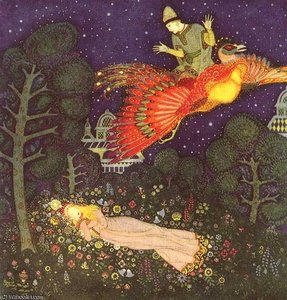
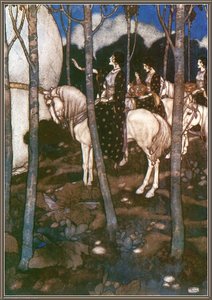
Edmund Dulac, a name synonymous with the shimmering elegance of the Golden Age of Illustration, embarked on a path far removed from his initial aspirations. Born Edmond Dulac in 1882 in Toulouse, France, he initially pursued studies in law at the University of Toulouse, a decision that proved fleeting. A burgeoning passion for art soon eclipsed the rigors of legal doctrine, leading him to the École des Beaux-Arts where he honed foundational skills and began to cultivate his distinctive artistic voice. This early dedication wasn’t confined to formal instruction; Dulac actively sought opportunities to refine his technique, winning prizes that signaled a promising future. A brief sojourn at the Académie Julian in Paris in 1904 offered further training, but it was his relocation to London in 1905 that truly ignited his career. The vibrant artistic landscape of England, coupled with a commission to illustrate the novels of the Brontë sisters, provided the fertile ground for Dulac’s extraordinary talent to blossom.
The Enchanting World of Dulac’s Fairy Tale Illustrations
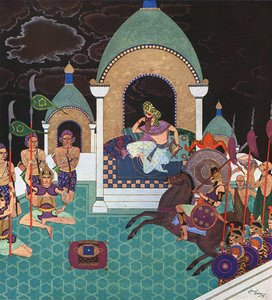 The Pearl of the Serpent
Discover 'The Pearl of the Serpent' by Edmund Dulac, a stunning Art Nouveau illustration brimming with orientalist detail and fairytale magic. A hand-painted reproduction available now!
Dulac quickly distinguished himself through his masterful interpretations of classic fairy tales. His illustrations weren't mere depictions; they were immersive journeys into realms of wonder and enchantment. He possessed a unique ability to capture the emotional core of these stories, imbuing them with a delicate balance of romance, mystery, and subtle melancholy. Works like his series for *Stories from The Arabian Nights* (1907) transported viewers to exotic landscapes filled with genies, sultans, and mythical creatures. The success wasn’t simply about recreating narratives; it was about evoking atmosphere – the shimmering heat of desert palaces, the hushed stillness of enchanted forests, the weight of ancient prophecies. His illustrations for Hans Christian Andersen's tales, published in 1911, similarly resonated with audiences, offering a sensitive and nuanced portrayal of beloved characters like *The Snow Queen* and *The Little Mermaid*. Dulac’s approach wasn’t about childish simplicity; it was about revealing the underlying complexities and emotional truths within these timeless narratives.
Orientalism, Symbolism, and the Art Nouveau Influence in His Work
Art Nouveau ( AR(T) noo-VOH; French: [aʁ nuvo] ; lit. 'New Art'), Jugendstil in German, is an international style of art, architecture, and applied art, especially the decorative arts. It was often inspired by natural forms such as the sinuous curves...
A defining characteristic of Dulac's style is his captivating blend of Orientalist influences with the flowing lines and organic forms of Art Nouveau. His fascination with Persian miniatures, Japanese woodblock prints, and Mughal art wasn’t merely aesthetic; it was a deep engagement with different cultural traditions that enriched his artistic vocabulary. This influence manifested in intricate patterns, rich color palettes – often dominated by jewel tones like sapphire blue, ruby red, and emerald green – and a meticulous attention to detail. Beyond the visual splendor, Dulac's work is imbued with symbolism. Recurring motifs—birds representing freedom or spiritual aspiration, clocks signifying the passage of time, serpents embodying temptation or hidden knowledge—add layers of meaning to his compositions. This symbolic depth elevates his illustrations beyond decorative beauty, inviting viewers to contemplate deeper themes and narratives. The sinuous curves and stylized natural forms characteristic of Art Nouveau are evident in everything from the flowing drapery of his figures to the elaborate ornamentation that adorns his scenes.
Dulac's *Rubaiyat* and Other Literary Masterpieces
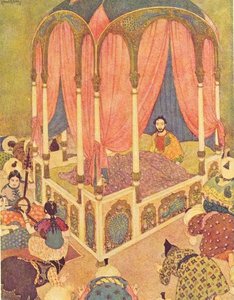
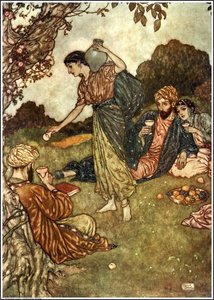 The Rubaiyat. Angel of the drink of Darkness
Edmund Dulac's 'The Rubaiyat. Angel of the Drink of Darkness' blends Art Nouveau, Symbolism & Orientalism. A dreamlike scene inspired by Omar Khayyam’s poetry.
Perhaps no single work embodies Dulac’s artistic genius more fully than his 1909 edition of *The Rubaiyat of Omar Khayyam*. This collection of Persian quatrains, translated by Edward FitzGerald, provided the perfect canvas for Dulac's unique talents. His illustrations weren’t simply accompaniments to the poetry; they were interpretations that captured the philosophical depth and sensual beauty of Khayyam’s verses. The images are dreamlike and evocative, filled with opulent details and a sense of otherworldly mystery. He masterfully depicted scenes of revelry, contemplation, and the fleeting nature of life, using rich colors and intricate patterns to create a visual feast for the eyes. Beyond *The Rubaiyat*, Dulac’s collaborations with publishers like Hodder & Stoughton resulted in stunning editions of Shakespeare's *The Tempest* (1908) and numerous other literary classics. Each project allowed him to explore different themes and styles, further solidifying his reputation as a versatile and innovative illustrator.
Beyond Books: Illustration for War Relief & Commercial Ventures
While Dulac is best known for his fairy tale illustrations, his artistic talents extended beyond the realm of deluxe gift books. The outbreak of World War I prompted him to contribute his skills to relief efforts, creating a series of illustrations for charity publications like *King Albert's Book* (1914) and *Edmund Dulac’s Picture-Book for the French Red Cross* (1915). These works, while serving a humanitarian purpose, also showcased his continued artistic excellence. Following the war, however, the market for lavishly illustrated books diminished. Dulac adapted to changing times by turning to magazine illustrations and other commercial ventures. He designed postage stamps – most notably those commemorating the coronation of King George VI in 1937 – and even banknotes during World War II, demonstrating his versatility and adaptability. These later works, while less celebrated than his earlier fairy tale illustrations, reveal a continued commitment to artistic quality and innovation.
Edmund Dulac’s Enduring Legacy and Artistic Impact
Edmund Dulac's influence on illustration continues to resonate today. His ability to seamlessly blend literary themes with Eastern artistic elements created a distinctive aesthetic that remains timeless. He wasn't merely an illustrator; he was a storyteller, a visionary who brought magical worlds to life through his exquisite watercolors and meticulous attention to detail. His work inspired generations of artists, and continues to captivate audiences with its beauty, mystery, and emotional depth. Today, original Dulac illustrations are highly sought after by collectors, and reproductions of his work grace the walls of homes around the world. At ArtsDot.com, we celebrate Dulac’s enduring legacy by offering high-quality reproductions of his most iconic works, allowing you to experience the enchantment of his art firsthand. Explore our collection and discover the timeless beauty of a true master of the Golden Age of Illustration.