The Luminous Vision of Alfred Montague
In the heart of the Victorian era, a period defined by both industrial upheaval and a profound romanticism toward the natural world, Alfred Montague emerged as a quiet but masterful observer of the British landscape. Born in London in 1832, Montague possessed an innate sensitivity to the fleeting nuances of light and atmosphere, a quality that would become the hallmark of his enduring legacy. His life and work serve as a window into a bygone era, capturing the serene beauty of rural England and the tranquil estuaries of continental Europe with an elegance that transcends time. While he may not have sought the loud acclaim of the avant-garde, his meticulous devotion to the subtleties of nature allowed him to carve out a significant space within the British Romantic tradition.
Montague’s artistic journey was deeply rooted in the rigorous academic traditions of his time. His studies at the prestigious Slade School of Fine Art provided him with a formidable foundation, placing him under the tutelage of luminaries such as Frederic Leighton and William Holman Hunt. These mentors, known for their commitment to idealized landscapes imbued with spiritual depth, undoubtedly instilled in Montague a reverence for classical beauty and a disciplined approach to composition. From these influences, he inherited a belief that a landscape was not merely a topographical record but an emotional vessel capable of conveying profound stillness and moral grace.
Technique and the Mastery of Atmosphere
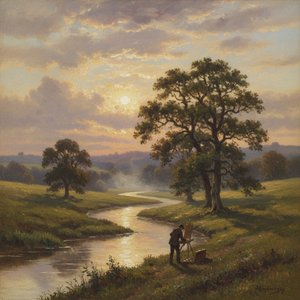
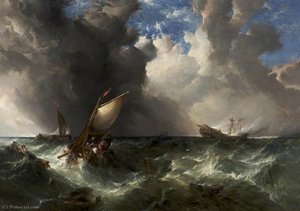
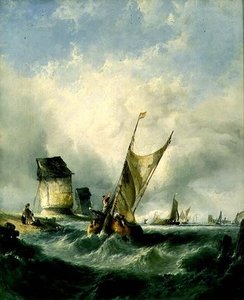
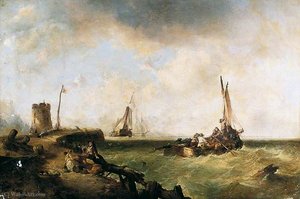
What distinguishes Montague’s oeuvre from many of his contemporaries is his unique ability to blend a meticulous, almost scientific attention to detail with the soft, emotive qualities of Impressionist-leaning brushwork. He was a master of the oil medium, utilizing delicate gradations of tone to recreate the heavy mists of winter mornings and the amber glow of twilight. His technique often employed a fluid brushstroke and a subtle palette, yet he was never afraid to utilize impasto to lend physical texture and depth to his canvases. This tactile approach is particularly evident in his depictions of the cresting waves in his seascape works or the heavy, billowing clouds that crown his expansive skies.
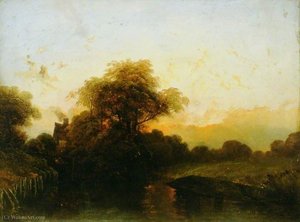
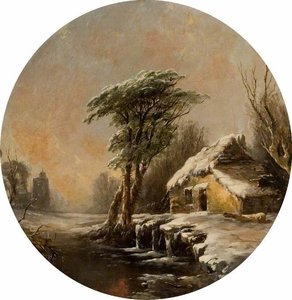
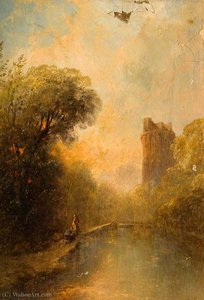
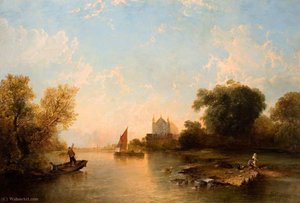
His fascination with light led him to explore various temporal settings, often choosing to depict the same location at different times of day to create balanced, contrasting pairs of paintings. This rhythmic exploration of light allowed him to capture the ephemeral nature of the environment—the way a sudden shadow might transform a river scene or how a dusting of snow could soften the edges of a village cottage. Through his eyes, the landscape became a living, breathing entity, constantly shifting under the influence of the sun and the seasons.
A Journey Across Landscapes and Borders
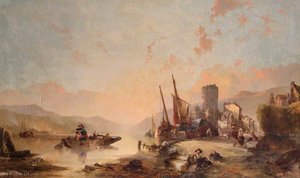
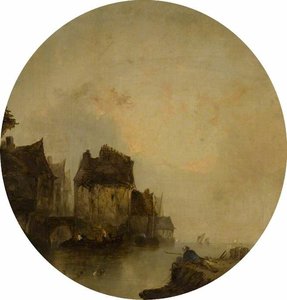
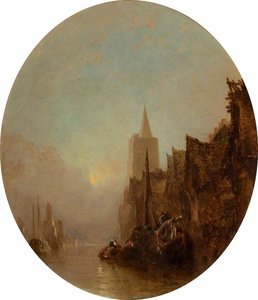
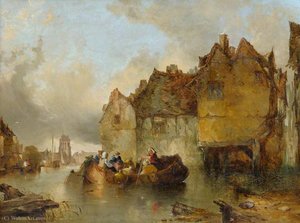
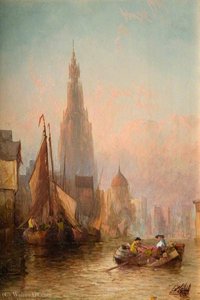
While much of Montague’s most cherished work focuses on the pastoral tranquility of the English countryside, his artistic curiosity frequently led him beyond the British Isles. He was a traveler of significant breadth, venturing through Holland, Belgium, and France to find new inspirations. His canvases often reflect the serene river scenes of the Seine and the Meuse, where he applied his signature atmospheric style to the continental waterways. Whether painting the rugged coastlines of England or the quiet estuaries of Europe, his subject matter remained a consistent celebration of the relationship between land, water, and sky.
The breadth of his repertoire included:
- Landscape Paintings: Evocative scenes of rural England and European riverbanks.
- Coastal and Estuary Scenes: Capturing the dynamic movement of tides and the interplay of light on water.
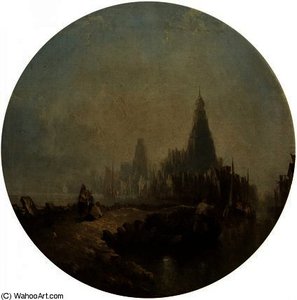
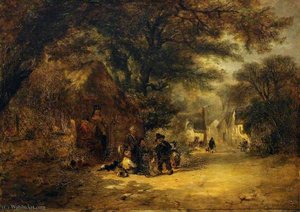
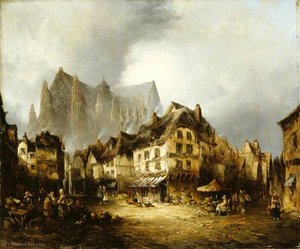
- Town Views: Detailed observations of urban and village life, often imbued with a sense of historical continuity.
- Seascapes: Occasional pure maritime studies that showcased his ability to handle the raw power of the ocean.
Legacy and Historical Significance
During his lifetime, Montague was a respected figure within the London art scene, earning election as a member of the Royal Society of British Artists in 1843. He exhibited extensively across the United Kingdom, from the prestigious halls of the British Institution to the galleries of Birmingham and Glasgow. His works were highly valued by collectors of his era, often commanding prices that reflected his standing among the professional painter class. Today, his paintings are preserved in significant collections, including the Salford Art Gallery and the City of York Art Gallery, ensuring that his quiet observations continue to speak to modern audiences.
The historical significance of Alfred Montague lies in his ability to bridge the gap between the structured realism of the early Victorian period and the more atmospheric, light-focused sensibilities that would later define much of 19th-century art. He remains a vital figure for anyone seeking to understand the romantic soul of the British landscape, offering a legacy of peace, precision, and an unwavering devotion to the beauty of the natural world.