Early Life and Intellectual Foundations
Anoli Perera, born in Colombo, Sri Lanka in 1962, embarked on a unique artistic journey that diverges from the conventional path of formal art education. Her formative years were steeped in academic pursuits—a Bachelor’s degree in political science, economics, and sociology from the University of Colombo laid a foundation not of brushstrokes and sculpting tools, but of critical thought and social awareness. This intellectual grounding would prove pivotal, shaping her artistic vision long after she ventured beyond the confines of traditional academia to pursue a life dedicated to visual expression. A postgraduate diploma in International Relations further broadened her perspective, fostering an understanding of global contexts that subtly permeates her work.
A Transnational Awakening and Artistic Emergence
The late 1980s marked a turning point as Perera relocated to the United States, spending three years immersed in art programs across Santa Barbara, California, and Princeton, New Jersey. This period wasn’t about acquiring technical mastery—it was an exploration, a dismantling of preconceived notions, and a courageous embrace of self-discovery. The freedom from rigid artistic dogma allowed her to forge her own path, blending diverse influences into a style uniquely hers. Upon returning to Sri Lanka, she became a central figure in the “90s Art Trend,” a movement that challenged established norms and injected contemporary thinking into the local art scene. This was a period of experimentation—installation, performance, and conceptual art took center stage, with Perera actively contributing to a shift towards more politically engaged and socially conscious artistic practices.
The Language of Bricolage: Materials as Narratives
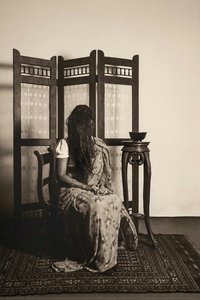
Perera’s work is profoundly characterized by the concept of “bricolage”—the art of creating something from disparate fragments. She doesn't simply *use* materials; she imbues them with meaning, weaving together torn saris, thread, lace, diary entries, and painted surfaces into textured narratives that speak volumes about memory, domesticity, and desire. This approach isn’t merely aesthetic; it’s a deliberate act of resistance against conventional artistic boundaries. Her installations, in particular, benefit from this expansive scale, allowing her to create immersive environments where textiles become potent symbols of personal and collective histories. The choice of materials is deeply autobiographical, reflecting the social contexts she navigates and challenging viewers to confront uncomfortable truths about identity, gender, and societal expectations.
Co-Founding Theertha and Institutional Impact
Beyond her individual artistic practice, Perera has been a tireless advocate for the arts in Sri Lanka. As co-founder and director of Theertha International Artists Collective, she played an instrumental role in revitalizing Colombo’s art scene. This progressive initiative provided a platform for artists to experiment, collaborate, and engage with international audiences—a crucial space for fostering dialogue and challenging established power structures. Her commitment extends further as a director of the Millennium Art Contemporary (MiAC), a non-profit company dedicated to supporting contemporary Sri Lankan artists. These endeavors demonstrate her belief in art’s transformative potential and her dedication to building a more vibrant and inclusive artistic community.
International Recognition and Enduring Significance
Anoli Perera's work has garnered international recognition, showcased at prestigious events such as Art Basel (Hong Kong), the India Art Fair, and the Colombo Art Biennale. Residencies at the University of Wollongong in Australia and the Fukuoka Asian Art Museum in Japan further broadened her exposure and influence. Her participation in the Fukuoka Art Triennale solidified her position as a leading voice in contemporary art. Perera’s enduring significance lies not only in her innovative use of materials and techniques but also in her unwavering commitment to addressing complex social issues through her art. She is an artist who challenges conventions, provokes thought, and ultimately, invites viewers to engage with the world around them in a more critical and compassionate way. Her work continues to resonate as a powerful testament to the transformative power of artistic expression.