Menu
FREE ART CONSULTATION

anton koberger

1442 - 1513

Quick Facts

  • Lifespan: 71 years
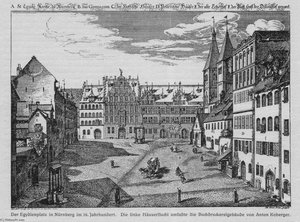
  • Top 3 works: The Egidienplatz in Nuremberg
  • Works on APS: 1
  • Born: 1442, Nuremberg, Germany
  • Nationality: Germany
  • More…

Art Quiz

There is only one correct answer for each question.

Question 1:
Q1
Question 2:
Q2
Question 3:
Q3
Question 4:
Q4
Question 5:
Q5

The Goldsmith’s Precision and the Dawn of Print

In the heart of Nuremberg, where the industrious spirit of a prosperous family of bakers once defined the local landscape, a new era of craftsmanship was being forged. Anton Koberger, born in the mid-15th century, began his professional journey not with ink, but with the delicate and exacting tools of a goldsmith. This early mastery of fine detail and metallurgical precision would become the silent architect of his later triumphs. Around 1470, Koberger transitioned from the meticulous artistry of precious metals to the revolutionary mechanics of movable type, establishing Nuremberg’s first printing house. It was a pivotal moment in history where the artisanal traditions of the Middle Ages met the burgeoning technological explosion of the Renaissance, setting the stage for a man who would transform the printed word into an international empire.

The Architect of the Printed Word

Koberger’s ambition propelled him far beyond the boundaries of a simple workshop; he constructed a sprawling industrial enterprise that functioned as the beating heart of European publishing. At its zenith, his operation was a marvel of early modern industry, boasting twenty-four presses and employing over one hundred skilled craftsmen, including typesetters, typefounders, and illuminators. His most enduring monument, the Liber Chronicarum—famously known as the Nuremberg Chronicle—stands as a monumental landmark of incunabula. This massive undertaking was far more than a mere book; it was a breathtaking tapestry of history and visual culture, utilizing intricate woodcuts to chronicle the world's story. Through his vast commercial network, which stretched from Basel to Paris and Lyon, Koberger ensured that the ideas and imagery of the German Renaissance could traverse borders, making him one of the first truly global figures of the printed age.

A Legacy Etched in Ink and Artistry

Beyond the sheer scale of his commercial success, Koberger’s true significance lies in his role as a pivotal patron and cultural catalyst. His life was deeply intertwined with the giants of the era; most notably, he served as the godfather to Albrecht Dürer, whose family lived on the very same street. This proximity fostered a unique collaborative environment where the technical prowess of the printing press met the unparalleled genius of Renaissance woodcut artistry. Koberger’s ability to integrate high-quality visual elements into mass-produced volumes helped democratize art, allowing the intricate beauty of the German Renaissance to reach a much wider audience than ever before. Though he passed away in 1513, the echoes of his industrious spirit remain visible in every woodcut and printed page that carries the legacy of Nuremberg’s golden age.