The Pioneering Vision of Badische Anilin- & Soda-Fabrik AG (BASF)
In the heart of 19th-century Germany, amidst the burgeoning industrial revolution, a company was born that would not only redefine the chemical landscape but also subtly shape the aesthetics and functionality of modern life: Badische Anilin- und Soda-Fabrik, later known as BASF. Founded in 1865 by Friedrich Engelhorn in Mannheim, its origins were deceptively humble – a response to the burgeoning demand for synthetic dyes sparked by Henry William Perkin’s accidental discovery of Mauveine. However, Engelhorn possessed a vision far exceeding mere dye production; he sought vertical integration, controlling every stage from raw materials to finished product, an unprecedented approach that laid the foundation for BASF's future dominance.
The initial years were marked by logistical challenges and a relocation across the Rhine River to Ludwigshafen. This move proved pivotal, providing access to crucial resources and establishing a sprawling industrial complex that would become synonymous with chemical innovation. Early successes centered on aniline dyes, rapidly expanding the color palette available to textile industries and beyond. But BASF’s ambition didn't stop at replicating existing products; it was driven by relentless research and development, a commitment that quickly propelled it into new territories of chemical synthesis.
From Dyes to Diversification: A Century of Innovation
The late 19th and early 20th centuries witnessed BASF’s remarkable diversification. Recognizing the limitations of relying solely on dyes, the company ventured into fertilizers, ammonia production (crucial for both agriculture and explosives), and a host of other chemical applications. This period was characterized by groundbreaking scientific breakthroughs, including the Haber-Bosch process for nitrogen fixation – a revolutionary technology that dramatically increased agricultural yields but also had profound implications for warfare. While ethically complex, this innovation underscored BASF’s capacity to tackle large-scale industrial challenges.
The interwar years saw further expansion into plastics and polymers, materials that would fundamentally alter consumer goods, construction, and transportation. This wasn't merely about creating new substances; it was about understanding the molecular structures of matter and manipulating them to achieve desired properties. BASF’s scientists weren’t just chemists; they were architects of a new material world.
The Rise of Industrial Design: Beyond Chemical Formulas
While often perceived as a purely chemical enterprise, BASF's influence extended into the realm of industrial design in surprising and significant ways. In the latter half of the 20th century, the company began to actively explore the aesthetic potential of its materials, recognizing that functionality alone wasn’t enough. This led to collaborations with designers and architects, resulting in iconic products like Styropor® (expanded polystyrene) which revolutionized packaging and insulation, and a range of innovative plastics used in automotive components and consumer electronics.
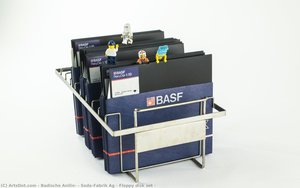
Perhaps less known but equally compelling is BASF's foray into data storage technology. The development of floppy disk sets and removable hard disks wasn’t simply an engineering feat; it was about creating reliable, user-friendly interfaces for the burgeoning digital age. These products, often sleekly designed and meticulously engineered, became integral to the rise of personal computing, demonstrating BASF’s ability to anticipate and shape technological trends.
Historical Significance and Legacy
BASF's impact on the 20th and 21st centuries is undeniable. Its innovations have touched nearly every aspect of modern life, from the food we eat (through fertilizers and crop protection products) to the cars we drive (with its plastics and coatings) and the homes we live in (insulated with Styropor®). The company’s commitment to research and development has consistently pushed the boundaries of chemical science, leading to breakthroughs in areas such as sustainable materials, renewable energy, and advanced pharmaceuticals.
However, BASF's history is not without its complexities. Its involvement in wartime production, particularly during both World Wars, raises ethical questions about the responsibility of corporations in times of conflict. Nevertheless, the company’s enduring legacy lies in its pioneering spirit, its relentless pursuit of innovation, and its ability to adapt and evolve in a rapidly changing world. Today, BASF remains the largest chemical producer globally, continuing to shape the future with its cutting-edge technologies and commitment to sustainability.