The Cartography of Memory: The Art of Christina McPhee
In the delicate intersection where geological permanence meets the ephemeral nature of human memory, the work of Christina McPhee resides. Born in Los Angeles in 1954, McPhee has spent her career constructing visual narratives that do more than merely depict a landscape; they inhabit it. Her practice is deeply rooted in the ancestral lands of the Chumash and Salinan peoples of Southern California, a connection that imbues her work with a profound sense of site-specificity and spiritual resonance. To encounter a McPhee piece is to enter a space where the boundaries between the physical earth and the psychological landscape begin to dissolve, revealing a world composed of layered histories and biological assemblages.
McPhee’s artistic lineage is marked by a significant intellectual inheritance. Her journey through the prestigious halls of Scripps College and later Boston University brought her under the mentorship of the legendary Philip Guston. This connection to Guston’s exploration of tonal abstraction and expansive, heavy canvases left an indelible mark on her aesthetic sensibilities. From this influence, she inherited a fascination with density and the way texture can communicate weight and presence. However, where Guston often delved into the visceral and the figurative, McPhee directs that same intensity toward the psychogenerative landscapes—spaces where scientific observation meets poetic intuition.
Technique as a Layered Narrative
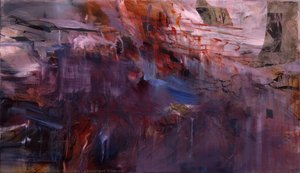
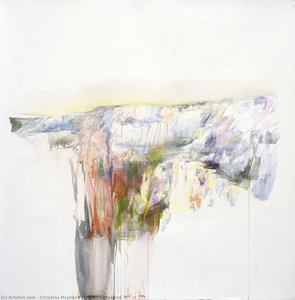
The mastery of McPhee’s work lies in her ability to manipulate medium and method to mirror the complexity of the natural world. She does not simply paint; she builds surfaces that reflect the geological strata of the earth itself. Her approach is characterized by a meticulous, almost forensic, observation of atmospheric conditions, light shifts, and topographical contours. In her drawings, the use of graphite and charcoal allows for a precise, linear precision that can evoke fugue-like structures, creating topologic fields that guide the eye through intricate pathways.
When she moves into painting, McPhee employs encaustic wax alongside pigment, a choice that is both technical and symbolic. The translucency and durability of wax allow her to fuse color and texture into surfaces that feel ancient and enduring, much like the landscapes she studies. This process of layering—whether through physical medium or digital photomontage—serves as a metaphor for the way memory accumulates over time. Her work often expands beyond the two-dimensional plane, moving from paper into animated single and multichannel video installations, where scientific visualization is transformed into alternative, subjective maps.
Global Recognition and Environmental Inquiry
McPhee’s significance in the contemporary art discourse is cemented by her participation in some of the world's most prestigious exhibition platforms. Her inclusion in Documenta 12 and the Bucharest Biennale signaled her emergence as a vital voice capable of addressing global concerns through local, site-specific inquiry. Her work frequently confronts the pressing realities of climate futures and environmental histories, often collaborating with sound artists, poets, and field research scientists to create multi-sensory experiences that explore "more-than-human" communities.
The legacy of her achievements is reflected in the prestigious institutions that hold her work within their permanent collections, including:
- The Whitney Museum of American Art, New York
- The International Center of Photography, New York
- The Kemper Museum of Contemporary Art, Kansas City
- The California Museum of Photography, University of California, Riverside
Ultimately, Christina McPhee’s art serves as a bridge between the seen and the felt. Through her rigorous exploration of biological and geological data, she creates a space for contemplation regarding our place within the ecosystem. Her work remains a testament to the power of art to act as both a scientific record and a spiritual map, capturing the essence of a world that is constantly collapsing and regenerating.