From Legal Precision to Photographic Vision
The life of Dr. Heinz Zinram began far from the soot and steel of London’s industrial heart, rooted instead in the intellectual rigor of prewar Vienna. Born in 1910, Zinram was initially destined for a career in law, earning his doctorate with an analytical precision that would later define his photographic eye. However, the shadows of history intervened; fleeing the rise of Nazism in 1939, he arrived in London not as a practitioner of law, but as a refugee seeking a new purpose. This transition from the structured world of legal documents to the spontaneous capture of light was profound. Initially using his 35mm Leica to assist fellow refugees, Zinram began to develop a way of seeing that transcended mere documentation, finding a unique way to translate the complexities of a changing world through a lens.
The Dramaturgy of Industry
As Britain entered the postwar era, Zinram emerged as a master of industrial photography, a genre often dismissed as purely functional. He possessed an uncanny ability to infuse the mechanical with the cinematic, treating factories and workshops as grand, theatrical stages. His style was a sophisticated blend of realism and drama, characterized by a masterful use of
chiaroscuro—the interplay of deep shadows and piercing light. Rather than seeking polished studio perfection, he sought the raw truth of the location. In his hands, the sprawling machinery of British manufacturing became something much more intimate. He captured:
- The rhythmic geometry of structural steel and heavy ironwork.
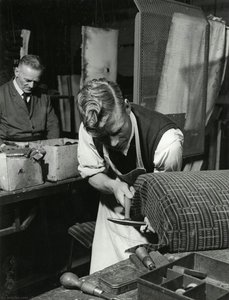
- The human element within the machine, from engineers to the "fluffers" cleaning the dark tunnels of the Underground.
- The evocative textures of worn wood, varnished surfaces, and cold metal.
Through this lens, the industrial landscape was not a symbol of cold efficiency, but a canvas for human experience and endurance.
A Legacy in Light and Shadow
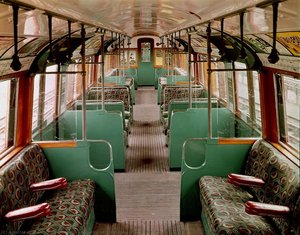
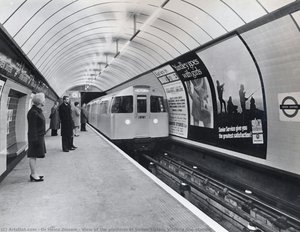
Perhaps his most enduring contribution lies in his evocative documentation of the London Underground, where he transformed transit into a study of nostalgia and design. In works such as his 1962 study of the
1938 tube stock carriage, Zinram invites the viewer to experience the rhythmic depth of a bygone era. He utilized symmetrical compositions and a rich, tactile palette of muted greens and deep reds to evoke a sense of stability and mid-century elegance. His photographs do more than record history; they capture the very soul of an era. By finding beauty in the mundane—in the dust of a tunnel or the symmetry of a train car—Zinram ensured that the pulse of 20th-century British industry would remain eternally vibrant, preserved through his singular, dramatic vision.