The Engineer's Transatlantic Odyssey
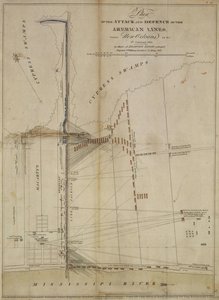
Arsène Lacarrière-Latour was a man whose life was defined by the intersection of structural precision and the untamed spirit of the New World. Born in Aurillac, France, in 1778, his early years were shaped by the rigorous discipline of an architect and engineer. Yet, the call of history led him far beyond the borders of Europe, into the heart of global upheaval. As a soldier in the French army during the tumultuous Haitian Revolution, Lacarrière-Latour witnessed firsthand the seismic shifts of the Atlantic world. This period of conflict did more than just shape his military career; it instilled in him a profound connection to the Americas, eventually leading him to become a naturalized citizen of the United States and a key figure in the defense of New Orleans during the War of 1812. His life was a remarkable journey across continents, moving from the battlefields of the Caribbean to the strategic landscapes of the American South.
The Watercolorist's Vision
His artistic evolution was deeply intertwined with his professional expertise as an engineer. The meticulous eye required for architectural drafting allowed him to approach the canvas with a unique sensibility, capturing the intricate details of cityscapes and the sweeping vistas of the Americas with unparalleled clarity. Through the delicate medium of watercolor, he translated the atmosphere of a changing continent into luminous, evocative scenes. His works are not merely depictions but serve as historical documents, rendered with a precision that honors the structural integrity of the environments he portrayed. In his hands, the fluidity of watercolor met the permanence of architectural thought, creating a body of work that serves as a visual memoir of the 19th-century Americas. Within his oeuvre, certain elements stand out:
- Architectural Precision: A focus on the structural essence and detail of landscapes and urban settings.
- Atmospheric Depth: The use of watercolor to capture the shifting light and spirit of the New World.
- Historical Documentation: Art that acts as a witness to the era of the Haitian Revolution and the War of 1812.
A Legacy Written in Light and Ink
Though his life eventually brought him back to France, where he passed away in 1837, the legacy of Lacarrière-Latour remains anchored in the history of the Americas. His contributions extend far beyond the canvas; as a writer and memoirist, he provided a vital written record of the conflicts that shaped nations. Today, his watercolor paintings stand as a testament to a life lived at the crossroads of war, engineering, and art. His works, preserved in institutions such as the
Musée de la Révolution Française, continue to offer a window into a bygone era, inviting modern viewers to rediscover the landscapes and histories he so carefully documented with both his pen and his brush.