The Baroque Visionary: The Life and Legacy of Giovanni Coli
In the grand, sweeping tapestry of the Italian Baroque, few threads are as intricately woven as those belonging to Giovanni Coli. Born in 1636 in the serene landscape of San Quirico d'Orcia, Tuscany, Coli emerged from a period of profound artistic transition, where the disciplined realism of the late Renaissance began to merge with the theatrical grandeur of the seventeenth century. His early years were shaped by the intellectual and humanist atmosphere of Lucca, a city that provided the foundational bedrock for his burgeoning talent. It was here, under the watchful and rigorous eye of Pietro Paolini, that Coli first learned to translate the physical world into pigment. Paolini, a master of meticulous detail and classical ideals, instilled in Coli a profound respect for anatomical accuracy and a disciplined approach to light—elements that would later allow Coli to navigate the more expansive, emotive demands of the Baroque style.
As his reputation grew, the pull of Rome became irresistible. This relocation was not merely a change in geography but a transformative leap into the heart of the artistic universe. In the shadow of the papal court, Coli found himself immersed in the works of giants like Pietro da Cortona, whose exuberant, flowing compositions offered a stark and thrilling contrast to his earlier, more restrained training. This period of exposure to Roman high Baroque allowed Coli to expand his stylistic vocabulary, moving beyond simple representation toward a more sophisticated engagement with movement, perspective, and the dramatic interplay of shadow and brilliance. It was during these formative years that he also forged an enduring and fruitful partnership with Filippo Gherardi, a fellow Lucchese artist whose shared lineage under Paolini created a unique creative synergy that would define much of their collaborative output.
A Master of Fresco and Collaborative Grandeur
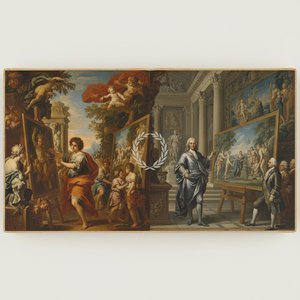
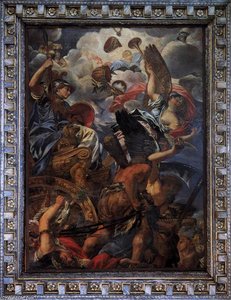
While Coli’s mastery extended to various mediums, it was in the monumental realm of fresco painting that his name achieved true permanence within the Italian landscape. His career was characterized by an extraordinary ability to command large-scale architectural spaces, turning ceilings and domes into windows onto the divine. Nowhere is this more evident than in his work in Venice, a city that demanded a specific kind of luminous, atmospheric brilliance. Working alongside Gherardi, Coli undertook breathtaking commissions that transformed sacred spaces into theatrical stages for spiritual narrative. In the church of San Nicolò da Tolentino, the duo executed the magnificent decoration of the dome, featuring the Glory of San Nicolò, a work that stands as a testament to his command over complex perspective and his ability to evoke a sense of celestial weightlessness.
The breadth of Coli's achievements is further illuminated by his contributions to other Venetian landmarks, such as the massive decorative schemes within the church of San Pantalon and the intricate frescoes adorning the Library of San Giorgio Maggiore. These works were more than mere decorations; they were sophisticated engagements with the humanist scholarship of the era, blending biblical storytelling with the contemporary prestige of Venetian nobility. His ability to weave together historical narrative, religious devotion, and the physical grandeur of the architecture demonstrates a level of artistry that transcended simple decoration, aiming instead for a total immersion of the viewer in a heightened reality.
Historical Significance and Artistic Resonance
The significance of Giovanni Coli lies in his role as a bridge between regional traditions and the universal language of the Baroque. He successfully synthesized the meticulous, almost scientific observation learned in Lucca with the sweeping, emotional dynamism found in Rome and Venice. His career serves as a vital case study in the power of artistic collaboration, particularly through his work with Gherardi, which demonstrated how shared training could evolve into a unified, groundbreaking aesthetic capable of tackling the most prestigious commissions of the age.
Though his life was relatively short, ending in 1681, the impact of his vision remains etched in the very architecture of the churches he adorned. Coli’s work represents a moment in art history where the boundaries between the earthly and the divine were intentionally blurred through the mastery of light, color, and scale. To study Coli is to witness the heartbeat of the Baroque—a period defined by its restless energy, its profound spiritual yearning, and an unyielding commitment to the beauty of the human form and the majesty of the heavens.