Menu
FREE ART CONSULTATION

gregory a. crewdson

Quick Facts

  • Art period: Contemporary
  • Born: 1962, Brooklyn, United States of America
  • Copyright status: Under copyright
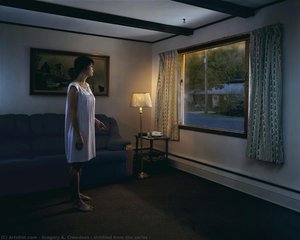
  • Top-ranked work: Untitled from the series
  • Nationality: United States of America
  • More…
  • Top 3 works:
    • Untitled from the series
    • Untitled
  • Works on APS: 2
  • Museums on APS:
    • Boca Raton Museum of Art
    • Nelson-Atkins Museum of Art
  • Also known as: gregory crewdson

Art Quiz

There is only one correct answer for each question.

Question 1:
Where was Gregory Crewdson born?
Question 2:
What is Gregory Crewdson known for creating?
Question 3:
Crewdson's images are often set in what type of landscapes?
Question 4:
What is a notable characteristic of Crewdson’s production process?
Question 5:
Which film series has been cited as an influence on Crewdson's style?

The Orchestration of the Uncanny

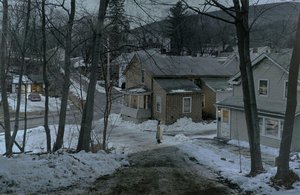
Gregory Crewdson does not merely take photographs; he directs them. To step into his world is to enter a meticulously constructed stage where the boundaries between reality and fiction dissolve under the glow of cinematic lighting. Born in Brooklyn in 1962, Crewdron has mastered the art of the large-scale production, commanding a crew of lighting experts, art directors, and stylists to breathe life into frozen, psychologically charged moments. His process is more akin to filmmaking than traditional photography, involving weeks or even months of preparation to capture a single, hauntingly beautiful frame. Each image serves as a window into a suburban landscape that feels both intimately familiar and profoundly alien, where the stillness of a street corner or the interior of a darkened room vibrates with an unspoken tension.

Suburban Shadows and Cinematic Echoes

The essence of Crewdson’s work lies in the liminal spaces—the twilight hours when natural and artificial lights collide, suggesting a moment of metamorphosis. His narratives often explore the friction between domesticity and the unknown, where characters appear caught in ritualistic or subconscious acts, as if under the spell of an unseen force. This sense of dread and wonder is deeply rooted in his cinematic influences, drawing from the psychological depth of Vertigo and the eerie atmosphere of Blue Velvet. One can see the spectral presence of Edward Hopper’s lonely urbanity and Diane Arbus’s unflinching gaze within his compositions. Through celebrated series such as Twilight and Beneath the Roses, he deconstructs the American dream, revealing the underlying anxieties, fears, and longings that haunt the quiet corners of suburban life.

A Legacy of Light and Transition

Crewdson’s artistic journey has been marked by profound personal and professional transitions. From his formative years studying at Purchase College to earning his MFA from the Yale School of Art, his evolution is inextricably linked to his environment. His move from the bustling streets of New York to a former Methodist church in western Massachusetts provided the backdrop for some of his most poignant work, including Cathedral of the Pines. This period of personal upheaval and relocation infused his imagery with a new layer of spiritual and existential inquiry. As a professor and director at Yale, he continues to influence a new generation of photographers who blend documentary styles with fictional elements. His body of work remains a monumental achievement in contemporary photography, standing as a testament to the power of the staged image to reveal the deepest truths of the human psyche.