The Visionary Synthesis of Hananiah Harari
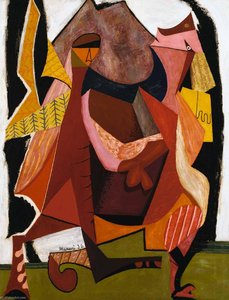
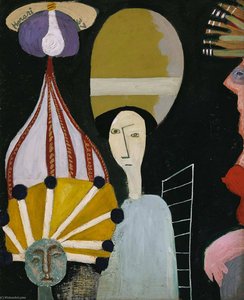
In the vibrant tapestry of twentieth-century American art, few figures possess a legacy as multifaceted and intellectually rigorous as Hananiah Harari. Born Richard Falk Goldman in Rochester, New York, on August 29, 1912, the artist would eventually transcend his given name to become a symbol of stylistic synthesis. His journey was one of profound movement—both geographical and aesthetic—stretching from the academic foundations of Syracuse University to the avant-garde heart of Paris. It was in the latter that Harari encountered the transformative energies of Cubism and Surrealism, studying under masters such as Fernand Léger, André Lhote, and Marcel Gromaire. These encounters did more than refine his technique; they provided him with a visual vocabulary that allowed him to bridge the gap between the geometric precision of European modernism and the dreamlike, psychological depths of the subconscious.
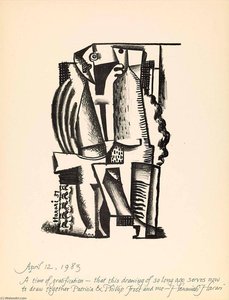
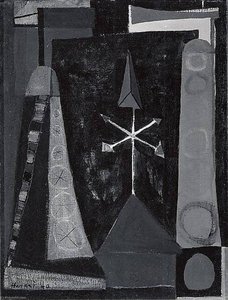
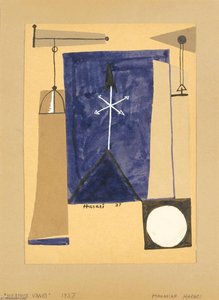
Upon returning to the United States in 1935, Harari emerged not merely as a painter but as a foundational architect of the American modern movement. His role in the establishment of the American Abstract Artists (AAA) in 1937 marked a pivotal moment in art history, as he helped champion geometric abstraction against the prevailing traditionalist tides of the era. Yet, Harari was never a prisoner to a single style. While his commitment to abstraction was resolute, he possessed a rare ability to pivot toward a breathtakingly precise trompe-l'œil realism. Inspired by the meticulous traditions of William Michael Harnett, he mastered the art of optical illusion, creating still lifes so tactile and convincing that they seemed to defy the two-dimensional plane. This duality—the ability to navigate between the structured logic of Cubism and the deceptive magic of hyper-realism—defined his unique contribution to the mid-century canon.
A Legacy of Symbolism and Social Resonance
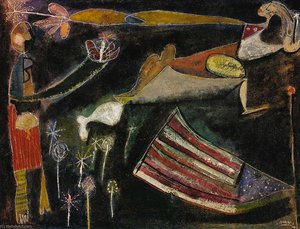
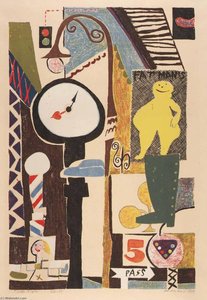
Beyond the technical mastery of his brush, Harari’s work often served as a profound vessel for social and political commentary. His art was deeply informed by his identity and the turbulent historical landscape of the 1930s and 40s. As a Jewish artist witnessing the terrifying rise of Fascism in Europe, he channeled his anxieties into powerful compositions such as The Dictators (1938), where collage and oil merged to create a visceral reaction to global tyranny. This capacity to weave contemporary struggle into abstract forms gave his work an emotional urgency that resonated far beyond the gallery walls. Even his more whimsical or urban-focused pieces, such as the captivating City Signs, reflect a keen eye for the rhythm and mechanical pulse of modern life, blending clocks, traffic lights, and human figures into a vibrant, interconnected cityscape.
The later years of Harari's life were marked by continued dedication to both the practice and the pedagogy of art. As an instructor at the School of Visual Arts and the Art Students League, he passed his formidable knowledge to new generations, maintaining a presence in the New York art scene for decades. His career also saw him navigate the complexities of the McCarthy era, where his contributions to The New Masses led to a period of professional blacklisting—a testament to the political weight his voice carried. Ultimately, Harari’s life was one of immense achievement and resilience; elected as an Academician of the National Academy of Design, he remained a steadfast patriot and a master of his craft until the very end. His oeuvre remains a captivating study in contrasts: between reality and illusion, between the structured and the surreal, and between the individual soul and the collective history of a changing world.