The Architect of Courtly Splendor: The Life of Henri Gissey
In the gilded corridors of the seventeenth-century French court, where every gesture was a choreographed performance and every costume a political statement, there existed an artist capable of capturing the very essence of royal grandeur. Henri Gissey, born in Paris around 1621, was far more than a mere painter; he was a master of visual narrative who helped define the aesthetic splendor of the early reign of Louis XIV. Though much of his personal biography remains shrouded in the mists of history—with records only confirming his passing in 1673—his presence is felt through the enduring brilliance of his designs and his profound ability to manipulate light and shadow to evoke the theatricality of the Baroque era.
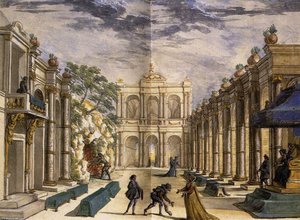
Gissey’s artistic journey likely began under the disciplined guidance of Nicolas Tourigny, a painter renowned for his religious compositions. This early apprenticeship provided him with a rigorous foundation in classical principles, instilling in him a lifelong devotion to anatomical precision and a balanced compositional structure. As he matured, Gissey transitioned from the solemnity of religious subjects toward the opulent demands of the Menus Plaisirs du Roi. Holding the prestigious post of dessinateur de la Chambre et du cabinet de Roi, he became a pivotal figure in shaping the visual language of the French monarchy, specifically through his work on the ballets de cour—the magnificent court ballets where the young King Louis XIV himself would dance among his courtiers.
A Mastery of Light and Theatricality
The hallmark of Gissey’s oeuvre is a breathtaking command of chiaroscuro. Drawing inspiration from the dramatic intensity of masters like Caravaggio and the atmospheric depth of Rembrandt, he utilized the interplay between profound darkness and piercing light to create works that felt alive with movement and emotion. This technique was particularly effective in his designs for the courtly spectacles, where he had to translate the ephemeral magic of dance and costume into permanent visual splendor. His ability to render the tactile reality of heavy silks, shimmering gold threads, and delicate feathers elevated his work from simple documentation to immersive sensory experiences.
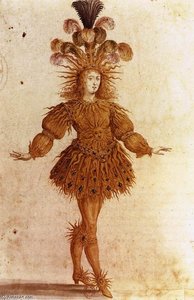
One of his most celebrated achievements remains the monumental tableau, “The Ballet of the Night”. This masterpiece, which continues to captivate viewers within the collections of the Musée Thomas-Henry in Évreux, serves as a testament to his ability to orchestrate complex, large-scale compositions. In such works, Gissey did not merely depict figures; he staged them, using light to guide the viewer's eye through a labyrinth of motion and myth. His skill as a draughtsman is equally evident in his pen works, such as the evocative “Louis XIV as Apollo,” where he utilized fine lines to capture the divine radiance of the sun god, mirroring the king's own burgeoning persona as the center of the French universe.
Legacy and Historical Significance
The historical significance of Henri Gissey lies in his role as a bridge between the classical traditions of the early seventeenth century and the high Baroque theatricality that would define the age of the Sun King. While he may be an enigmatic figure in terms of personal biography, his influence on the court style was unmistakable. He set the stage for future designers like Jean Bérain the Elder, who would later refine the very aesthetics Gissey helped establish. His work provided the visual blueprint for a period of French history characterized by unparalleled luxury and the deliberate use of art as an instrument of state power.
Today, the legacy of Gissey survives through the precious fragments of his vision preserved in museums across France. To study his work is to witness the birth of a national style—one that combined:
- Anatomical Rigor: A commitment to the physical truth of the human form inherited from his classical training.
- Textural Brilliance: An unparalleled ability to simulate the weight and luster of royal regalia through paint and ink.
- Dramatic Narrative: The use of light as a storytelling tool to heighten the emotional stakes of mythological and courtly scenes.
Through his meticulous attention to detail and his profound understanding of the theatrical, Henri Gissey ensured that the splendor of the French Baroque would not merely be remembered, but vividly felt by generations to come.