A Sculptor Dedicated to Remembrance: Jakob Otto Schweizer
The history of American monumental sculpture is etched in bronze and stone, much of it shaped by the hands of Jakob Otto Schweizer. Born on March 27, 1863, in Zurich, Switzerland, Schweizer’s life was a journey of movement across continents, yet his artistic soul remained anchored in the classical traditions of Europe. His early training at the Industrial Art School of Zurich provided the technical foundation, but it was his subsequent studies at the Dresden Academy of Fine Arts under the renowned Johannes Schilling that truly refined his vision. This period of academic rigor instilled in him a profound respect for anatomical precision and the grand, heroic scale that would later define his most celebrated works.
Between 1889 and 1894, Schweizer immersed himself in the cultural splendor of Florence, Italy. Wandering through the shadows of the Renaissance masters, he absorbed the principles of harmony, idealized form, and the emotional depth found in Italian sculpture. This European apprenticeship was crucial; it provided him with a sophisticated aesthetic vocabulary that he would eventually transplant to American soil. When he arrived in New York City in 1894, and subsequently settled in Philadelphia, he brought with him not just a set of tools, but a deep-seated reverence for the Beaux Arts style—a movement characterized by grandeur, symmetry, and an exquisite attention to detail.
The Architect of Memory
Schweizer’s arrival in America coincided with a period of intense national reflection, as the United States sought to memorialize the profound sacrifices of the Civil War. His ability to translate historical gravity into physical form made him the preeminent sculptor for such solemn tasks. Through his connections within the German Society of Pennsylvania, he secured commissions that would cement his legacy. One of his most significant early triumphs was a bronze statue honoring General John Peter Gabriel Dubois, a work that demonstrated his capacity to convey both the strength of a soldier and the heavy weight of historical consequence.
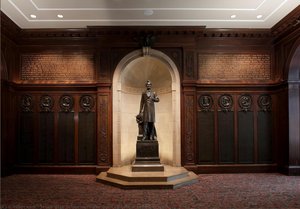
His contribution to the Gettysburg Battlefield remains perhaps his most enduring achievement. Schweizer created more sculptures for this hallowed ground than any other artist, including a breathtaking, larger-than-life statue of Abraham Lincoln for the Pennsylvania State Memorial. In this work, one can see the culmination of his training: the meticulous use of lost wax casting to capture the subtle textures of fabric and the somber expression of a leader in mourning. His work at Gettysburg serves as more than mere decoration; it acts as a silent, permanent dialogue between the past and the present.
A Legacy in Bronze and Stone
Beyond his war memorials, Schweizer’s repertoire was remarkably diverse, spanning from equestrian monuments to intimate portraiture. His statue of Baron von Steuben in Milwaukee stands as his singular equestrian masterpiece, showcasing his skill in capturing the dynamic energy of a horse in motion alongside the commanding presence of the military leader. He was also a master of smaller-scale works, producing dozens of busts, bas-reliefs, and medallions that captured the likenesses of contemporary figures with remarkable dignity.
The breadth of his impact can be seen through several key milestones:
- Monumental Commemorations: His ability to create lasting symbols for the Colorado State Capitol and the Arkansas State Capitol.
- Civic Contributions: The creation of the All Wars Memorial to Colored Soldiers and Sailors in Philadelphia, a poignant tribute to often-overlooked historical figures.
- Technical Mastery: The seamless integration of classical European techniques with the burgeoning American Beaux Arts movement.
As Schweizer moved through the early 20th century, his work continued to shape the visual landscape of American civic identity. Though he passed away in 1955 at the age of 92, his sculptures remain standing—sentinels of history that continue to invite reflection on heroism, loss, and the enduring power of memory.