A Tapestry of Ancestry and Global Movement
Jeffrey Gibson’s life is a vibrant mosaic, woven from the disparate threads of a nomadic existence and deep-rooted ancestral traditions. Born in 1972 in Colorado Springs, his early years were defined by a sense of constant motion, traversing landscapes from North Carolina and New Jersey to West Germany and South Korea. This global odyssey, shaped by his father’s work as a civil engineer for the United States Department of Defense, instilled in him a unique perspective on cultural fluidity and the intersection of identities. Yet, beneath this international movement lay an unshakeable connection to his Mississippi Choctaw and Cherokee heritage. His art serves as a profound bridge between these two realities—the ancient, enduring traditions of his people and the contemporary, often fragmented, experience of a modern, globalized world.
The Alchemy of Tradition and Pop Culture
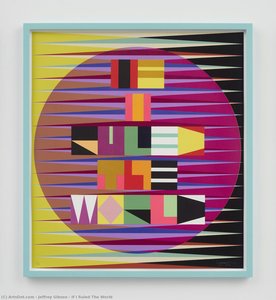
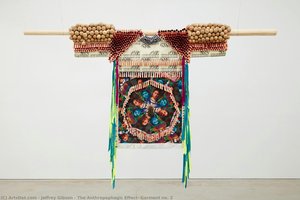
In his studio, Gibson performs a kind of visual alchemy, merging the sacred with the ephemeral to create works that are as much about resistance as they are about beauty. He utilizes techniques such as appliqué, quilting, and assemblage, breathing new life into ancestral crafts to confront the heavy legacies of colonialism and dispossession. His practice often incorporates found objects—animal hides, feathers, and textiles—transforming them into evocative symbols of resilience. There is a striking, electric tension in his work; he seamlessly integrates the bold energy of pop art and the complexities of queer theory with the rhythmic patterns of Indigenous aesthetics. This synthesis is perhaps most evident in pieces that reference the nineteenth-century Ghost Dance spiritual movement or utilize screen-printed typography inspired by the pulse of 1980s dance clubs. Through this method, Gibson engages in a form of cultural cannibalism—the anthropophagic effect—whereby colonized cultures consume and repurpose the visual language of the colonizer to forge a new, unyielding, and dominant tradition.
A Legacy Forged in the Global Spotlight
The trajectory of Gibson’s career has moved from the prestigious academic halls of the School of the Art Institute of Chicago and the Royal College of Art in London to the most significant stages of the international art world. His recent representation of the United States at the 2024 Venice Biennale marked a historic milestone, as he became the first Indigenous artist to hold a solo exhibition within the American pavilion. This achievement is not merely a personal triumph but a profound moment for contemporary art history, signaling a reclamation of narratives that have long been silenced or excluded from the canon. Today, through his teaching at Bard College and his continued exploration of identity, Gibson remains a trailblazing figure, ensuring that the voices of the Choctaw and Cherokee people resonate with strength, beauty, and an uncompromising presence in the global consciousness.