The Architect of Atmosphere: The Life and Legacy of Johann Christian Friedrich Hölder
In the twilight of the eighteenth century, as the rigid certainties of the Enlightenment began to yield to the emotive swells of Romanticism, the art world witnessed the emergence of a visionary whose work bridged the gap between classical precision and atmospheric soul. Johann Christian Friedrich Hölder (1741–1822) was not merely a painter, but a master of space and light, a man whose dual mastery of architecture and fine art allowed him to construct worlds that were as structurally sound as they were emotionally resonant. Born in Strasbourg to the court painter Konrad von Mannermlich, Hölder’s very foundation was laid in the meticulous observation of his father’s studio. This early tutelage instilled in him a profound reverence for detail, a quality that would later allow him to capture the subtle nuances of the natural world with an almost scientific accuracy, yet imbued with a burgeoning Romantic spirit.
Hölder’s journey through the artistic epicenters of Europe—from the rigorous academic environment of Mannheim to the sophisticated studios of Paris—equipped him with a versatile toolkit. He possessed the technical discipline of the classical tradition, yet his heart beat in rhythm with the changing cultural tides. This unique duality was most evident in his administrative and architectural triumphs. As the General Director of Buildings for the Duke of Zweibrücken, Hölder undertook the monumental task of designing Schloss Karlsberg. This baroque masterpiece, overlooking the serene waters of Lake Constance, stands as a testament to his ability to command grand, structural narratives. In his architecture, one finds the same sense of permanence and dignity that he sought to capture in his landscapes; both were exercises in creating a lasting impression of majesty and order.
A Visionary of the Romantic Landscape
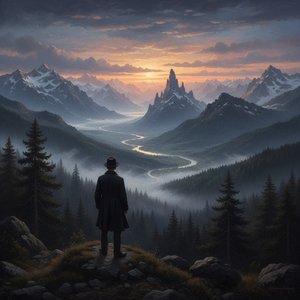
While his architectural achievements provided a framework for physical reality, it was in the realm of landscape painting that Hölder truly explored the intangible. As the Romantic movement began to prioritize intuition and the sublime over pure reason, Hölder’s work evolved into a profound exploration of nature's quiet power. Unlike many of his contemporaries who sought to idealize or mythologize the landscape, Hölder pursued a path of atmospheric realism. He was a painter of light and shadow, a chronicler of the way mist clings to a valley or how the dying embers of sunset transform a rugged horizon. His landscapes do not merely present a view; they invite an experience.
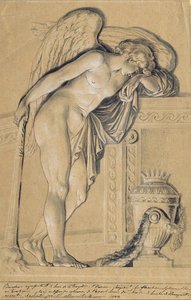
His mastery is perhaps most poignantly felt in works such as Hymen Mourning (1775), where classical symbolism meets a serene, almost melancholic beauty. In his hands, the landscape becomes a stage for the human condition, reflecting themes of loss, endurance, and the eternal cycle of nature. This ability to weave deep, symbolic meaning into the very fabric of the scenery helped pave the way for the great German Romantic masters who followed. His influence can be traced through the lineage of artists who sought to capture the sublime—that breathtaking intersection of awe and terror found in the untamed wild.
A Lasting Contribution to European Heritage
Beyond the canvas and the blueprint, Hölder’s historical significance lies in his role as a custodian of culture. His devotion to the arts extended far beyond his own creative output; he was a dedicated connoisseur and collector whose vision helped shape the institutional landscape of Bavaria. By curating significant collections and eventually donating them to Munich, he provided the essential bedrock for what would become the Alte Pinakothek. As the Director of Galleries for King Maximilian I Joseph, he acted as a vital bridge between the aristocratic patronage of the past and the public cultural institutions of the future.
The legacy of Johann Christian Friedrich Hölder is one of profound integration. He successfully merged the structural rigor of an architect with the sensitive eye of a landscape painter, and the administrative duty of a director with the creative passion of an artist. His life serves as a beautiful illustration of a transitional era, capturing the moment when the world moved from the ordered light of day into the mysterious, evocative shadows of the Romantic soul. Today, his works remain enduring invitations to contemplate our relationship with the natural world and the enduring beauty of the landscapes we inhabit.