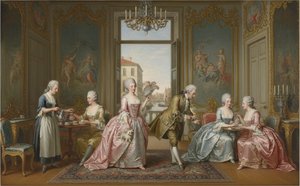
The Venetian Visionary: The Life and Legacy of Józef Grassi
In the grand tapestry of eighteenth-century European art, few figures bridge the gap between the structured elegance of Vienna and the luminous, watery magic of Venice as gracefully as Józef Grassi. Born in 1758 into a prosperous family with deep roots in Salzburg, Grassi’s early life was steeped in the classical ideals and humanist scholarship that would later define his artistic soul. His formative years in Vienna provided him with a rigorous foundation, particularly under the tutelage of Johann Georg Albrechtsperger III, a master of the Neoclassical style. This training instilled in him a profound respect for proportion, clarity, and the dignified restraint that characterized the era's academic traditions.
However, the call of the Adriatic was too potent to resist. In 1783, Grassi embarked on a transformative journey to Venice, a move that would irrevocably alter the course of his career. He did not merely arrive in Venice as a student, but as an observer captivated by the luministic traditions left by masters such as Antonio Canaletto and Giovanni Battista Piranesi. This relocation allowed him to immerse himself in a city where light and shadow perform a perpetual dance upon ancient stone and rippling canals. It was here that Grassi’s style began to evolve, blending his Viennese Neoclassical discipline with the atmospheric, almost ethereal, qualities of Venetian painting.
A Master of Light and Architectural Precision
Grassi’s body of work serves as a meticulous visual diary of a vanishing era. He possessed an extraordinary ability to document the architectural grandeur of Venice with a precision that bordered on the scientific, yet he never allowed technical accuracy to overshadow the emotional resonance of his scenes. His canvases are celebrated for their meticul and atmospheric perspective, capturing the subtle nuances of light as it reflects off the Grand Canal or settles into the shadowed corners of St Mark’s Basilica. By employing pyramidal compositions, he lent a sense of monumental stability to the bustling cityscapes, making the Doge’s Palace appear both timeless and imposing.
Beyond the stone and mortar of Venice, Grassi was a profound interpreter of the human spirit. His portraiture stands as a testament to his psychological depth. Moving away from the stiff, formal arrangements common in many contemporary works, Grassi sought to capture the true character of his subjects—ranging from high-ranking diplomats to the intellectual elite of Europe. His technique involved:
- Subtle Modeling: Using delicate transitions of tone to create a sense of three-dimensional presence and vitality.
- Muted Palettes: Employing sophisticated, understated colors that emphasized the dignity and inner composure of his sitters.
- Humanist Compassion: Infusing each portrait with an empathetic gaze that revealed the underlying emotions and intellect of the individual.
Historical Significance and Enduring Influence
The significance of Józef Grassi lies in his unique position as a cultural conduit between two of Europe's most important artistic hubs. While his heart beat for the Venetian landscape, his sensibilities remained anchored in the refined values of Viennese society. This duality allowed him to create art that was both geographically specific and universally appealing to the aristocratic tastes of the late eighteenth and early nineteenth centuries.
As the decades progressed toward the mid-nineteenth century, Grassi’s work remained a bastion of classical grace amidst the rising tides of Romanticism. His ability to render the verisimilitude of the Venetian streets while maintaining an air of poetic nostalgia ensured his place in the annals of art history. Today, we look back at Grassi not just as a chronicler of architecture, but as a painter who understood that the true essence of a place—and a person—is found in the delicate interplay of light, shadow, and soul.