The Luminous Legacy of Kojima Shikkosai
In the twilight of the Edo period, a time when the refined aesthetics of Japan were reaching a breathtaking crescendo, the name Kojima Shikkosai emerged as a beacon of unparalleled craftsmanship. Born in Tokyo in 1764, Shikkosai lived through an era of profound cultural flourishing, navigating the complex social landscape of the waning Tokugawa rule. While the precise details of his early years remain shrouded in the gentle mists of history, it is widely understood that he was born into a lineage deeply rooted in the sacred traditions of lacquer artistry. This ancestral connection provided him with more than just technical instruction; it offered an inheritance of spirit, allowing him to master the arduous and meditative complexities of lacquerwork under the guidance of esteemed masters.
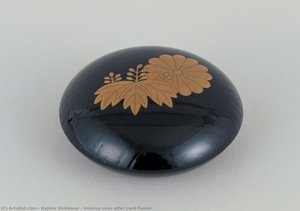
The essence of Shikkosai’s genius lay in his ability to transform functional objects into poetic vessels of light and meaning. His artistry was centered upon the meticulous world of lacquerware, where he specialized in the creation of elaborately decorated boxes and ceremonial vessels. He possessed a singular talent for the application of gold leaf, using it not merely as decoration, but as a medium to capture and manipulate light. Within these gilded surfaces, Shikkosai wove intricate floral motifs, most notably the chrysanthemum. In the Japanese tradition, these blossoms are far more than botanical studies; they serve as potent symbols of longevity, rejuvenation, and prosperity, imbuing his work with a silent, enduring prayer for well-being.
Mastery of Technique and Aesthetic Vision
To observe a piece by Shikkosai is to witness a profound dialogue between color theory and compositional balance. His approach was characterized by a sophisticated understanding of how subtle enamel pigments could harmonize with the radiant brilliance of precious metals. This mastery is perhaps most exquisitely captured in his celebrated work, ‘Incense Case after Lord Fumally’s Favorite Rakú Piece.’ This masterpiece was commissioned by Matsudaira Fumai, the seventh feudal lord of the Matsue Domain, and stands as a testament to Shikkosai's ability to bridge the gap between different artistic disciplines. By recreating the essence of a legendary Raku ceramic piece through the medium of lacquer, he demonstrated a reverence for the ceramic arts that was characteristic of the era’s refined aesthetic ideals.
Shikkosai’s stylistic evolution was deeply influenced by the dual pillars of his contemporary culture: the spiritual depth of Buddhist iconography and the sophisticated, often opulent, tastes of the Japanese aristocracy. His work reflected a world where art was inseparable from ritual and social standing. Through his hands, the heavy, dark medium of lacquer became something ethereal and luminous. He did not merely decorate surfaces; he layered meaning, using the interplay of shadow and gold to evoke the transient beauty of the natural world.
Historical Significance and Enduring Influence
The historical importance of Kojima Shikkosai extends far beyond the physical objects he produced. He represents the zenith of Edo-period craftsmanship, a period where the boundaries between artisan and artist were beautifully blurred. His ability to synthesize traditional motifs with innovative technical applications helped define the visual language of Japanese luxury during a transformative century. Even as the political structures of Japan shifted toward the Meiji era, the standard of excellence set by Shikkosai remained a benchmark for subsequent generations of lacquer artists.
Today, his legacy survives in the quiet splendor of museum collections, where his works continue to captivate the modern imagination. He remains a pivotal figure whose life and art embody the soul of an era—a master who could take the raw elements of earth and metal and refine them into a timeless expression of Japanese grace and permanence.