Early Life & Artistic Foundations: A Japanese Education
Léonard Tsuguharu Foujita’s artistic journey began not amidst the bohemian circles of Montparnasse, but within the structured traditions of Japan in the late 19th century. Born in Tokyo in 1886, his early life was marked by a familial dedication to intellectual pursuits – his father, an Army Medical Director, instilled a value for discipline and observation that would later permeate Foujita’s artistic vision. While initially drawn to painting as a young boy, the path wasn't immediately clear. His father, seeking guidance from the renowned surgeon and novelist Ōgai Mori, was advised to encourage formal training within Japan before considering a European education. This led Foujita to enroll in 1905 at the Tokyo National University of Fine Arts and Music, where he immersed himself in both yōga (Western-style painting) under Seiki Kuroda and nihonga (Japanese-style painting). This dual exposure proved pivotal. He wasn’t simply learning technique; he was absorbing contrasting philosophies – the emphasis on perspective and realism of Western art alongside the delicate brushwork, symbolic depth, and inherent flatness characteristic of Japanese traditions. Even his early watercolors, exhibited at the Exposition Universelle in Paris as a representative work from a Japanese middle school, hinted at a nascent talent poised to synthesize these disparate influences.
Parisian Ascent: Foujita and the École de Paris
 Wikipedia: School of Paris
The School of Paris (French: École de Paris, pronounced [ekɔl də paʁi]) refers to the French and émigré artists who worked in Paris in the first half of the 20th century. The School of Paris was not a single art movement or institution, but refers to...
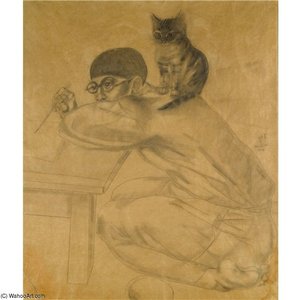
In 1913, at the age of twenty-seven, Foujita embarked on his long-held dream – a journey to Paris. He arrived in a city already buzzing with artistic innovation, a crucible where established norms were being challenged and new movements were taking shape. Unlike many artists who sought immediate affiliation with a specific school, Foujita’s integration into the Parisian art scene was organic, yet remarkably swift. He quickly became associated with the loosely defined École de Paris, a vibrant community of foreign-born artists who collectively redefined modern painting. This wasn't a formal institution but rather an atmosphere – a shared spirit of experimentation and a willingness to embrace diverse perspectives. Foujita’s distinctive style, already hinting at its unique character, resonated with the avant-garde sensibilities of Montparnasse. He forged friendships with luminaries like Picasso, Modigliani, and Soutine, engaging in lively debates about art, life, and the very nature of representation. His unusual fashion – a signature straight-cut fringe and round glasses – made him an instantly recognizable figure, embodying the cosmopolitan energy of the era.
The 'Grand Fond Blanc': A Signature Style Emerges
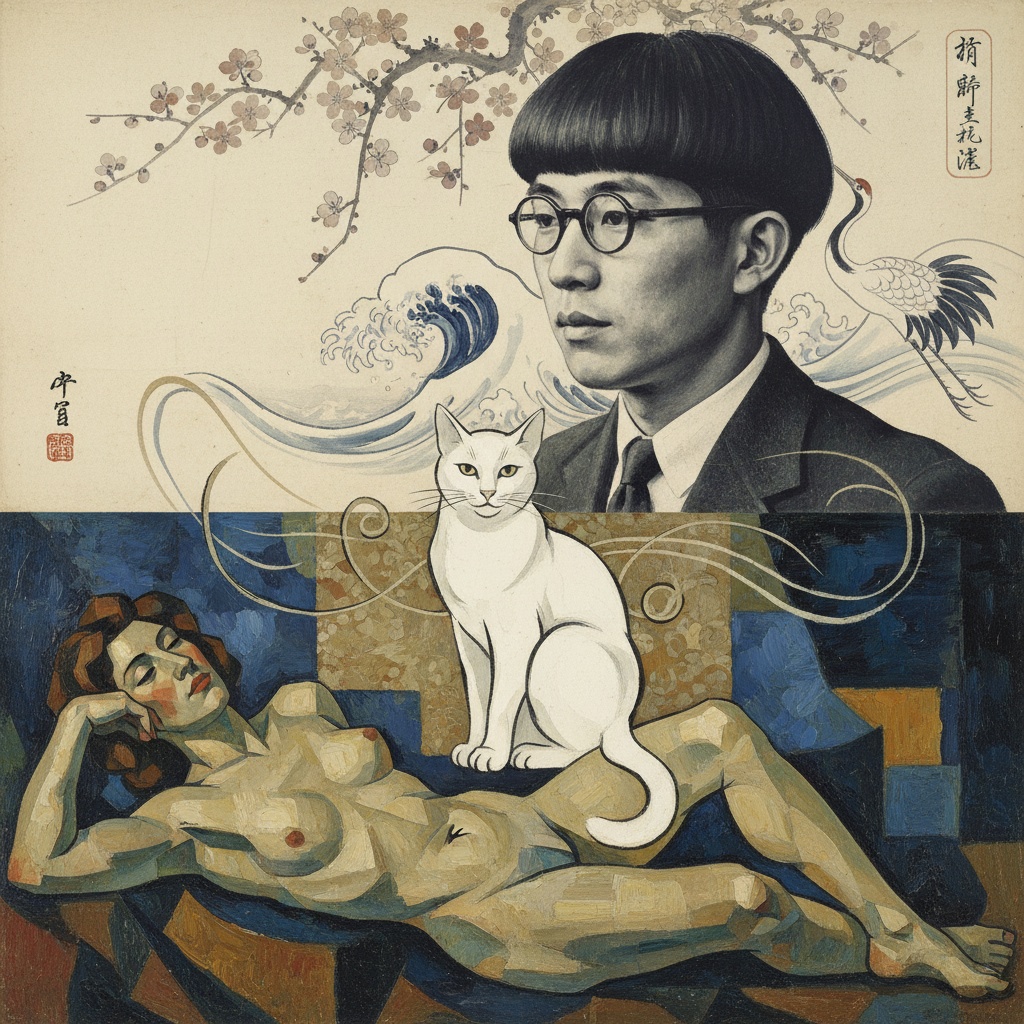
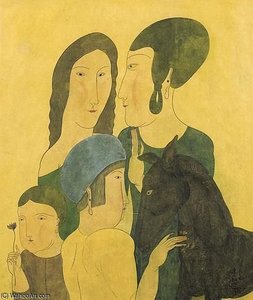
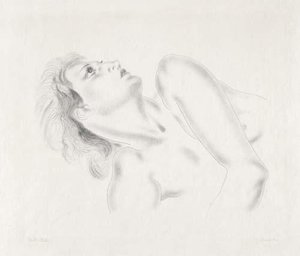
While Foujita absorbed influences from his contemporaries, he didn’t simply mimic their styles. He embarked on a quest to forge his own visual language, one that seamlessly blended Japanese aesthetics with European modernism. This culminated in the development of his signature technique: the Grand Fond Blanc, or “great white ground.” This involved applying multiple layers of milky white paint to create a luminous backdrop against which delicate ink lines would define his subjects. The effect was profoundly evocative, reminiscent of traditional Japanese paper and ivory painting – a subtle texture that imbued his works with an ethereal quality. This wasn’t merely a technical innovation; it was a deliberate attempt to evoke the spirit of Japanese art within a Western context. The white ground served not just as a canvas but as a symbolic space, suggesting depth, tranquility, and a unique sense of intimacy. It allowed his figures – often nudes or still lifes – to emerge with a haunting fragility.
Beyond Nudes: Exploring Foujita’s Diverse Oeuvre
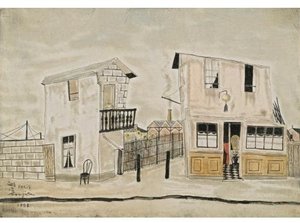 Scene De Rue, Paris
Discover 'Scene De Rue,' Léonard Tsugouharu Foujita’s evocative Parisian street scene. A naive masterpiece blending Japanese & Western styles, showcasing unique brushwork & symbolic details.
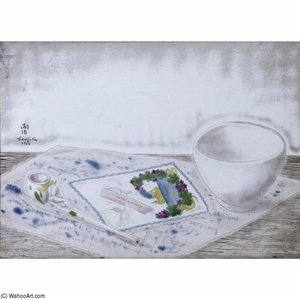
Although Foujita is perhaps best known for his sensuous depictions of female nudes, limiting his artistic scope to this single genre would be a profound disservice. His oeuvre encompassed a remarkable diversity of subjects and styles. He was a skilled portraitist, capturing the personalities of his contemporaries with both sensitivity and psychological insight. His still lifes, often featuring flowers or everyday objects, reveal a meticulous attention to detail and a subtle mastery of composition. During a three-year period traveling through South and North America in the 1930s, he documented his observations in sketches and paintings, capturing the landscapes and cultures with a fresh perspective. Furthermore, Foujita’s work extended beyond painting; he was also an accomplished illustrator and writer, demonstrating a multifaceted artistic sensibility. His self-portraits, often imbued with a melancholic introspection, offer a glimpse into the artist's complex inner world.
A Complex Legacy: War, Return to Japan & Final Years
Foujita’s life took a dramatic turn during World War II. Upon his return to Japan in 1933, he was appointed an official war artist, tasked with creating paintings that would bolster morale and glorify the Japanese military effort. This period remains controversial, casting a shadow over his legacy. While these works garnered acclaim at the time, they were met with mixed public reaction following Japan’s defeat. The post-war art scene in Japan offered little opportunity for Foujita, prompting his return to France in 1950. He embraced French citizenship in 1955 and underwent a profound spiritual transformation, converting to Catholicism in 1959 and adopting the name Léonard as a tribute to Leonardo da Vinci. His final major undertaking was the creation of frescoes for the Chapelle Notre-Dame-de-la-Paix in Reims (1965–66), a testament to his newfound faith and artistic vision. He died shortly after its completion, leaving behind a body of work that continues to fascinate and inspire.
Foujita's Enduring Influence and Market Presence
Today, Foujita is remembered as a pivotal figure in the années folles of 1920s Paris, a symbol of artistic innovation and cultural exchange. His unique synthesis of Japanese sensibility and European modernism continues to resonate with collectors and art enthusiasts alike. While his wartime paintings remain a subject of debate in Japan, retrospective exhibitions since 2006 have sought to establish his place within the broader context of twentieth-century Japanese art history. His works are held in major museum collections worldwide, including the Metropolitan Museum of Art, the Musée d’Art Moderne de la Ville de Paris, and the National Museum of Modern Art, Kyoto. The market for Foujita's paintings has seen increasing demand in recent years, reflecting a growing appreciation for his distinctive style and enduring legacy. At ArtsDot.com, we are proud to offer high-quality reproductions of Foujita’s masterpieces, allowing art lovers to experience the beauty and tranquility of his work firsthand. Explore our collection today and discover the captivating world of Léonard Tsuguharu Foujita.