The Alchemist of Form: The Legacy of Leonhard I Bräm
In the heart of the Swiss Renaissance, amidst the intellectual ferment of sixteenth-century Zürich, the name Leonhard I Bräm resonates as a whisper from a transformative era. A figure who bridged the gap between the meticulous precision of the goldsmith and the expressive potential of sculpture, Bräm emerged during a period when humanist ideals were beginning to dismantle the rigid structures of medieval thought. Though historical records offer only fragmented glimpses into his personal life, his presence in the artistic landscape is undeniably profound. As a master who achieved prominence in 1531, he navigated a world where art was not merely decoration but a complex language of symbolism, theology, and social critique.
The foundations of Bräm’s extraordinary skill were laid under the tutelage of the renowned Hans Grüninger, a master goldsmith whose own travels through Italy had infused his work with the burgeoning spirit of the Italian Renaissance. This apprenticeship was far more than a technical education; it was an immersion into a new way of seeing. From Grüninger, Bräm inherited a profound respect for classical proportions and the delicate mastery required to manipulate precious materials. The techniques of carving ivory and modeling wax—disciplines that demand both extreme patience and a visionary understanding of volume—became the bedrock of his later explorations in more permanent, tactile mediums like ceramic and alabaster.
A Masterpiece of Humanist Wit
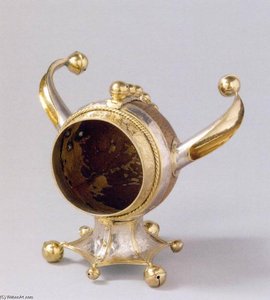
Perhaps nothing captures the essence of Bräm’s artistic soul quite like his most celebrated creation, the “Cup in the shape of a fool’s head.” Executed around 1560, this work serves as a breathtaking intersection of craftsmanship and intellectual provocation. To gaze upon this piece is to encounter the very heartbeat of Renaissance humanism. The sculpture, meticulously fashioned from alabaster, presents a human skull adorned with the stylized emblems of a fool—a daring visual metaphor that likely drew inspiration from the biting social satires of Erasmus of Rotterdam. In this single object, Bräm managed to encapsulate the era's fascination with the duality of existence: the fragility of life and the folly of human pride.
The technical execution of such a piece speaks to a level of virtuosity that transcends simple ornamentation. The way Bräm manipulated the translucent qualities of the alabaster to mimic the starkness of bone, while simultaneously integrating the whimsical elements of the fool’s regalia, demonstrates an artist who was as much a storyteller as he was a technician. His ability to breathe life into inanimate stone and ceramic allowed him to participate in the great Renaissance dialogue, using his art to question dogma and celebrate the complexities of the human condition.
Historical Significance and Artistic Endurance
While the broader history of the Swiss Renaissance is often overshadowed by the grander movements of Italy or France, Leonhard I Bräm stands as a testament to the vibrant, localized innovations occurring within the Alpine regions. His work represents a unique synthesis of Northern European detail and Southern European classical influence. By elevating the medium of ceramic and stone sculpture through the lens of goldsmithing precision, he expanded the boundaries of what decorative arts could achieve, transforming functional objects into profound vessels of philosophical inquiry.
Today, Bräm’s legacy endures not merely in museum collections but in the way we understand the evolution of European art. He remains a pioneer who understood that true artistry lies in the ability to marry technical perfection with intellectual depth. His contributions continue to fascinate scholars and collectors, serving as a poignant reminder of a time when every curve of a sculpture and every shadow in a carved skull could hold the weight of an entire civilization's changing worldview.