The Ghent Legacy and the Mastery of Detail
In the vibrant, industrious workshops of Ghent, where the light of Flanders danced upon fine vellum, Lucas Horenbout began his journey into the heart of artistic excellence. Born into a lineage of masters, he was shaped by the profound influence of his father, Gerard Horenbout, a titan of the manuscript illumination tradition. This early immersion in the Ghent-Bruges school instilled in him an unwavering commitment to meticulous craftsmanship and a realism that captured the very essence of his subjects. The Flemish tradition, characterized by subtle shading and an almost supernatural attention to detail, provided the foundation upon which Lucas would build a legacy that transcended borders.
A Royal Appointment in the Tudor Court
The mid-1520s marked a transformative era as Horenbout crossed the channel to England, bringing with him the sophisticated aesthetic of his homeland. His arrival coincided perfectly with the ambitious cultural revival led by Cardinal Wolsey, who sought to breathe new and magnificent life into English manuscript illumination. The recognition of his talent was swift and profound; appointed as King’s Painter, Horenbout became a central figure in the court of Henry VIII. This period of royal patronage allowed him to translate the grander traditions of Flemish panel painting into the intimate, delicate medium of the portrait miniature, effectively bridging two distinct artistic worlds through his unique ability to capture both majesty and intimacy.
The Architect of the English Miniature
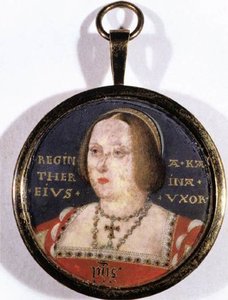
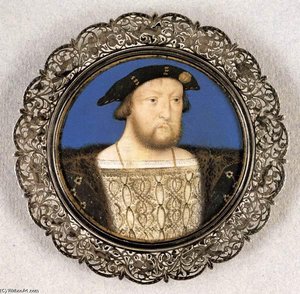
Beyond his role as a courtier, Horenbout was the true architect of a new English tradition. He pioneered the art of the portrait miniature, a medium that demanded both technical precision and an ability to convey deep psychological resonance within a tiny, precious frame. His works, such as the commanding 1526 portrait of Henry VIII and the poignant depiction of Catherine of Aragon, are more than mere likenesses; they are windows into the power and anxiety of the Tudor age. Through his brush, the miniature became a vessel for political identity and personal intimacy, defined by several key technical hallmarks:
- The use of subtle, lifelike shading to create depth on a minuscule scale.
- A mastery of color that brought a vibrant, fleshy realism to royal subjects.
- An ability to capture the regal presence and underlying vulnerability of his patrons.
An Enduring Artistic Impression
Though much of Horenbout’s life remains shrouded in the mists of history, his impact on the trajectory of English art is undeniable. He did not merely transplant Flemish techniques to English soil; he planted the seeds for a distinct national style that would flourish for generations. By blending the decorative splendor of the Ghent-Bruges school with the burgeoning needs of the Tudor monarchy, Lucas Horenbout ensured that his name would forever be etched into the annals of art history as the master who shaped the very face of English portraiture.