Maksymilian Dionizy Gierymski: A Polish Realist Caught Between Uprising and Unseen Potential
Born in Warsaw on October 9, 1846, Maksymilian Dionizy Gierymski’s life was tragically short, ending in Reichenhall, Bavaria, in 1874 at the age of twenty-seven. Yet, within those brief years, he carved a distinctive niche for himself as one of the most compelling figures of the Munich Realistic School – a movement that sought to capture the gritty realities of Polish life and history with unflinching honesty. His story is intertwined with Poland’s turbulent 19th century, marked by political upheaval, national longing, and an often-difficult relationship between artists and the established powers.
Gierymski's early years were shaped by the January Uprising of 1863, a pivotal moment in Polish history. At seventeen, he bravely joined the insurrectionary forces, fighting against Russian rule. This experience profoundly impacted his artistic vision, instilling a deep sense of patriotism and a desire to depict the struggles of his people. Following the uprising’s suppression, he narrowly avoided persecution, utilizing a government scholarship to pursue formal training in Munich – a move that would ultimately define his career.
Training and Early Influences in Munich
Arriving in Munich in 1867, Gierymski initially enrolled in the antiquity class at the Academy of Fine Arts, ostensibly to hone his drawing skills. However, he quickly gravitated towards Juliusz Kossak, a prominent landscape painter known for his depictions of horses and hunting scenes. Kossak recognized Gierymski’s potential and introduced him to Franz Adam, a master painter specializing in battle scenes – a genre that would become central to Gierymski's oeuvre. Adam’s workshop provided the young artist with invaluable training in composition, technique, and the dramatic portrayal of historical events.
Gierymski’s artistic development was further influenced by Hermann Anschütz, a historical painter at the Academy, and later by Alexander Strähuber, both respected figures within the Munich art community. He also benefited from the tutelage of Sándor Wagner, a talented assistant who helped to shape Gierymski's understanding of light, shadow, and anatomical accuracy. The atmosphere of the workshop fostered a spirit of experimentation and innovation, allowing Gierymski to develop his own distinctive style – one characterized by its realism, emotional intensity, and often bleak portrayal of human suffering.
A Palette of Polish Realism: Themes and Techniques
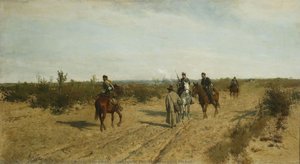
Gierymski’s artistic output spanned a diverse range of subjects, but he is most celebrated for his depictions of battle scenes, insurgent life, and landscapes of southern Poland. Unlike the idealized portrayals common in academic art, Gierymski presented a raw and unflinching view of conflict – the chaos of war, the desperation of refugees, and the hardships faced by ordinary people. His paintings are not romanticized celebrations of heroism; instead, they offer poignant glimpses into moments of profound human suffering.
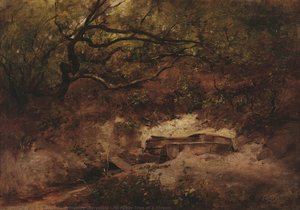
His mastery of watercolour was particularly noteworthy. He skillfully employed delicate washes and subtle gradations of tone to create atmospheric effects and capture the fleeting expressions on his subjects’ faces. Works like “Krajobraz leśny” (1866) showcase his ability to render the textures of nature with remarkable detail, while paintings such as “Wymarsz powstańców ze wsi w 1863 roku” (1867) and “Powrót bez pana” (1868) powerfully convey the emotional weight of historical events. His meticulous attention to detail, combined with his expressive use of color and light, created a uniquely compelling visual language.
Recognition and Legacy
Despite his talent and dedication, Gierymski’s work was largely overlooked in Poland during his lifetime. The conservative art establishment often rejected his unflinching realism, viewing it as too critical of the nation's past. He regularly exhibited his paintings in Warsaw from 1868 onwards, but they received limited acclaim within his homeland. However, in Western Europe, particularly in Germany and France, Gierymski’s work gained recognition for its emotional depth and artistic merit.
His legacy is now being reassessed as a crucial precursor to Polish realism. Works like “Insurgent Patrol” (1867) and "Celebrations of Sabbath on Vistula" (1868) offer powerful insights into the social and political realities of 19th-century Poland. His paintings are featured in prominent museums, including the Warsaw National Museum and the Museum Pomorskie in Danzig, ensuring that his artistic contributions are finally receiving the recognition they deserve. Maksymilian Gierymski’s tragically short life serves as a poignant reminder of an artist whose vision was ahead of its time – a realist who captured the spirit of a nation struggling for independence and self-determination.