The Renaissance Polymath: The Dual Legacy of Marin Le Bourgeoys
In the grand tapestry of the French Renaissance, few figures possess a legacy as strikingly dualistic as Marin Le Bourgeoys. Born in the historic environs of Lisieux, Normandy, around 1550, Le Bourgeoys was far more than a mere craftsman; he was a true polymath whose intellect bridged the gap between the delicate aesthetics of fine art and the rugged precision of military engineering. While history often remembers him through the lens of his revolutionary mechanical inventions, his early life was deeply rooted in the traditions of the artisan, where the hands that would later refine the flintlock mechanism were first trained to master the subtle nuances of painting and sculpture. This foundational period of artistic training, likely nurtured under the prestigious patronage of François de Bourbon, comte de Montpensier, instilled in him a profound understanding of form, texture, and visual narrative—elements that would eventually infuse his mechanical designs with a unique sense of structural elegance.
The trajectory of Le Bourgeoys’ life took a monumental turn when his extraordinary talents caught the eye of King Henry IV. In 1594, he was appointed as Valet de Chambre to the monarch, a position of immense prestige that brought him into the very heart of the French Royal Court. This era of royal service was not merely a period of professional stability but a golden age of creative and scientific exploration. The King, recognizing the breadth of Le Boursebous's genius, even granted him living quarters within the Grand Gallery of the Louvre. Within these hallowed halls, the boundaries between art and science dissolved; Le Bourgeoys moved seamlessly from producing evocative artworks to developing complex instruments such as air guns, crossbows, and movable globes. His ability to serve both the aesthetic desires and the strategic needs of the crown solidified his status as an indispensable figure in the burgeoning French state.
A Masterpiece of Engineering: The Flintlock Revolution
While his paintings captured the regal splendor of the era, it was Le Bourgeoys’ contribution to weaponry that would fundamentally alter the course of human history. Before his intervention, firearms were notoriously temperamental and perilous devices, often prone to accidental discharge. Between 1610 and 1615, Le Bourgeoys achieved a breakthrough that would dominate European warfare for over two centuries: the perfection of the flintlock mechanism. By introducing a "half-cocked" position, he created a safety feature that allowed a weapon to be loaded without the immediate risk of firing—a leap in engineering that prioritized the lives of soldiers as much as the accuracy of their shots. This innovation was not merely a technical adjustment but a profound shift in the reliability of gunpowder technology, spreading rapidly across the continent and establishing a standard of excellence that defined the era of musketry.
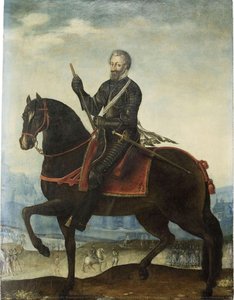
This mechanical brilliance was mirrored in his most celebrated visual achievement, the equestrian portrait of Henri IV before the siege of a town. In this work, Le Bourgeoys utilized his deep understanding of military reality to create something far more profound than a simple royal likeness. The painting serves as a visceral window into the anxieties and triumphs of a nation navigating religious discord. Through the use of meticulous detail—the sheen of blackened armor, the powerful stance of the black horse, and the atmospheric tension of the siege—he captured the very essence of leadership and resilience. His style, which drew inspiration from the heroic condottieri portraits of Italy, blended a gritty realism with an idealized grandeur, ensuring that his subjects were seen not just as men, but as symbols of national stability.
An Enduring Influence on Art and Industry
The life of Marin Le Bourgeoys concluded in 1634, yet the echoes of his work continued to resonate through the centuries. His ability to synthesize the disparate worlds of the studio and the workshop left an indelible mark on the development of European industry and the evolution of military art. He remains a singular figure who proved that the precision required for engineering is not so different from the precision required for a brushstroke; both demand an intimate understanding of how components—be they pigments or iron springs—interact to create a functional and beautiful whole.
To reflect on his multifaceted career is to witness the true spirit of the Renaissance:
- Artistic Mastery: His ability to capture the psychological depth of monarchs through painting and sculpture.
- Scientific Innovation: The creation of the flintlock mechanism, a cornerstone of modern firearm history.
- Royal Service: A distinguished career at the Louvre, serving both Henry IV and Louis XIII.
- Versatility: An unparalleled range of skills spanning from luthier and sculptor to engineer and inventor.