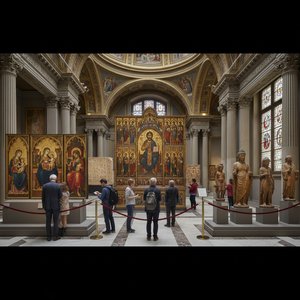
Master of the Saint Lambrecht Votive Altarpiece
The Master of the Saint Lambrecht Votive Altarpiece, a pivotal figure in Austrian Gothic art, remains shrouded in scholarly debate regarding his precise identity and chronological placement. Active around 1430-1440, he emerged from the vibrant artistic milieu of Styria during a period marked by fervent piety and burgeoning civic pride—a context that profoundly shaped his oeuvre. While definitive attribution has proven elusive due to stylistic similarities with other artists of the era, meticulous analysis suggests connections to the broader Bohemian International Gothic tradition, alongside influences from Cologne and Westphalia, demonstrating an artist acutely attuned to artistic currents circulating across Europe.
- Early Life & Training: Precise biographical details are scarce, fueling speculation about his origins and formative years. Evidence points to a workshop centered in Sankt Lambrecht Abbey, Styria, where he honed his skills under the tutelage of masters like Hans von Judenburg and Hans von Tübingen—artists whose stylistic approaches mirrored those of the Master’s own distinctive style.
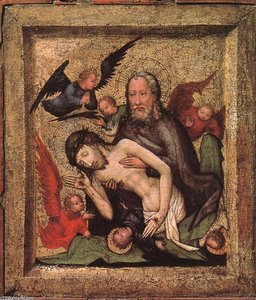
- Notable Works: The Saint Lambrecht Votive Altarpiece stands as his magnum opus, a monumental panel depicting Abbot Heinrich Moyker kneeling before the Virgin Mary, accompanied by St Hemma of Gurk, amidst a landscape commemorating Hungary's triumph over Ottoman forces. This masterpiece exemplifies the artist’s masterful command of color and texture—characteristics that extend to numerous other paintings attributed to him, including the Trinity with Christ Crucified ('Throne of Mercy') housed in London’s National Gallery.
- Stylistic Characteristics: The Master's style is characterized by a harmonious blend of Bohemian International Gothic elegance and Cologne Renaissance refinement. His compositions prioritize clarity and balance, employing flattened perspectives and stylized drapery—techniques that reflect the prevailing aesthetic sensibilities of his time. Furthermore, he skillfully integrates architectural elements into his landscapes, creating immersive environments that convey spiritual depth.
- Influence & Legacy: The Master’s work exerted considerable influence on subsequent generations of Austrian artists, fostering a tradition of devotional painting rooted in meticulous observation and expressive symbolism. His stylistic innovations contributed to the development of Viennese Gothic art and established him as a cornerstone of Styrian artistic heritage—a legacy that continues to inspire admiration and scholarly inquiry today.
- Ongoing Research & Debate: Despite extensive research efforts, definitive attribution remains contentious among art historians. Comparisons with Hans von Tübingen and stylistic parallels with other artists underscore the complexities inherent in reconstructing his artistic biography. Nevertheless, the Saint Lambrecht Votive Altarpiece—alongside its associated stained glass window—continues to serve as a testament to the Master’s unparalleled artistry and enduring contribution to European religious iconography.
Sources: Baldass, L.; Wilcken, L. et al.; Garzarolli-Thurnlackh, K.; Oettinger, K.; Black, O.; Röhrig, H.; Schäfer, J.; Scholderer, M.; Schubert, R.; Zaisl, G.; Zimmer, P.