The Brewer’s Son Who Mapped the World
The story of Matthäus Seutter is one of the most remarkable transformations in the history of European cartography, a journey that began far from the delicate copperplates and ink-stained studios of the great publishing houses. Born in Augsburg, Germany, on September 20, 1678, Seutter’s early life was destined for a much more grounded profession; he began his career as an apprentice brewer, a trade that seemed entirely disconnected from the scientific and artistic heights he would later achieve. Yet, driven by an unfulfilled creative spirit, he abandoned the brewery for Nuremberg, where he sought out the legendary Johann Baptist Homann. Under Homann’s masterful tutelage, Seutter transitioned from a student of craft to a master of engraving, absorbing the meticulous techniques required to translate the vast complexities of the Earth onto paper.
This apprenticeship was more than mere technical training; it was an immersion into the very heart of the Enlightenment's geographical ambitions. By studying under Homann, one of the most influential map publishers of the era, Seutter learned how to marry scientific accuracy with aesthetic grandeur. Around 1700, demonstrating a bold and independent spirit, Seutter departed from his mentor’s shadow to establish his own cartographic publishing house in his native Augsburg. While the early years of his independent venture were marked by the struggles common to any new entrepreneur, his unwavering commitment to excellence allowed him to carve out a unique niche in the competitive European market.
A Master of Engraving and Imperial Recognition
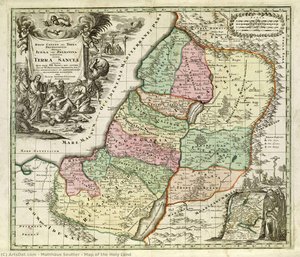
Seutter’s work is characterized by a profound duality: it is simultaneously a rigorous scientific record and a breathtaking display of artistic virtuosity. While much of his cartographic output drew upon the foundational work of established firms like Homann and Delisle, Seutter breathed new life into these geographic outlines through his exceptional engraving skills. He possessed a rare ability to incorporate decorative flourishes—ornate cartouches, mythical sea creatures, and delicate topographical embellishments—that transformed a simple map into a piece of fine art. This stylistic choice did not merely decorate the page; it elevated the atlas to an object of prestige and wonder for collectors across the continent.
The pinnacle of his professional prestige arrived in 1732, when Emperor Charles VI bestowed upon him the illustrious title of Imperial Geographer. This was no mere honorary gesture; it was a formal recognition of his significant contributions to the advancement of geographical knowledge and his role in cementing Augsburg as a premier center for artistic and scientific production. This title granted him a level of authority that resonated through the scholarly circles of Europe, signaling that his maps were trusted authorities on the shape and state of the known world.
Legacy of the Augsburg Cartographer
The enduring significance of Matthäus Seutter lies in his ability to bridge the gap between the utilitarian need for navigation and the human desire for beauty. His most celebrated achievement, the Atlas Novus Sive Tabulae Geographicae, stands as a testament to his prolific career and his mastery of the medium. Through his work, we see the world through the eyes of the 18th century—a period of expanding horizons and intense curiosity. Even after his death in 1757, his influence persisted, as his son Albrecht Carl continued the family firm, ensuring that the Seutter name remained synonymous with cartographic excellence.
Today, the works of Seutter are cherished not only by historians but by art lovers who find beauty in the intricate lines and historical narratives etched into his copperplates. His legacy is found in:
- The Art of the Atlas: Redefining the map as a decorative masterpiece through sophisticated engraving.
- Scientific Continuity: Maintaining the high standards of German cartography by refining and expanding upon the works of his predecessors.
- Imperial Prestige: Elevating the status of the Augsburg publishing industry to an international stage under the mantle of the Holy Roman Empire.