The Vibrant Chronicle of New Zealand Railways: R.E. Owen and the Publicity Branch
R.E. Owen’s artistic legacy is inextricably linked to the golden age of New Zealand railways, a period brimming with optimism, exploration, and a burgeoning national identity. Born in Poverty Bay, his career as an artist within the New Zealand Railways Publicity Branch (1940-1987) wasn't merely about selling train tickets; it was about crafting a visual narrative of Aotearoa – its landscapes, its people, and the promise of connection across a vast and often challenging land. Owen’s work stands as a remarkable testament to the power of illustration in shaping public perception and fostering a sense of national pride during a crucial era of growth and transformation.
The Railways Publicity Branch itself was a fascinating entity – a government-sponsored department tasked with promoting rail travel, not just as a means of transport but as an experience. Established in 1920, it operated under the watchful eye of the Minister of Railways, employing artists, photographers, and writers to create a cohesive brand identity for New Zealand railways. Owen’s role within this team was pivotal; he wasn't simply a designer churning out posters; he was a storyteller, meticulously capturing the essence of various regions and experiences through his distinctive illustrations.
A Palette of Place: Style and Technique
Owen’s artistic style is immediately recognizable – characterized by bold colours, simplified forms, and an almost childlike charm. He eschewed photographic realism in favour of a more expressive, illustrative approach, drawing heavily on the Regionalist movement that was gaining traction internationally at the time. This stylistic choice wasn't arbitrary; it reflected a deliberate desire to celebrate the familiar, the comforting – the heartland of New Zealand. His illustrations weren’t meant to be literal representations but rather evocative glimpses into specific places and moments.
His technique involved primarily linocut printing, a process that lent itself perfectly to his bold colour palette and simplified forms. The slightly textured quality of the prints adds a tactile element to his work, grounding it in the physicality of the medium. He frequently employed bright, saturated hues – reds, yellows, blues – often juxtaposing them to create dynamic compositions that immediately drew the eye. A key element was his ability to distill complex scenes into instantly understandable visual cues; a mountain range became a series of stylized peaks, a bustling town square transformed into a collection of simplified figures.
Iconic Images and Regional Narratives
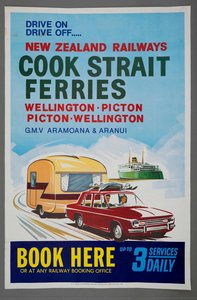
Owen’s most enduring contributions are undoubtedly the iconic posters advertising New Zealand's Cook Strait Ferries. The “Drive on Drive Off” campaign, featuring images of gleaming ferries navigating the turbulent waters between Wellington and Picton, is perhaps his best-known work. These weren’t just advertisements; they were carefully constructed narratives designed to entice travellers with the promise of adventure and scenic beauty. The posters frequently depicted idyllic landscapes – snow-capped mountains, rolling hills, pristine beaches – alongside images of Māori culture and railway infrastructure, subtly weaving together a complex tapestry of New Zealand identity.
Beyond the ferries, Owen’s work encompassed a vast range of subjects: from promoting tourist destinations like Rotorua's geothermal wonders to showcasing regional festivals and events. His illustrations for “Winter Sports” captured the spirit of adventure and outdoor recreation, while his depictions of Māori culture – meeting houses, ceremonial gatherings – demonstrated a genuine respect for indigenous traditions. He consistently sought to portray New Zealand as a land of contrasts: rugged wilderness alongside fertile farmland, ancient traditions coexisting with modern progress.
Legacy and Historical Significance
R.E. Owen’s work represents more than just a collection of visually appealing posters; it's a valuable historical record of 20th-century New Zealand. His illustrations offer a unique window into the country’s evolving identity, reflecting the optimism and aspirations of a nation forging its own path. The Railways Publicity Branch, under Owen’s guidance, played a crucial role in shaping public perceptions of New Zealand – promoting tourism, fostering national pride, and celebrating the country's diverse landscapes and cultures.
His influence extends beyond the realm of advertising; Owen’s distinctive style has become synonymous with the golden age of New Zealand railways. His work is now housed in major museums and galleries across the country, serving as a reminder of a time when art played a vital role in shaping the nation's visual landscape. Owen’s legacy continues to inspire artists and designers today, demonstrating the enduring power of illustration to capture the spirit of a place and its people.