Menu
FREE ART CONSULTATION

Office of Maxwell Fry and Jane Drew

Quick Facts

  • Copyright status: Under copyright
  • Works on APS: 1
  • Nationality: United Kingdom
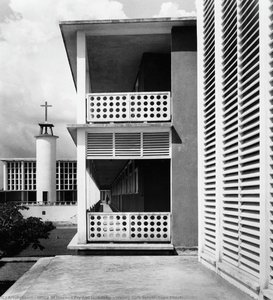
  • Top 3 works: Wesley Girls School, Cape Coast
  • Also known as:
    • Fry
    • Drew and Partners
  • More…
  • Art period: Contemporary
  • Museums on APS: Royal Institute of British Architects
  • Born: 1950, London, United Kingdom
  • Top-ranked work: Wesley Girls School, Cape Coast

Art Quiz

There is only one correct answer for each question.

Question 1:
The Office of Maxwell Fry and Jane Drew is best known for pioneering what architectural style?
Question 2:
In which city did Fry and Drew play a pivotal role in the planning and design of a new capital?
Question 3:
What was a key characteristic of Fry and Drew's architectural approach?
Question 4:
Besides Maxwell Fry, who were the other two architects that joined the practice in 1952?
Question 5:
Jane Drew's early career involved working for modernist architects like Wells Coates and Ernő Goldfinger, absorbing principles of what?

Pioneering Modernism: The Collaborative Vision of Maxwell Fry and Jane Drew

The story of the Office of Maxwell Fry and Jane Drew, later evolving into Fry, Drew and Partners, is a compelling narrative of architectural innovation deeply intertwined with the social and political currents of the mid-20th century. Emerging in post-war Britain, their practice wasn’t simply about erecting buildings; it was about forging a new way of life through design – one that embraced modernist principles while remaining acutely sensitive to context, climate, and cultural nuance. Established in 1950, the firm quickly distinguished itself as a beacon of progressive thought, challenging conventional architectural norms and championing a humanistic approach to building. Their influence resonated far beyond the United Kingdom, leaving an indelible mark on landscapes as diverse as India, Ghana, and Iran. The partnership’s strength lay not only in their shared vision but also in their individual strengths: Maxwell Fry's early exposure to vernacular architecture during his time in India, coupled with Jane Drew’s commitment to social housing and functional design, created a powerful synergy that defined their work.

Formative Years and Influences

Maxwell Fry’s architectural journey began with classical training but swiftly pivoted towards the burgeoning modernist movement. His experiences working in India during the 1920s proved transformative, instilling within him a deep appreciation for indigenous building techniques and an understanding of how architecture could respond to specific environmental challenges. This wasn't about imposing a style; it was about adapting principles to create truly functional and harmonious spaces. Jane Drew, graduating from the Architectural Association in 1934, absorbed the tenets of functionalism and rational design while working with prominent modernist architects like Wells Coates and Ernő Goldfinger. However, her focus extended beyond aesthetics – she possessed a profound understanding of human needs, particularly within the realm of social housing. Both Fry and Drew were captivated by the ideas emanating from the Bauhaus and the architectural philosophies of Le Corbusier, but they weren’t slavish imitators. They recognized the need to translate these principles into a distinctly British idiom and, crucially, to adapt them for use in vastly different climates and cultural settings. Their travels throughout Europe broadened their understanding of modernist trends, informing their designs with a cosmopolitan sensibility.

A Legacy in Concrete and Light: Key Projects

The Office of Maxwell Fry and Jane Drew undertook an extraordinarily diverse range of projects, demonstrating their versatility and commitment to architectural problem-solving. Perhaps their most significant undertaking was their pivotal role in the planning and design of Chandigarh, India – a new capital city envisioned as a symbol of post-independence progress. Working alongside Le Corbusier, they were responsible for key government buildings and housing schemes, skillfully integrating modernist principles with Indian traditions and materials. This wasn’t simply about transplanting European designs; it was about creating a uniquely Indian modernism. Another notable achievement was the Wesley Girls School in Cape Coast, Ghana. This project exemplified their dedication to providing quality educational facilities in tropical climates, employing passive ventilation techniques and locally sourced materials to create comfortable and sustainable learning environments. Back in Britain, they designed numerous housing estates, prioritizing affordability, functionality, and a sense of community. These weren’t merely dwellings; they were intended as catalysts for social cohesion and improved living standards. Their architectural approach was consistently characterized by a focus on functionalism – the belief that form should follow function – simple geometric forms, restrained aesthetics, an emphasis on natural light and ventilation, and a deep respect for local contexts.

Evolution and Enduring Significance

The inclusion of Lindsey Drake and Denys Lasdun in 1952 marked a period of significant growth and innovation for the practice, becoming Fry, Drew, Drake and Lasdun. While Lasdun eventually established his own firm, the core principles championed by Fry and Drew continued to guide their work. Their legacy extends far beyond individual buildings; they were instrumental in promoting modernist architecture throughout the British Empire and beyond, demonstrating its adaptability and potential for positive social impact. They challenged traditional colonial architectural practices, advocating for a more equitable and responsive approach to building design in developing nations. Their commitment to social housing, coupled with their innovative use of materials and techniques, profoundly influenced subsequent generations of architects. The office’s international scope and its ability to seamlessly blend modernist principles with local traditions cemented their place as pioneers of global modernism. Maxwell Fry and Jane Drew didn't just design buildings; they designed for people, creating spaces that were not only aesthetically pleasing but also functional, sustainable, and deeply rooted in the communities they served. Their work continues to inspire architects today, reminding us of the power of architecture to shape a better future.