The Scholar Turned Revolutionary: Fry’s Early Life & Influences
 Wikipedia: Roger Fry
Roger Eliot Fry (14 December 1866 – 9 September 1934) was an English painter and critic, and a member of the Bloomsbury Group. Establishing his reputation as a scholar of the Old Masters, he became an advocate of more recent developments in French pa...
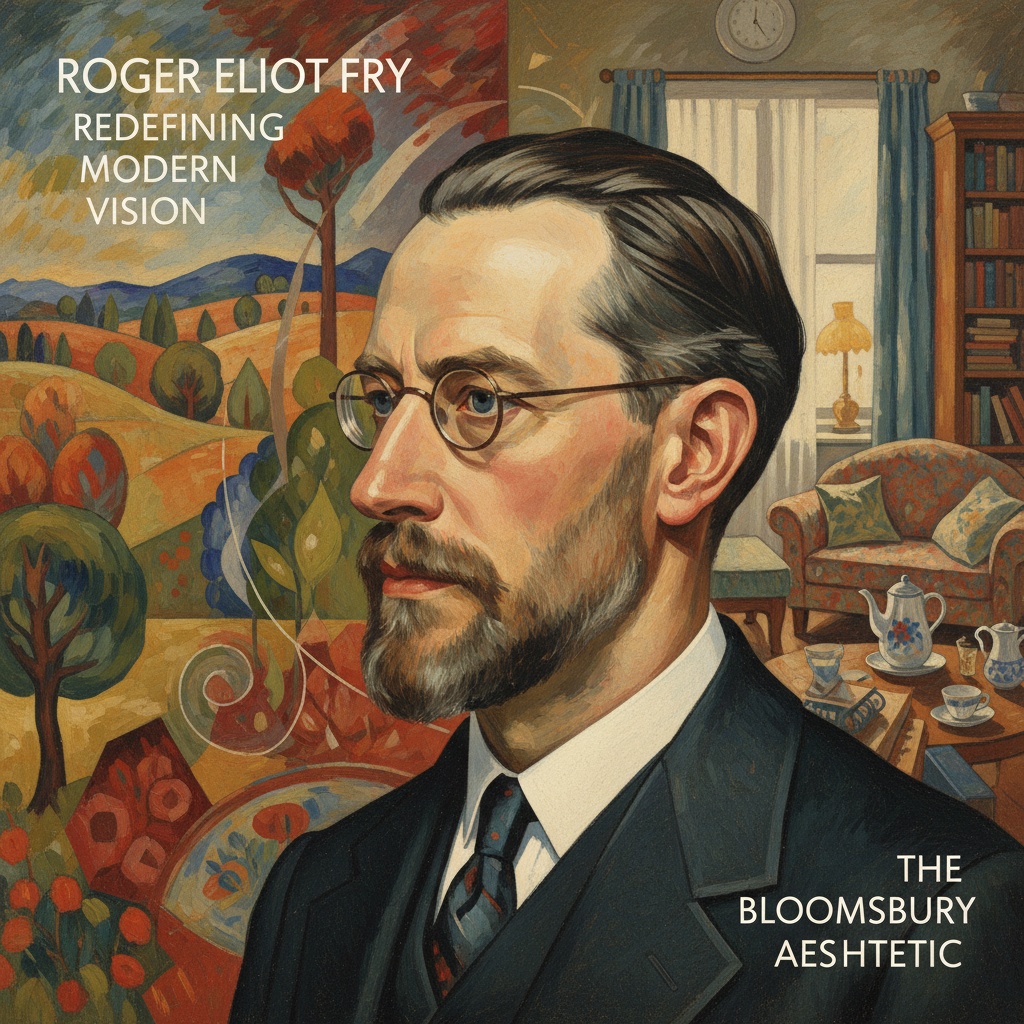
Roger Eliot Fry, a name synonymous with the introduction of modern art to Britain, wasn't born into a world of radical aesthetics. His beginnings were steeped in Victorian tradition, a comfortable upbringing within a prominent Quaker family. The son of judge Edward Fry, young Roger initially pursued a path dictated by societal expectation – natural sciences at King’s College, Cambridge. Yet, even amidst the rigors of scientific study, an undercurrent of artistic sensibility flowed. This early intellectual discipline, however, proved unexpectedly formative. It instilled in him a meticulous observational skill and a commitment to analytical thinking that would later define his approach to art criticism. His time within the Cambridge Apostles, a freethinking society, further nurtured a spirit of independent thought, laying the groundwork for challenging established norms.
The pivotal shift came with Fry’s move to Paris and Italy. Immersing himself in the world of Old Masters—the Renaissance landscapes, the subtle nuances of Italian painting—he developed a profound understanding of artistic technique and historical context. This wasn't merely an academic pursuit; it was a deeply personal journey of discovery. He began to paint himself, though his early works reveal a more conventional style, hinting at the burgeoning talent that would eventually find its unique voice. It was this rigorous grounding in tradition, paradoxically, that equipped him to recognize and champion the revolutionary departures emerging from France.
Post-Impressionism Defined: Challenging Conventions & Shaping a New Aesthetic
Post-Impressionism (also spelled Postimpressionism) was a predominantly French art movement which developed roughly between 1886 and 1905, from the last Impressionist exhibition to the birth of Fauvism. Post-Impressionism emerged as a reaction agains...
Upon his return to England, Fry’s reputation as an Old Masters scholar solidified. However, he was increasingly drawn to the burgeoning movements in French painting—movements that were largely ignored or dismissed by the British art establishment. He wasn't simply interested in *what* these artists were painting; he was captivated by *how* they painted. This distinction is crucial. Fry didn’t see Post-Impressionism as a rejection of Impressionism, but rather as its logical evolution—a move away from purely optical representation towards a greater emphasis on form, structure, and emotional expression.
The term “Post-Impressionism” itself was largely Fry's invention, coined to categorize artists like Cézanne, Gauguin, van Gogh, and Seurat. It wasn’t about adhering to a single style but recognizing a shared desire to move beyond the fleeting impressions of light and color towards something more enduring—a subjective interpretation of reality. He argued that paintings weren’t simply windows onto the world; they were constructed realities, imbued with the artist's unique sensibility. This emphasis on formal properties – shape, mass, composition – over narrative detail was a radical departure from Victorian aesthetic ideals.
The Grafton Galleries Exhibitions: A Catalyst for Modern Art in Britain
In 1910, Fry took a monumental risk. He organized an exhibition at the Grafton Galleries in London titled *Manet and the Post-Impressionists*. The reaction was…mixed, to say the least. Critics were often scathing, dismissing the works as crude, unfinished, or simply incomprehensible. Yet, despite the initial hostility, the exhibition drew over 25,000 visitors—a testament to its provocative power. It was a watershed moment, introducing British audiences to artists who would fundamentally alter the course of modern art.
The impact wasn’t immediate, but it was profound. Fry followed up with a second Post-Impressionist exhibition in 1912, further solidifying his position as a champion of the avant-garde. These exhibitions weren't merely displays of paintings; they were acts of intellectual and artistic defiance. He challenged viewers to see beyond representational accuracy, to appreciate the underlying structure and emotional resonance of the works. The shockwaves reverberated through the British art world, paving the way for new generations of artists and critics.
Fry and the Bloomsbury Group: Collaboration, Controversy, and Shared Vision
The Bloomsbury Group was a group of associated British writers, intellectuals, philosophers and artists in the early 20th century. Among the people involved in the group were Virginia Woolf, John Maynard Keynes, E. M. Forster, Vanessa Bell, and Lytto...
Roger Fry’s influence extended far beyond his curatorial work. He was a central figure in the Bloomsbury Group—a loose collective of writers, intellectuals, philosophers, and artists who challenged Victorian social conventions and embraced a bohemian lifestyle. His close relationships with figures like Virginia Woolf, E.M. Forster, Vanessa Bell, and Duncan Grant were both personally enriching and artistically stimulating.
The collaboration between Fry, Bell, and Grant was particularly significant. They often worked together, experimenting with form and color, pushing the boundaries of artistic expression. However, this close proximity also led to tensions. Fry’s intellectual authority sometimes clashed with the more intuitive approaches of his colleagues. The founding of the Omega Workshops in 1913—a design collective aimed at creating affordable, aesthetically pleasing objects for everyday life—further highlighted these creative differences. Despite the internal conflicts, the Bloomsbury Group provided a fertile ground for artistic innovation and intellectual debate.
Beyond Painting: Fry’s Impact on Design, Criticism, and Public Taste
Fry's influence wasn't limited to painting or even the art world itself. He believed that good design should be accessible to everyone, not just the elite. The Omega Workshops, though short-lived, embodied this philosophy—producing textiles, ceramics, furniture, and other objects characterized by bold colors, simplified forms, and a rejection of Victorian ornamentation.
His writings on art were equally influential. He emphasized the importance of understanding the formal properties of paintings – shape, color, composition – over their narrative content or historical context. This approach revolutionized art criticism in Britain, encouraging viewers to engage with artworks on a more visceral and intellectual level. Fry’s legacy extends beyond specific movements or artists; it lies in his ability to reshape public taste, fostering a greater appreciation for modern art and design.
A Lasting Legacy: The Enduring Influence of Roger Eliot Fry
Roger Eliot Fry died in 1934, but his impact continues to resonate today. He wasn’t merely an advocate for Post-Impressionism; he was a visionary who fundamentally altered the way we perceive and understand art. His emphasis on formal analysis, emotional expression, and the subjective interpretation of reality remains central to contemporary art criticism.
The Courtauld Institute of Art in London houses his extensive collection, providing a tangible link to his groundbreaking work. At ArtsDot.com, we celebrate Fry’s legacy by offering high-quality reproductions of the masterpieces he championed—allowing you to experience the transformative power of Post-Impressionism firsthand. Explore our collection and discover the enduring beauty and intellectual depth of artists like Cézanne, Matisse, and van Gogh – a testament to the revolutionary vision of Roger Eliot Fry.