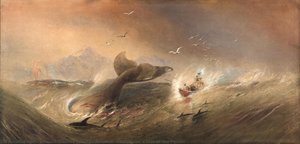
A Mariner's Eye for Victorian Majesty
Oswald Walters Brierly stands as a prominent figure in 19th-century British marine painting, renowned not merely for his technical skill but also for his unwavering dedication to capturing the grandeur and drama of naval life during Queen Victoria’s reign. Born in Chester, Cheshire, in 1817, Brierly descended from an established family with roots stretching back centuries, fostering within him a predisposition towards artistic pursuits nurtured by his father, Thomas Brierly, a physician who himself dabbled in amateur painting. This familial encouragement propelled him toward formal art education at the academy of Henry Sass in Bloomsbury, where he honed his observational abilities and developed a foundational understanding of artistic principles that would later define his meticulous approach to the sea.
The trajectory of Brierly's life was profoundly shaped by his immersion in the maritime world. Beyond the studio, he sought knowledge at Plymouth, studying naval architecture and rigging—a discipline that instilled in him a scientific accuracy regarding the anatomy of ships. This technical expertise allowed him to render vessels with an authenticity that resonated deeply with contemporary audiences. His artistic journey was further enriched by transformative voyages; notably, his 1842 expedition aboard Benjamin Boyd’s yacht, the Wanderer, which carried him from Liverpool to Sydney. This odyssey across the globe exposed him to breathtaking landscapes and the raw power of the ocean, cementing a lifelong fascination with the boundless beauty and unpredictable temperament of the maritime realm.
The Art of the Voyage and Royal Recognition
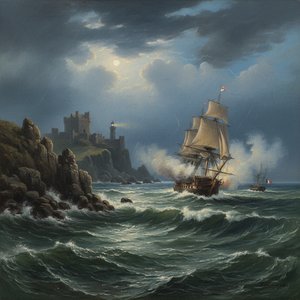
Brierly’s artistic sensibilities were undeniably molded by the spirit of Romanticism, absorbing elements of Turner’s atmospheric landscapes and Constable’s serene depictions of nature. However, he swiftly distinguished himself through a singular focus on the marine realm, blending the emotional weight of Romanticism with the precision of a naval architect. His work often captured the tension between the fragile human element and the overwhelming majesty of the sea, whether depicting the calm of a sheltered bay or the terrifying squall of a storm. During his time in New South Wales, Brierly even ventured into the realm of murals, painting scenes such as H.M.S. Rattlesnake in a squall off the Island of Timor, which are celebrated as some of the earliest significant maritime murals in Australia.
The pinnacle of his professional success arrived through royal patronage and official appointments. Recognizing his exceptional talent for documenting the naval splendor of the era, Queen Victoria appointed Brierly as her official marine painter. This prestigious role placed him at the heart of British maritime history, tasking him with capturing the very essence of the Empire's naval might. His ability to translate the complex rigging, the play of light on salt spray, and the disciplined movement of men-of-war into evocative canvases earned him a lasting legacy. Through his brush, the triumphs and the quiet, rhythmic beauty of the Victorian navy were preserved for posterity, making him not just a painter of ships, but a chronicler of an era's maritime soul.
Legacy of a Master Marine Painter
The historical significance of Sir Oswald Walters Brierly lies in his unique ability to marry scientific observation with artistic emotion. His works serve as vital historical documents, providing a window into the naval technology and the atmospheric conditions of the 19th century. The enduring appeal of his paintings can be found in several key elements:
- Technical Precision: His deep understanding of naval architecture ensured that every mast, sail, and hull was rendered with an accuracy that commanded respect from sailors and scholars alike.
- Atmospheric Depth: By utilizing the light and shadow techniques characteristic of his era, he breathed life into the sea, making the water appear as a living, breathing entity.
- Historical Documentation: His depictions of specific vessels, such as the Pique and the Gorgon, provide an invaluable visual record of the ships that defined British naval supremacy.
- Global Perspective: His travels from the English coast to the Australian frontier allowed him to bring a diverse range of maritime environments into the Victorian art canon.
Today, Brierly's work continues to captivate collectors and historians, standing as a testament to a life spent navigating both the literal and metaphorical currents of the great oceans. His legacy remains anchored in the profound respect he held for the sea and his unparalleled ability to render its majesty upon the canvas.