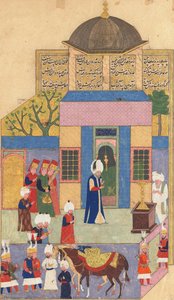
Qasim al-Husayni al-'Aridi (Luqman): Pioneer of Islamic Cartography
Qasim al-Husayni al-'Aridi, commonly known as Luqmān, stands as a pivotal figure in the annals of medieval Islamic scholarship and cartography. Born in Qazvin, Iran around 1203 CE, he emerged from the Maliki school of jurisprudence—a prominent legal tradition—to become one of the foremost cosmographers of his time, leaving an indelible mark on the intellectual landscape of Persia and beyond.
- Early Life & Education: Little is known definitively about Luqmān’s formative years. However, scholarly consensus suggests he received a rigorous education rooted in Islamic theology and jurisprudence, equipping him with the analytical skills necessary for his ambitious scientific pursuits. His mastery of Arabic illuminated texts undoubtedly fueled his intellectual curiosity.
- The Sayyid Luqman Codex: Luqmān’s legacy rests primarily upon the “Sayyid Luqman Codex,” a monumental manuscript produced circa 1283 CE. This remarkable atlas meticulously documented the geography of Persia and its surrounding regions, incorporating astronomical observations to determine precise locations. It represents an unprecedented effort to synthesize classical Greek knowledge with Islamic scholarship—a testament to Luqmān’s intellectual vision.
- Methodology & Innovation: Unlike contemporary cartographers who relied on Ptolemaic projections derived from Greco-Roman sources, Luqmān championed a more sophisticated approach. Utilizing trigonometric calculations and incorporating data gleaned from travelers' accounts—particularly those detailing routes to Mecca—he crafted maps that achieved remarkable accuracy. This innovative methodology distinguished him from his peers and cemented his reputation as a visionary scientist.
- Influence & Legacy: The Sayyid Luqman Codex served as an invaluable resource for subsequent generations of scholars and navigators, shaping the understanding of Persia’s geography for centuries to come. Its meticulous detail and incorporation of astronomical observations established a new standard for Islamic cartography—inspiring further explorations into the intersection of science and religion.
- Historical Significance: Luqmān's work embodies the spirit of intellectual exchange during the Mongol era, demonstrating the enduring power of classical learning revitalized by Islamic scholarship. He remains an exemplar of scholarly dedication and a cornerstone in the history of geographical knowledge—a figure whose contributions continue to resonate within the broader context of medieval European cartography.
As evidenced by the binding from History of Sultan Süleyman by Sayyid Luqmān, Luqmān’s influence extended beyond his own time, impacting artistic representations and scholarly discourse alike.