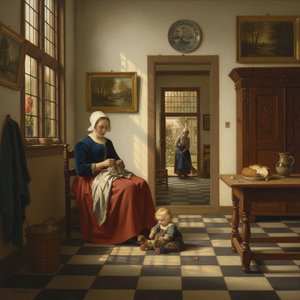
The Master of Intimate Moments: The Life and Legacy of Reynier de la Haye
In the golden light of the seventeenth-century Netherlands, a period defined by unparalleled prosperity and cultural flowering, the works of Reynier de la Haye offered a window into the soul of a nation. While many of his contemporaries sought to capture the grandiosity of historical epics or the complex allegories of mythology, de la Haye found profound beauty in the quiet, the mundane, and the deeply human. His artistry was not merely about recording faces, but about capturing the very breath of life within the domestic spheres of the Dutch Golden Age. Through his masterful command of light and shadow, he transformed simple genre scenes into enduring meditations on existence, grace, and the fleeting nature of time.
The foundations of de la Haye’s talent were laid in the vibrant artistic atmosphere of Amsterdam. Born around 1606, his early development was profoundly shaped by his father, Pieter van La Haye, a skilled painter and engraver. This familial apprenticeship provided more than just technical instruction; it instilled in the young artist a reverence for the meticulous detail and structural integrity required of high-caliber portraiture. As he matured, de la Haye’s style began to absorb the revolutionary techniques circulating through the Dutch art world. Most notably, evidence suggests he was influenced by the legendary Rembrandt Harmensz van Rijn. From this connection, de la Haye inherited a sophisticated use of chiaroscuro—the dramatic interplay between light and dark—which allowed him to sculpt figures out of the shadows and imbue his subjects with a palpable psychological depth. This ability to render subtle facial expressions and the weight of a gaze became a hallmark of his oeuvre.
A Symphony of Light and Subject
De la Haye’s subject matter often centered on the musicality of life, frequently depicting musicians and lute players lost in melodic contemplation. These works are far more than mere portraits; they are atmospheric studies where the tension of a finger on a string or the tilt of a head conveys an entire emotional landscape. His ability to blend the aristocratic elegance of his patrons with the earthy realism of everyday people created a unique stylistic bridge, allowing him to navigate both the high-society portraiture and the intimate genre scenes that defined the era.
The technical brilliance of his work can be observed in several key areas:
- Textural Realism: His capacity to render the sheen of silk, the roughness of wood, and the delicate translucency of skin.
- Psychological Depth: The use of subtle shadows to suggest the inner thoughts and hidden emotions of his sitters.
- Compositional Harmony: A masterful arrangement of figures and objects that guides the viewer's eye through a narrative flow within a single frame.
Beyond the musicians, de la Haye’s repertoire extended to scholars, families, and members of the upper echelons of Dutch society. In these paintings, he captured the social fabric of seventeenth-century Holland, documenting the clothing, interiors, and customs of a period in transition. His work serves as a vital historical record, preserving the dignity of the individual amidst the shifting tides of history.
Historical Significance and Enduring Resonance
As the Dutch Golden Age reached its zenith, de la Haye established himself as a pivotal figure whose influence resonated through the studios of Amsterdam. His career, which spanned much of the mid-to-late seventeenth century, represents the pinnacle of Dutch genre painting—a movement that prioritized the observation of reality over the invention of fantasy. While biographical records from this era can sometimes be fragmented, the enduring presence of his works in prestigious collections speaks to a legacy of excellence that transcended his immediate lifetime.
Today, the significance of Reynier de la Haye lies in his ability to make the ephemeral feel eternal. He taught us that there is as much majesty in a scholar reading by candlelight as there is in a king upon a throne. By focusing on the nuances of daily life and the quiet dignity of the human spirit, he created an art form that remains deeply relatable across centuries. His paintings continue to invite viewers into a world of aristocratic grace and everyday intimacy, reminding us that the most profound stories are often told in the softest whispers of light.