The Poetics of Presence: The Art of Roxana Halls
Born in 1974 in Plaistow, London, Roxana Halls has cultivated a practice that serves as a profound meditation on the human condition, specifically through the lens of identity and resistance. Her artistic journey is deeply rooted in the spirit of the feminist art movement, emerging from a period defined by the dismantling of patriarchal structures and the reclamation of female agency. Influenced by the pioneering works of artists such as Mary Beth Edelson and Joyce Kozloff, Halls’s oeuvre is an unwavering commitment to portraying women not merely as subjects, or objects of beauty, but as complex individuals possessing deep psychological depth and a quiet, indomitable defiance against societal expectations.
Halls’s early life was marked by an aspiration toward the dramatic arts; her childhood dreams of becoming an actress have left an indelible mark on her painterly language. This background in performance informs the baroque sensibility that permeates her canvases. She often views the act of painting as a form of performance, where her models become collaborators in creating theatrical, staged scenarios. In these works, the viewer is not a passive observer but an active participant, invited to tease out the hidden narratives and unspoken tensions embedded within each carefully composed scene. This sense of drama is balanced by a meticulous, almost obsessive pursuit of realism, a technique she refined through rigorous self-directed study and frequent, contemplative visits to the National Gallery.
Technique, Light, and the Shadow of History
The technical mastery of Roxana Halls lies in her ability to marry breathtaking accuracy with emotional resonance. Her approach draws heavily from the masters of chiaroscroll, such as Rembrandt and Caravaggio, utilizing the dramatic interplay of light and shadow to reveal the inner lives of her subjects. Through this method, she captures more than just physical likeness; she illuminates the subtle nuances of human expression, revealing vulnerabilities and hidden desires that lie beneath the surface. Her canvases are characterized by a profound attention to detail, where every texture and shadow contributes to a larger psychological landscape.
Her influences are as diverse as they are eclectic, creating a magpie-like collection of cultural references that span centuries and mediums. Halls draws inspiration from:
- Classical and Baroque Art: The dramatic lighting and composition of historical masters.
- Avant-garde Cinema and Literature: The evocative power of visual storytelling and the poetic weight of authors like Sylvia Plath.
- Contemporary Music: The raw, emotive landscapes found in the music of Nick Cave, Robert Wyatt, and Peaches.
- Scientific and Historical Archives: References to Charcot’s photographic studies and the wartime paintings of Dame Laura Knight.
Themes of Identity, Class, and Resistance
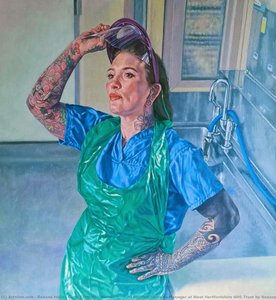
Beyond the technical brilliance of her work, Halls’s paintings serve as a critical examination of gender, class, sexuality, and identity. She possesses a unique aesthetic attraction to both the beautiful and the discarded—the "careworn" elements of existence that often escape the gaze of traditional fine art. While series such as Shadow Play and Suspended Women may evoke the surrealist imagery of Dorothea Tanning or Meret Oppenheim, Halls resists the label of Surrealism, preferring to focus on the tangible elements of theatricality, illusion, and magic.
Her career has been marked by significant milestones that bridge the gap between fine art and performance. A notable achievement includes her 2009 exhibition, Roxana Halls’ Tingle-Tangle, produced for the National Theatre in London. In this project, she adopted the persona of an impresario, utilizing the language of cabaret to blur the lines between the gallery space and the stage. Through this continuous exploration of the boundaries between life and art, Roxana Halls remains a vital voice in contemporary British painting, offering a window into the complex, often silent struggles for autonomy in a modern world.