The Ethereal Brush of a Landscape Poet
In the twilight of the Ming Dynasty, a period marked by both cultural splendor and profound transition, the art of Sheng Mao-yeh emerged as a poignant bridge between the visual and the lyrical. Known by his contemplative sobriquet, Nian An, Sheng Mao (盛茂燁) was a master whose life and work were inextricably woven into the intellectual fabric of Suzhou. While the precise dates of his birth and passing remain shrouded in the mists of history, his presence in the annals of Chinese art is unmistakable. Born in Jiaxing, Zhejiang Province, but finding his true artistic home in the vibrant cultural landscape of Jiangsu, Sheng developed a style that did not merely depict nature, but rather translated the very soul of classical poetry into monochrome ink.
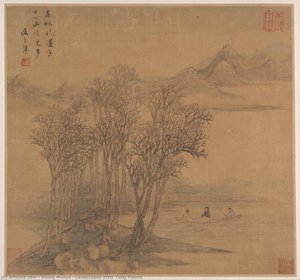
The essence of Sheng’s artistry lies in his profound connection to the Suiboku ga tradition, or ink wash painting. His work is characterized by a breathtakingly spacious and foggy atmosphere, creating a sense of infinite depth that invites the viewer into a meditative state. Rather than focusing on the rigid outlines of the physical world, Sheng utilized varying concentrations of black ink to simulate the ephemeral qualities of the natural realm—the dampness of a mountain mist, the weight of a heavy cloud, or the serene stillness of a hidden lake. This technique allowed him to capture what scholars call the spirit of the subject, prioritizing emotional resonance and atmospheric truth over mere topographical accuracy.
Poetic Resonance and Artistic Lineage
Sheng Mao’s development as an artist was deeply shaped by the prestigious lineage of Chinese masters. He drew significant inspiration from the refined aesthetics of Zhao Mengfu and Chen Lin, artists who championed a sophisticated approach to landscape that integrated philosophical depth with meticulous brushwork. From these influences, Sheng inherited a dedication to the idea that a painting should function as a visual poem. His most celebrated achievement is perhaps his ability to breathe life into the verses of the Tang Dynasty; his landscapes often serve as visual interpretations of the works of legendary poets such as Li Bai and Du Fu.
To observe a Sheng Mao-yeh landscape is to read a poem through the eyes. His mastery of the medium is evident in several key artistic elements:
- Moist Brushwork: The use of soft, saturated strokes on silk and fan panels to create textures that feel alive with moisture and light.
- Monochrome Mastery: A sophisticated command over the grayscale spectrum, using subtle shifts in ink tone to suggest distance, shadow, and atmosphere.
- Symbolic Landscapes: The deliberate inclusion of elements like towering pines, misty valleys, and tranquil waters that mirror the themes of nostalgia and permanence found in classical literature.
A Legacy Preserved in Ink
The historical significance of Sheng Mao-yeh extends far beyond the borders of Suzhou. His work embodies a pervasive sense of fin-de-siècle nostalgia, capturing a melancholic beauty that reflected the fading grandeur of the Ming era. This emotional depth has ensured his enduring relevance in the global art canon. Today, his masterpieces are not merely relics of a bygone age but are celebrated as pinnacle examples of the ink wash tradition, held in some of the world's most prestigious institutions.
The enduring legacy of Nian An is reflected in the permanent collections of several esteemed museums, including:
- The Metropolitan Museum of Art
- The British Museum
- The Indianapolis Museum of Art
- The Walters Art Museum
- The Nelson-Atkins Museum of Art
Through his delicate touch and profound sensitivity, Sheng Mao-yeh transformed the landscape into a vessel for memory and emotion. His ability to harmonize the ruggedness of nature with the elegance of classical verse ensures that his "landscape poetry" continues to resonate with anyone seeking beauty in the subtle nuances of the monochrome world.