A Legacy of Textured Narrative: The Artistry of Susan Allix
In the delicate intersection where literature meets fine craft, the work of Susan Allix emerges as a profound testament to the power of the handmade. Born in 1943 in the United Kingdom, Allix has carved out a singular niche within the realm of book arts, transforming the physical vessel of the book into an immersive sensory experience. Her journey began with the foundational studies of painting at the Guildford School of Art, but it was her pursuit of postgraduate studies at the Royal College of Art that truly defined her trajectory. Specializing in printmaking, she developed a mastery over medium and texture that would become the hallmark of her career, allowing her to treat every page not merely as a surface for text, but as a canvas for intricate visual storytelling.
The soul of Allix’s aesthetic is deeply rooted in her early explorations of European traditions. During her time studying abroad in Italy on a prestigious Prix de Rome scholarship, she became captivated by the meticulous precision of etching and engraving. This immersion in classical techniques instilled in her a lifelong reverence for detail and symbolic depth. Such influences are palpable in her later works, where the weight of history meets a contemporary sensibility. Through her creative imprint, The Willow Press, established in 1973, Allix achieved a rare level of artistic autonomy. She became a true polymath of the book arts, overseeing every stage of production—from the initial conceptual spark and typography to the final, painstaking binding or box-making.
Technique and the Alchemy of Paper
To encounter a work by Susan Allix is to engage with a complex layering of textures and light. Her process is an alchemical blend of traditional printmaking methods and innovative color application. She skillfully navigates a diverse repertoire of techniques, including letterpress printing, linoleum cuts, woodcuts, and the delicate pochoir stenciling method. This technical versatility allows her to create works that possess a palpable physical presence, where the indentation of the press and the grain of the wood contribute to a nostalgic, evocative mood.
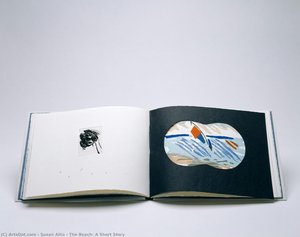
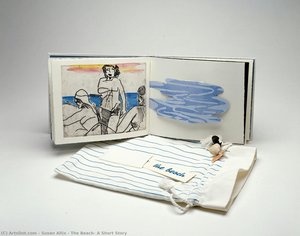
A defining characteristic of her work is her holistic approach to materials. Allix does not merely select paper; she curates it, often collecting sheets from her travels or commissioning handmade fine art papers that serve a specific narrative purpose. Her books might feature commercially molded sheets or decoratively patterned surfaces, all chosen to harmonize with the themes of the text. This dedication to the tactile nature of her medium ensures that her publications, such as the vibrant and abstract The Beach, function as much as sculptural objects as they do literary works.
Themes, Recognition, and Lasting Impact
Allix’s oeuvre is a tapestry of landscapes, both real and imagined. Her fascination with ancient aesthetics and coastal serenity is reflected in notable titles such as Egyptian Green, which explores the allure of ancient landscapes, and her reimagining of the classic Rubaiyat of Omar Khayyam. Whether she is capturing the rhythmic patterns of a shoreline or the intricate details of a Persian-inspired sketch, her work consistently evokes a sense of wonder and historical continuity.
The significance of her contribution to the British printmaking and book arts communities is cemented by the prestigious collections that house her work. Her artistic legacy is preserved within the archives of:
- The British Library
- Yale University (Yale Center for British Art)
- The Smithsonian Libraries
- The National Museum of Women in the Arts
- The UK Government Art Collection
Through her unwavering commitment to the integrity of craft, Susan Allix has ensured that the art of the book remains a vital, breathing medium. Her ability to weave together typography, illustration, and binding into a singular, cohesive narrative continues to inspire those who find beauty in the meticulous and the profound.