The Weaver of Irish Elegance
Sybil Connolly was far more than a mere designer; she was a visionary who wove the very soul of Ireland into the fabric of international high fashion. Born in 1921 in Swansea, Wales, to an Irish father and a Welsh mother, her life was a tapestry of cultural influences that would later define her aesthetic. Her early years were steeped in a profound appreciation for craftsmanship, a gift nurtured by her Welsh grandfather. This foundational love for texture and material would become the heartbeat of her career, allowing her to bridge the gap between the rustic charm of Irish heritage and the sophisticated runways of Paris and New York.
Her journey toward becoming "Dublin's Dior" began with a rigorous apprenticeship in London under the esteemed Bradley brothers. It was here, amidst the meticulous demands of high-end dressmaking, that Connolly mastered the technical precision required for haute couture. This period of formal training provided her with the structural knowledge to manipulate heavy, traditional fabrics into silhouettes that were both avant-garde and timeless. When she returned to Ireland, she did not merely bring back skills; she brought a mission to elevate local artistry to a global stage.
A Revolution in Textile and Tradition
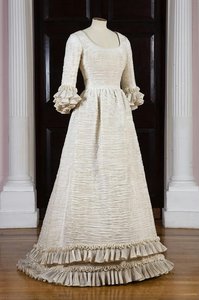
What truly set Connolly apart from her contemporaries was her revolutionary approach to materiality. While the fashion capitals of the world were focused on silk and lace, Connolly looked toward the rugged landscapes of her home. She possessed an uncanny ability to take traditional Irish textiles—such as heavy tweeds, hand-woven linens, and intricate laces—and transform them into garments of ethereal lightness and grace. Her work was a poetic dialogue between the old world and the new, where the weight of history met the fluidity of modern movement.
The ascent of her career was marked by moments of pure cinematic brilliance. In 1952, her debut collection at Dunsany Castle captured the imagination of the fashion elite, largely due to the influential endorsement of Carmel Snow, the legendary editor-in-chief of Harper's Bazaar. This connection acted as a golden thread, pulling Connolly’s designs from the emerald hills of Ireland into the bright lights of the American market. Her ability to marry the ruggedness of Irish textures with the refined elegance required by the international jet set made her an instant icon of style.
Legacy and the Iconography of Style
The historical significance of Sybil Connolly lies in her role as a cultural ambassador. She did not just dress women; she dressed an era. Her most enduring legacy is perhaps captured in the iconic imagery of Jacqueline Kennedy Onassis, for whom Connolly designed garments that epitomized mid-century sophistication. To see a Connolly creation worn by such a global tastemaker was to see the triumph of Irish identity on the world stage. Her client list read like a roll call of twentieth-century royalty and glamour, including Elizabeth Taylor and the great American dynasties like the Rockefellers.
Beyond the individual garments, her impact can be measured by the doors she opened for subsequent generations of Irish designers. As a member of the "Big Three" alongside Irene Gilbert and Raymond Kenna, she helped establish a distinct national school of design that refused to be overshadowed by Paris. Even today, her name evokes a sense of romanticism and structural integrity. She remains a national treasure, remembered not just for the clothes she made, but for the way she taught the world to see the beauty, strength, and elegance inherent in the Irish spirit.