Menu
FREE ART CONSULTATION

The Venice And Murano Glass And Mosaic Company

Quick Facts

  • Copyright status: Under copyright
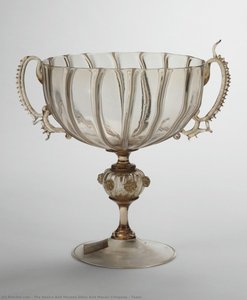
  • Top 3 works: Tazza
  • Top-ranked work: Tazza
  • More…
  • Works on APS: 1
  • Museums on APS: Palácio Nacional da Ajuda
  • Also known as:
    • Pauly & C. – Compagnia Venezia Murano
    • Compagnia Di Venezia E Murano
    • Salviati &C.
    • V&Mg&Mc

The Enduring Legacy of the Venice and Murano Glass & Mosaic Company

For over a century and a half, the name “Venice and Murano Glass & Mosaic Company” has resonated with the artistry and innovation synonymous with Venetian glassmaking. However, its story is not one of simple continuity but rather a fascinating evolution born from ambition, revivalism, and ultimately, a dedication to preserving a uniquely fragile art form. The company’s origins lie in the mid-19th century, a period when the once-dominant Venetian glass industry faced decline. It was Antonio Salviati, a Vicenza lawyer with a vision, who spearheaded its rebirth. In 1866, he established Compagnia Venezia-Murano in London, backed by archaeologist Austen Henry Layard and antiquarian Sir William Drake. Salviati’s goal wasn't merely to produce glass; it was to *restore* Venetian glassmaking to its former glory, a pursuit rooted in meticulous reproduction of Renaissance originals.

A Fusion of Past and Present

Salviati understood that simply copying the past wouldn’t be enough. He assembled a team of master glassblowers and sought expertise from other fields – goldsmithing, engraving – to ensure authenticity. Artists like Giuseppe Devers were brought on board to teach techniques such as enamelling and gilding, breathing new life into ancient methods. The early work of the company focused heavily on recreating Roman murrine mosaics and elaborate chandeliers, pieces that evoked a sense of historical grandeur. This initial phase was significantly influenced by archaeological discoveries and the prevailing Victorian taste for revival styles. Sir Charles Eastlake’s influential handbook *Hints on Household Taste* provided further support, championing the aesthetic principles guiding Salviati's endeavors. The company quickly gained recognition, supplying pieces to discerning collectors and institutions, including a substantial collection purchased by the National Gallery of Victoria in Melbourne during the 1880 International Exhibition. These early acquisitions demonstrate the immediate appeal and perceived quality of the Company’s work.

Expansion and Diversification

The year 1919 marked a pivotal moment with the merger of Pauly & C., founded in 1902, and Compagnia di Venezia e Murano. This union consolidated resources and expertise, setting the stage for further expansion. In 1932, the acquisition of MVM Cappellin & C., along with its extensive archive of designs, proved invaluable. The company wasn’t content to remain solely focused on reproduction; it actively embraced modern design alongside its historical work. This shift was further solidified in 1990 with the purchase of Toso Vetri d’Arte glassworks, a move that brought new artistic voices and techniques into the fold. Throughout this period, Pauly & C. – Compagnia Venezia e Murano maintained retail showrooms and participated in international exhibitions, showcasing both antique pieces and contemporary creations.

Generations of Master Glassmakers

The story of Venice and Murano Glass & Mosaic Company is inextricably linked to the generations of master glassmakers who honed their skills within its walls. The company became a crucible for talent, fostering an environment where traditional techniques were passed down and innovative approaches were encouraged. Notably, several prominent families – Barovier, Seguso, Toso – trace their lineage back to artisans who worked at Pauly & C., eventually establishing their own renowned glass houses. This demonstrates the Company’s role not just as a producer of fine art but also as an incubator for future generations of Venetian glass artists. The legacy of these master craftspeople continues to shape the landscape of Murano glassmaking today, with their influence visible in countless workshops and studios across the island.

Historical Significance and Enduring Appeal

The Venice and Murano Glass & Mosaic Company occupies a unique position in the history of Venetian art. It played a crucial role in revitalizing an industry on the brink of collapse, preserving ancient techniques while simultaneously embracing modern design sensibilities. While some critics have noted that early reproductions could sometimes lack originality, the company’s broader impact is undeniable. Its commitment to quality craftsmanship and its willingness to experiment ensured that Venetian glassmaking remained a vibrant force on the international stage. Today, pieces created by the Venice and Murano Glass & Mosaic Company are highly sought after by collectors worldwide, representing not only exquisite artistry but also a tangible link to a rich cultural heritage. The company’s enduring appeal lies in its ability to capture the *liquid light* and timeless beauty that have defined Venetian glass for centuries – a testament to Salviati's original vision and the skill of the artisans who brought it to life.

Art Quiz

There is only one correct answer for each question.

Question 1:
Pauly & C. – Compagnia Venezia Murano was founded approximately how long ago?
Question 2:
What is Pauly & C. – Compagnia Venezia Murano primarily known for producing?
Question 3:
In what year was Pauly & C. – Compagnia Venezia Murano formed through a merger?
Question 4:
Who was Antonio Salviati?
Question 5:
What was a key goal of Antonio Salviati's initiative?