Menu

virginie élodie marie thérèse demont-breton

1859 - 1935

Quick Facts

  • Museums on APS: Le Carton Voyageur - Musée de la carte postale
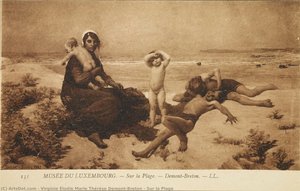
  • Top 3 works: Sur la Plage
  • Died: 1935
  • Art period: 19th Century
  • Also known as:
    • virginie demont-breton
    • virginie elodie marie therese demont-breton
  • Works on APS: 1
  • More…
  • Lifespan: 76 years
  • Born: 1859, Coutras, France
  • Nationality: France
  • Copyright status: Public domain
  • Top-ranked work: Sur la Plage

A Legacy Forged in Light and Lineage

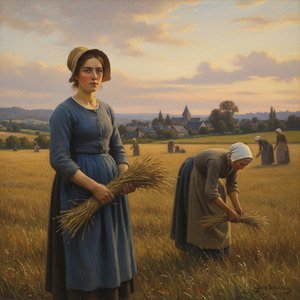
Born into a world where the brushstroke was a language, Virginie Élodie Marie Thérèse Demont-Breton emerged from the artistic cradle of Courrières, France. As the daughter of the renowned naturalist painter Jules Breton, her very existence was intertwined with the rhythms of the canvas and the traditions of French realism. Her early years were not merely an education but a profound immersion; by the tender age of fourteen, she had already begun to master the nuances of light and form. This connection to art was further enriched by the mentorship of the formidable Rosa Bonheur, whose strength and sensitivity provided a blueprint for Virginie’s own creative journey. Under such tutelage, her talent blossomed, moving beyond mere imitation toward a soulful interpretation of the natural world.

The Coastal Visionary of Wissant

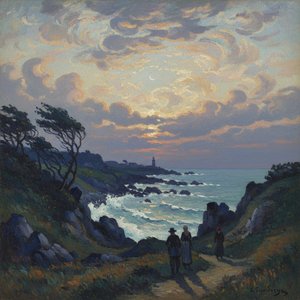
In 1880, marriage to the painter Adrien Demont did not signal an end to her individual pursuit but rather the beginning of a shared artistic odyssey. Together, they found their spiritual and creative home in the windswept beauty of Wissant, on the Côte d'Opale. This coastal landscape became the heartbeat of her work. The shifting tides, the salt-sprayed cliffs, and the ethereal light of the Opal Coast served as her primary musings. Alongside her husband, she helped lead a vibrant group of artists known as the Wissant circle, turning their villa into a sanctuary for intellectual and artistic exchange. Her paintings, such as the evocative Sur la Plahge, capture more than just scenery; they evoke the very atmosphere of the sea, blending Impressionist light with a deep, rhythmic resonance that speaks to the enduring power of the coast.

A Champion for the Female Perspective

Beyond the tranquil shores and sun-drenched portraits, Demont-Breton’s significance lies in her courageous role as a pioneer for women in the arts. Her leadership as President of the Union of Women Painters and Sculptors from 1895 to 1901 was a landmark moment in the struggle for inclusivity within the Parisian art scene. She did not merely paint; she paved the way, ensuring that the voices of her female contemporaries could be heard amidst the male-dominated salons. Her accolades—including a prestigious gold medal at the Amsterdam Exposition of 1884 and numerous honorable mentions at the Salon des artistes français—served as testament to her technical mastery and her indomitable spirit. Today, her work remains a luminous bridge between the traditions of her father’s realism and the evocative freedom of Impressionism, leaving behind a legacy of both beauty and bravery.

Art Quiz

There is only one correct answer for each question.

Question 1:
What was Virginie Demont-Bretton's father known for?
Question 2:
Who served as a mentor to Virginie Demont-Bretton?
Question 3:
In what year did Virginie Demont-Bretton marry Adrien Demont?
Question 4:
Where did Virginie and Adrien Demont build their villa?
Question 5:
What architectural style is Virginie Demont-Bretton's villa designed in?