The Architecture of Memory: The Artistic Journey of Yane Calovski
In the contemporary art landscape, few voices navigate the delicate intersection of spatial politics and historical reconstruction as poignantly as Yane Calovski. A Macedonian artist, researcher, and cultural activist, Calovski has cultivated a practice that transcends mere visual representation, opting instead to build immersive environments where history is not a static record but a living, breathing entity. Based between the historic streets of Skopje and the vibrant, multidisciplinary hubs of Berlin, his work serves as a profound meditation on how we inhabit space and how those spaces, in turn, shape our collective consciousness.
Calovski’s artistic sensibility was forged amidst the seismic shifts of late 20th-century geopolitics. Born in Skopje in 1973, his formative years were defined by the profound transition from the socialist framework of Yugoslavia to the emergence of an independent Macedonian statehood. This era of flux—marked by the dismantling of old certainties and the construction of new national identities—instilled in him a lifelong fascination with the mechanics of historical dissemination. He learned early on that history is often a matter of perspective, a realization that would later become the cornerstone of his site-specific installations.
A Global Education and the Evolution of Form
The development of Calovski’s technical mastery is a testament to a truly international education, blending Eastern European roots with Western academic rigor. His journey took him to the United States, where he studied at the Pennsylvania Academy of the Fine Arts (PAFA) in 1996 and Bennington College in 1997. It was during this period that he refined his foundational skills in drawing and sculpture, developing a precise visual language capable of articulating complex structural ideas. However, it was his postgraduate pursuits in Japan and the Netherlands that truly expanded his conceptual horizons.
Studying at CCA Kitakyushu (1999–2000) and later at the prestigious Jan van Eyck Academie in Maastricht (2002–2004) allowed Calovski to integrate diverse cultural perspectives into his work. These experiences moved him away from traditional sculptural boundaries and toward a more fluid, multidisciplinary approach. He began to view the organization of space not just as an aesthetic choice, but as a narrative tool. By manipulating the interplay between images, objects, and the viewer’s movement through a room, he developed a method for challenging conventional perceptions of reality and truth.
Spatial Narratives and the Immersive Experience
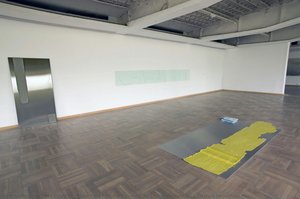
Calovski’s mature work is characterized by a deliberate rejection of grand, sweeping narratives in favor of meticulous, localized detail. He approaches each new location with a sense of site-specificity, treating the environment as a collaborator rather than a mere backdrop. His practice often manifests through:
- Installation Art: Utilizing the organization of space to create tension between the physical object and its historical context.
- Performance: Incorporating the human element to enact narratives that engage audiences directly within their surroundings.
- Research-Driven Practice: Using archival investigation to uncover and recontextualize forgotten or suppressed histories.
Through these mediums, Calovski creates what can be described as experiential archives. His work does not simply ask the viewer to look; it invites them to inhabit a moment of critical reflection. By focusing on the adaptable form and the subtle nuances of site-specific details, he prompts a deeper contemplation of how social and cultural identities are constructed and maintained. In an age of rapid globalization, Calovski’s ability to anchor complex social themes within the tangible reality of physical space ensures his enduring significance in the contemporary art dialogue.