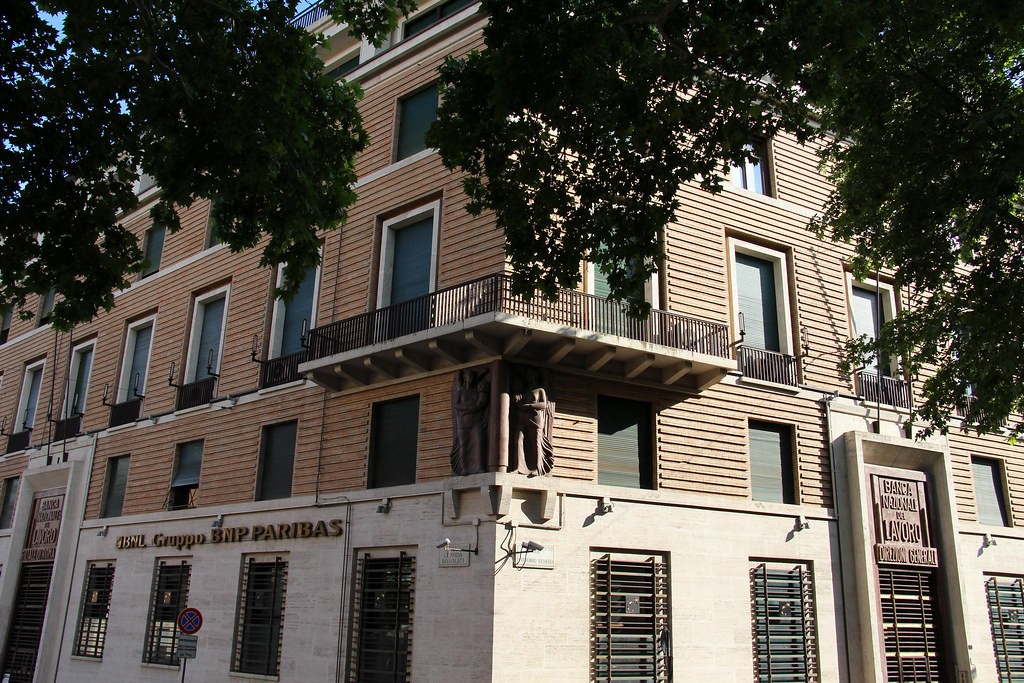


A Glimpse into Rationalist Rome: Exploring the Banca Nazionale del Lavoro
Nestled within the heart of Rome, a city steeped in millennia of history and artistic grandeur, lies the Banca Nazionale del Lavoro (BNL). More than just a former banking institution, this imposing building stands as a remarkable testament to the 1930s – a period defined by bold architectural vision and a fervent embrace of functionality. Designed by the influential Marcello Piacentini, a key figure in the Italian Rationalist movement, the BNL headquarters is an unexpectedly rich repository of art, offering visitors a captivating journey through Italian design, banking history, and the spirit of a nation undergoing significant transformation.
- Architectural Significance: The building’s façade immediately commands attention. Its stark lines, geometric forms, and use of concrete – a material championed by Rationalist architects – create an undeniably monumental presence. Piacentini meticulously planned every detail, from the grand entrance to the carefully considered internal spaces, reflecting the era's belief in efficiency and order. The building’s design is not merely functional; it’s a deliberate statement about Italy’s aspirations for modernity and progress.
- A Hidden Treasure: What truly sets the BNL apart is its remarkably diverse art collection. Beyond its impressive exterior, the interior houses a selection of works spanning several centuries, showcasing a range of artistic styles and reflecting Rome's role as a cultural crossroads.
Artistic Echoes: A Collection of Italian Masters
The BNL’s collection is a delightful surprise for visitors, revealing a carefully curated assemblage that speaks to the city’s rich artistic heritage. Prominently featured are works by Canaletto, whose captivating cityscapes offer intimate glimpses into 18th-century Rome – capturing the bustling streets and iconic landmarks with remarkable detail. Equally compelling is Jean-Baptiste Camille Corot's serene landscapes, particularly “View of St. Peter’s and the Castel Sant’Angelo,” which masterfully evokes the play of light and atmosphere characteristic of the artist’s style. The building also hosts ‘50 Painters for Rome’, a unique exhibition that brings together diverse artistic styles connected to the city of Rome.
- Canaletto's Rome: His detailed depictions provide invaluable insights into the urban landscape of the period, offering a visual record of Rome’s evolution.
- Corot’s Light and Atmosphere: Corot’s works demonstrate his ability to capture the subtle nuances of light and shadow, creating paintings that are both visually stunning and emotionally resonant.
A Banking Legacy & Historical Context
Established in 1893 through a series of mergers, the Banca Nazionale del Lavoro played a pivotal role in Italy’s economic development for over a century. Initially conceived as a cooperative institution supporting workers' organizations, it evolved into a major player in the Italian financial system. The building itself offers a tangible link to this history, reflecting the changing priorities and architectural trends of its time. The BNL’s story is intertwined with significant events in Italy’s 20th-century history – from the rise of Fascism to post-war reconstruction and beyond. Notably, during the period of Benito Mussolini's rule, the bank was involved in financing projects aligned with the regime’s agenda, including the construction of monumental buildings like the Palazzo della Civiltà Italiana.
Beyond the Facade: A Unique Cultural Experience
Visiting the Banca Nazionale del Lavoro is more than just a sightseeing trip; it's an immersive experience that combines architectural appreciation with artistic discovery. The building’s design, its surprising art collection, and its historical significance create a compelling narrative about Italy’s past and present. The BNL stands as a powerful reminder of Rome’s enduring legacy – a city where history, art, and finance converge in a truly remarkable setting. It's a place to contemplate the evolution of Italian design, the complexities of banking history, and the vibrant cultural tapestry that defines this captivating metropolis.
A Note on Pietro Gagliardi
It’s worth noting the significant contribution of Pietro Gagliardi (1809-1890), an Italian painter & architect known for frescoes & decorations in Rome's churches and palaces. His work, often characterized by Neoclassical & Romantic influences, complex themes, and a masterful use of color, provides a fascinating parallel to the artistic sensibilities reflected within the BNL’s collection.