 Ver en contexto
 Enviar
 Compartir
 Detalles

 Descargar
 Similares
 Radiografía
 Presentación de diapositivas
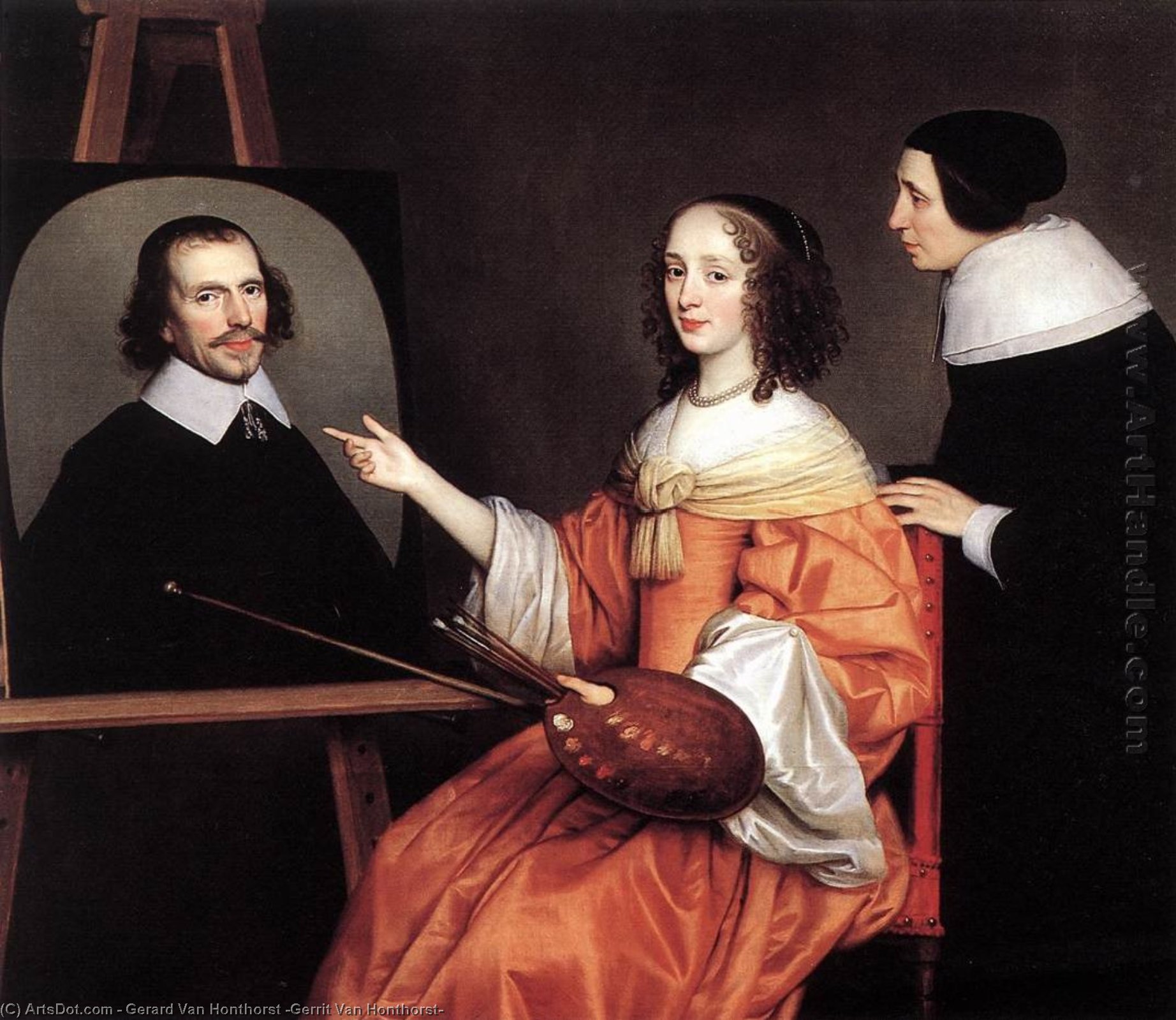
Margareta Maria de Roodere and Her Parents
 Acrylic On Canvas
- WallArt
- Baroque Light Shadow
 1652
1652 140.0 x 170.0 cm
 Centraal Museum
 Ver más
Giclée / Impresión de arte
Impresiones giclée o en lienzo de calidad de museo con producción rápida y opciones de acabado flexibles. ( Comprar pintura hecha a mano Comprar imagen)




P118B $10

P118H $10

P118W $10

P438Z $10

P508JH $12

P508YH $12

P805H $10

P805Z $10

P919BZ $10

P919G $10

P919XJ $10

P959ZH $10

P968JZ $12

W106C $8

W218G $10

W218JH $8

W218Y $10

W307PJ $10

W316G $10

W316PJ $8

W316Y $10

W398PJ $8

W4111J $10

W500HY $15

W500JH $15

W692G $12

W849H $8

W940BG $15

W953PJ $8




Elija entre nuestros tamaños predefinidos que respetan las proporciones originales de la obra.

Puede introducir sus propias dimensiones para adaptarse a un marco o espacio específico. Si el tamaño seleccionado no coincide con las proporciones de la imagen original, recortaremos la obra de arte o extenderemos la imagen con un borde con efecto espejo o de color sólido. Se enviará una maqueta digital para su aprobación antes de que comience la producción.
Tenga en cuenta que la vista previa en pantalla no refleja el recorte o la extensión real. Solo la maqueta mostrará con precisión la composición final.
Aunque existen tamaños personalizados, recomendamos seleccionar una dimensión de la lista predefinida para preservar las proporciones originales.
Envío a todo el mundo () en 2 semanas en lugar de las 4/5 semanas estándar. (24 agosto)

Envío exprés gratuito a todo el mundo

Lienzo de lino de alta calidad

Seguro de envío total

Garantía de reembolso de impuestos aduaneros

Garantía de fidelidad cromática exacta

Política de devolución de 60 días (solo por defectos)

Garantía de devolución del 100% del dinero

Descuento por cantidad
 La opción de vidrio solo está disponible en tamaños inferiores a 110 cm.

Margareta Maria de Roodere and Her Parents
Giclée / Impresión de arte
Dimensiones de la reproducción
-


Precio total final
$ 62
Descripción de la pieza
A Masterpiece Illuminated: Gerard van Honthorst’s “Margareta Maria de Roodere and Her Parents”
Gerard van Honthorst stands as one of the most captivating figures of Utrecht’s artistic landscape, born in 1592 amidst a burgeoning Renaissance spirit. His early training under his father instilled him with foundational skills in decorative painting—a discipline that would serve as invaluable preparation for his subsequent explorations into dramatic composition and masterful draughtsmanship. Yet, it was Rome – the epicenter of Baroque innovation – where Honthorst truly cemented his legacy, transforming from a promising apprentice into an artist irrevocably shaped by Caravaggio’s revolutionary approach to illumination. This transformative encounter ignited within him a passion for tenebrism, a technique that would become synonymous with his distinctive artistic voice and earn him the memorable moniker “Gherardo delle Notti,” or Gerard of the Nights. The painting itself, “Margareta Maria de Roodere and Her Parents,” exemplifies this Baroque fascination with chiaroscuro—the interplay between light and darkness—with breathtaking precision. Executed in 1652, it depicts a portrait of Margareta Maria de Roodere and her family, capturing them within a meticulously crafted interior scene bathed in dramatic pools of luminescence. Honthorst’s masterful manipulation of light casts shadows that sculpt the figures, conveying not merely physical form but also psychological depth—a hallmark of Baroque artistry aimed at stirring emotion and provoking contemplation. The composition is deliberately asymmetrical, guiding the viewer's gaze across the canvas with an intuitive grace characteristic of Honthorst’s oeuvre. A chair positioned prominently on the right side contributes to the overall visual dynamism, anchoring the scene while simultaneously emphasizing the spatial depth achieved through masterful perspective. The woman’s attire—described as orange or red depending on lighting—suggests wealth and status, aligning with the societal conventions of the period. Her gesture towards her husband underscores familial bonds and reinforces the narrative intent of portraying a harmonious domestic tableau. The man’s facial features are rendered with remarkable detail, capturing subtle expressions that convey both dignity and warmth. Beyond its technical brilliance, “Margareta Maria de Roodere and Her Parents” resonates with profound symbolic significance. Light represents divine grace and enlightenment—concepts central to Baroque theology—while darkness symbolizes mortality and obscurity. Honthorst’s deliberate use of tenebrism underscores these themes, inviting viewers to consider the complexities of human existence within a framework of spiritual aspiration. The painting transcends mere representation; it aspires to evoke an emotional response—a feeling of serenity mingled with awareness—reflecting the Baroque ideal of “kunst für Gemüt,” or art for the soul. This remarkable artwork continues to inspire artists and collectors alike, offering a glimpse into the artistic fervor of Utrecht during its Golden Age. Its enduring appeal lies not only in Honthorst’s unparalleled skill but also in the painting's ability to communicate timeless truths about family, faith, and the human condition—qualities that resonate powerfully with audiences today. A high-quality reproduction allows one to appreciate the nuances of Honthorst’s technique and immerse oneself in the evocative atmosphere of Baroque Rome.Obras relacionadas
Biografía del artista
Primeros años y formación
Gerrit van Honthorst, un destacado pintor del Siglo de Oro neerlandés, nació el 4 de noviembre de 1590 en Utrecht, Países Bajos. Era hijo de un pintor decorativo y inicialmente se formó bajo la tutela de su padre. Posteriormente, continuó su educación artística con Abraham Bloemaert.Carrera e influencias
La carrera temprana de Van Honthorst incluyó una visita a Roma, donde fue fuertemente influenciado por el estilo de Caravaggio. Esta influencia es evidente en sus obras posteriores, particularmente en su uso de escenas iluminadas artificialmente, lo que le valió el apodo de "Gherardo delle Notti" o "Gerard de las noches". Tras su regreso a los Países Bajos, Van Honthorst se convirtió en un retratista líder.Patronazgo y encargos notables
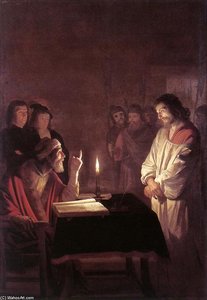
El trabajo de Van Honthorst tuvo una gran demanda, con notables patronos que incluyen a Vincenzo Giustiniani, quien lo encargó para pintar "Cristo ante el sumo sacerdote", ahora alojado en la National Gallery de Londres. También trabajó para Cosimo II de' Medici, Gran Duque de Toscana, y fue un favorito entre la República Neerlandesa y en el extranjero.Legado y vida posterior
En 1620, Van Honthorst regresó a Utrecht, donde construyó una considerable reputación. Para 1623, el año de su matrimonio, se había convertido en presidente del gremio de San Lucas en Utrecht. Su éxito llevó a recomendaciones por parte de Sir Dudley Carleton para el Conde de Arundel y Lord Dorchester.Obras clave y colaboraciones
- "La toma de Cristo", una obra colaborativa inicialmente atribuida a Van Honthorst, ahora reconocida como obra de otro artista.
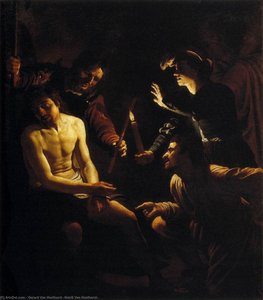
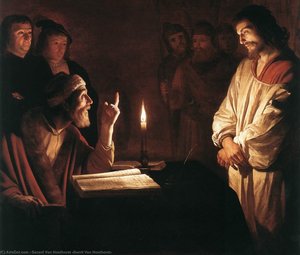
- "Cristo ante el sumo sacerdote", encargado por Vincenzo Giustiniani, muestra la habilidad de Van Honthorst para capturar escenas iluminadas artificialmente.
- Colaboraciones con otros artistas, como Peter Paul Rubens, demuestran su influencia en el estilo barroco flamenco.
Movimiento artístico y estilo
Van Honthorst formó parte del movimiento de los utrecht caravaggisti, caracterizado por su uso de una iluminación dramática y una profundidad emocional intensa. Su obra refleja la influencia del barroco italiano, al mismo tiempo que contribuye al desarrollo del Siglo de Oro neerlandés.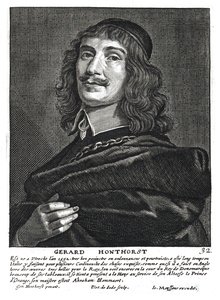
Gerard van Honthorst
1590 - 1656 , Países Bajos
Datos clave
- Artistas Influenciados:
- Rembrandt van Rijn
- Georges de la Tour
- Artistas Que Influyeron:
- Caravaggio
- Abraham Bloemaert
- Fecha De Nacimiento: 4 de noviembre de 1590
- Lugar De Nacimiento: Utrecht, Países Bajos
- Movimiento Artístico: Caravaggismo Utrechtano
- Nacionalidad: Neerlandés
- Nombre Completo: Gerard van Honthorst
- Obras Notables:
- Cristo ante el sumo sacerdote
- La toma de Cristo
- Escenas nocturnas iluminadas
Artículos relacionados
Gerard van Honthorst: Illuminating the Dutch Golden Age with Caravaggism & Courtly Grace
Explore the captivating world of Gerard van Honthorst, a Dutch Golden Age master renowned for his dramatic chiaroscuro & courtly portraits. Discover his life, art, and lasting influence on Baroque painting.

Los 10 Maestros del Barroco Holandés: Obras que Definen una Época | ArtsDot
Descubre los 10 imprescindibles del Barroco holandés: Rembrandt, Vermeer y más. Explora la historia, técnica y belleza de estas obras maestras. Reproducciones de arte en ArtsDot.com para decorar tu hogar con elegancia.

Reflejos de una Época Dorada: La Pintura Barroca Holandesa y la Innovación Cultural
Descubra la riqueza y el detalle de la pintura barroca holandesa del Siglo de Oro. Explore las obras maestras de Rembrandt, Vermeer y otros artistas clave. Análisis experto e historia cultural.

Rembrandt van Rijn: Las 25 Obras Maestras que Definen un Genio | Arte, Historia y Decoración
Descubre las 25 obras maestras de Rembrandt van Rijn, el genio del barroco holandés. Explora su historia, técnica y simbolismo en retratos icónicos como 'La Ronda Nocturna'. Encuentra reproducciones de arte exclusivas para decorar tu hogar con ArtsDot.com.

Los 10 Maestros del Siglo de Oro Holandés: Arte, Historia y Decoración Exclusiva
Descubre los 10 imprescindibles del Siglo de Oro Holandés: Rembrandt, Vermeer y más. Explora la historia, técnica y belleza de estos lienzos clásicos. Encuentra reproducciones de arte exclusivas para decorar tu hogar en .