The Post-War Crucible: The Birth of Abstract Expressionism
Abstract expressionism in the United States emerged as a distinct art movement in the aftermath of World War II and gained mainstream acceptance in the 1950s, a shift from the American social realism of the 1930s influenced by the Great Depression an...
To understand the seismic rupture that was Abstract Expressionism, one must first confront the heavy, fractured atmosphere of the mid-twinteth century. The aftermath of World War II left a profound scar on the collective human psyche, creating a world grappling with unprecedented trauma, existential uncertainty, and the shattering of established social norms. In this climate of disillusionment, the art world experienced a monumental shift in gravity. The center of the Western art universe began to migrate from the historic streets of Paris to the burgeoning energy of New York City. This was not merely a change in geography, but a fundamental transformation in how humanity sought to articulate the unspeakable.
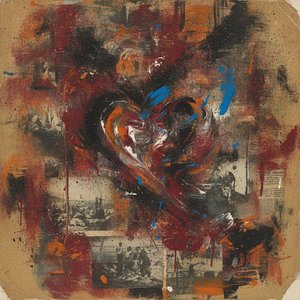
Emerging in the 1940s and gaining mainstream dominance in the 1950s, Abstract Expressionism rejected the representational, religious, and classical motifs that had long defined Western aesthetics. It was a movement born from the wreckage of global conflict, moving away from the American social realism of the 1930s—which had been so deeply influenced by the Great Depression and the powerful Mexican muralists—toward a defiant embrace of subjectivity. As the term was first applied to American art in 1946 by critic Robert Coates, it signaled a new era where the canvas became a site for exploring the inner landscape of the human spirit, unburdened by the need to mirror the external world.
This movement was deeply intertwined with the rise of psychoanalysis, particularly the influential work of Carl Jung. Artists sought to tap into the collective unconscious, utilizing spontaneous and automatic methods inspired by Surrealist pioneers like André Masson and Max Ernst. By blending the emotional intensity of German Expressionism with the radical visual vocabularies of Futurism and Cubism, these artists created a new language of freedom. For those who seek to bring this era of profound intellectual struggle into their own spaces, our museum-grade oil reproductions offer a tactile connection to this history, capturing the very essence of post-war modernism.
Action Painting: The Canvas as an Arena of Physical Event
 Red Sunday Morning
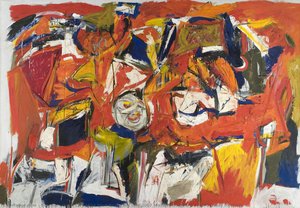
A Symphony of Visceral Emotion In the vast, evocative landscape of Abstract Expressionism, few works capture the raw, pulsating energy of the human psyche quite like Red Sunday Morning . This monumental canvas, measuring an imposing 202 x 289 cm, ser...
Within the broader Abstract Expressionist movement, a particularly visceral subset emerged, famously termed Action Painting by critic Harold Rosenberg. For these artists, the canvas was no longer a surface for reproducing an image, but rather an "arena in which to act." The act of painting became a physical event, a rhythmic and often chaotic manifestation of the artist's movement across the workspace. This technique demanded a bodily engagement that transformed the studio into a stage for existential performance.
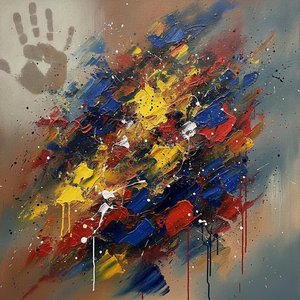
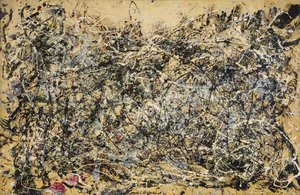
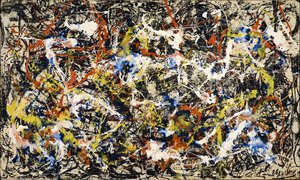
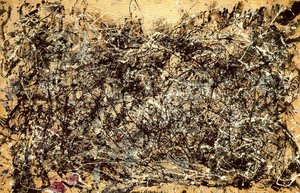
Consider the legendary approach of Jackson Pollock, whose drip technique redefined the boundaries of medium and motion. Through energetic gestures, splatters, and pours, the artist’s physical presence is etched into the very texture of the work. This legacy of movement is also visible in the works of Michael Goldberg, a pivotal figure of the Second Generation New York School. In masterpieces such as Red Sunday Morning, one can witness a symphony of visceral emotion. The painting serves as a profound window into the turbulent beauty of the subconscious, where vibrant reds and sun-drenched yellows dance across a monumental surface in a rhythmic, almost chaotic arrangement.
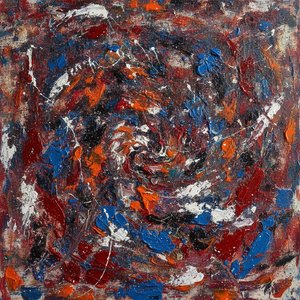
The technique of action painting relies heavily on impasto texture and layered complexity. Each brushstroke or drip carries the weight of the artist's physical labor, creating a rich, tactile surface that catches light and shadow in a three-dimensional dance. This is why a hand-painted oil reproduction from our collection holds such distinction; unlike a flat digital print, our artists utilize heavy textures and visible brushwork to replicate the true energy of the "action" itself. To witness these works is to experience the raw, pulsating energy of the human psyche, captured in a moment of pure, unadulterated creation.
Color Field Painting: Exploring Chromatic Depth and Pure Abstraction
 Color Field Painting: The Emotional Power of Pure Abstraction and Chromatic Depth
The Post-War Crucible: The Emergence of Color Field from Abstract Expressionism Beyond the Brushstroke: A Definitive Guide to the Emotional Power of Color Field Painting The Genesis of Abstraction: From Post-War Trauma to the Rise of Color Field Beyo...
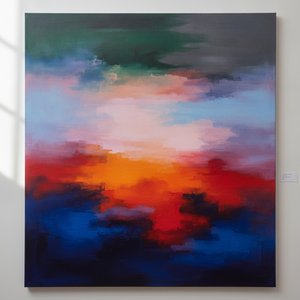
As the movement matured, a distinct and more meditative current began to emerge from the shadows of gestural chaos. While Action Painting focused on the drama of the brushstroke, Color Field painting sought a different kind of truth—one found in the emotional power of pure abstraction and chromatic depth. This branch of the movement moved away from the theatricality of the gesture, seeking instead to move the viewer through the sheer, unmediated presence of color.
Color Field artists utilized large expanses of color to create immersive environments that invited contemplation rather than confrontation. The goal was to achieve a sense of the infinite, using color as a vehicle for spiritual or emotional resonance. This approach stripped art down to its most fundamental elements: hue, saturation, and scale. By removing recognizable figures and narrative constraints, these artists allowed the viewer to lose themselves in a sea of pigment, where the boundaries between the self and the artwork began to dissolve.
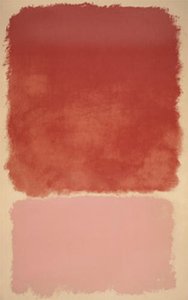
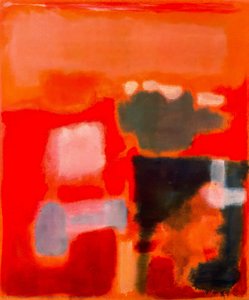
The works of artists like Mark Rothko or the later explorations of Raymond Parker demonstrate this mastery of atmosphere. In these canvases, color is not merely a decorative element but a structural force that defines the emotional landscape. The tension between warm oranges and cooling blues can mirror the duality of human experience—the struggle between passion and introspection. For collectors looking to create a sense of calm or profound depth in an architectural space, Color Field works provide an unparalleled aesthetic, especially when rendered on large-scale canvases that command the room with their quiet, monumental authority.
The New York School: Titans of Gesture and Subconscious Creation
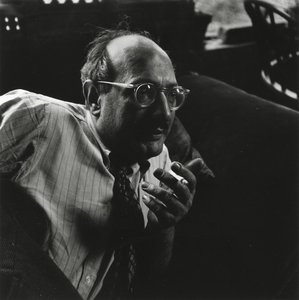
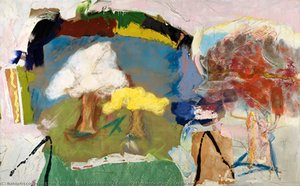 born new york city 1924 died new york city 2007 michael goldberg
Michael Goldberg: A Pioneer of Gesture and Color Born in the Bronx in 1924, Michael Goldberg emerged from the vibrant, post-war crucible of New York City as a singular and powerful voice within the Abstract Expressionist movement. His artistic journe...
The heart of this revolution beat within the legendary studios and bars of Manhattan. The "New York School" was not a formal organization but a community of artists—including Arshile Gorky, Franz Kline, Willem de Kooning, and Lee Krasner—who engaged in spirited intellectual skirmishes that redefined modernism. These artists were often connected through shared spaces like the Eighth Street Club or the Cedar Bar, where the boundaries between social life and artistic theory were perpetually blurred.
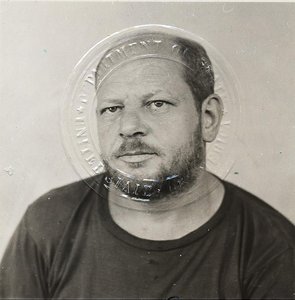
This community was characterized by a profound dedication to exploring the limits of the medium. Figures like Milton Resnick contributed to this evolution with works that featured bold colors and intricate patterns, pushing the boundaries of what abstraction could achieve. Even the younger generation, such as Michael Goldberg, who studied under the legendary Hans Hofmann, carried forward the teachings of spontaneity and the expressive potential of color. The influence of Hofmann’s theories on "push and pull" helped solidify a visual language that emphasized the dynamic relationship between shapes and colors within a composition.
Legacy and Evolution: From the Trauma of War to Modernist Freedom
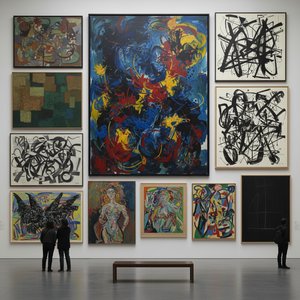
Most Abstract Expressionist paintings are large-scale, include non-objective imagery, lack a clear focal point, and show visible signs of the artist's working ...
The trajectory of Abstract Expressionism represents one of the most significant shifts in art history, moving the focus of the creative world from Europe to America. It was a movement that successfully navigated the transition from the heavy, fractured atmosphere of post-war trauma to a state of liberated, modernist expression. By rejecting representational motifs, these artists paved the way for subsequent generations to explore personal identity, political commentary, and pure formal experimentation.
Today, the influence of this era can be seen in everything from contemporary large-scale installations to the very way we perceive color and texture in modern design. The movement proved that art could exist independently of visual references, focusing instead on the emotional and expressive qualities of the medium itself. It taught us that the canvas could be a mirror for the soul, a place where the most complex human emotions—fear, joy, grief, and transcendence—could be rendered visible.
Whether you are an art student studying the mechanics of the drip technique or a collector seeking to adorn a home with the profound depth of a Color Field masterpiece, the era of Abstract Expressionism offers endless inspiration. At ArtsDot.com, we invite you to explore this extraordinary period of history through our curated collection of hand-painted reproductions. From the visceral textures of Action Painting to the serene expanses of Color Field, our works are crafted to bring the soul of the museum into your private collection, ensuring that the flame of modernism continues to burn brightly in the homes of the future.