Introduction
To step into the world of Ukiyo-e is to wander through the "Floating World" itself—a realm where the ephemeral beauty of a passing moment is captured with eternal precision. There is a profound, quiet magic in these woodblock prints; they do not merely depict scenes, but rather invite us to breathe in the mist of a Mount Fuji morning or feel the rhythmic pulse of an Edo-period teahouse. As we begin our journey through these ten definitive masterpieces, imagine yourself walking through a curated gallery where the scent of aged paper and fresh ink lingers in the air, guiding you toward works that once pulsed with the vibrant energy of urban Japan.
Emerging during the Edo period, Ukiyo-e served as the heartbeat of a rising merchant class, capturing the transient pleasures of life: the grace of a kabuki actor, the delicate silhouette of a courtesan, and the dramatic landscapes that define the Japanese archipelago. These were not merely artworks, but cultural windows—mass-produced yet deeply soulful—that bridged the gap between high art and the everyday joys of the common people. Through the meticulous layering of color and the sharp, elegant lines of the master carvers, a unique visual language was born, one that would eventually travel across oceans to ignite the fires of Impressionism in Europe.
Today, these masterpieces remain profoundly meaningful, offering us a meditative escape into a world where nature and humanity exist in a delicate, stylized harmony. They remind us that beauty is often found in the fleeting—the curve of a wave, the slant of rain, or the soft light of dusk. As we unveil this selection of ten iconic works, prepare to encounter the technical brilliance and emotional depth that transformed simple woodblock printing into a global legacy of unparalleled aesthetic influence.
Phoenix - Katsushika Hokusai
 Phoenix - Katsushika Hokusai
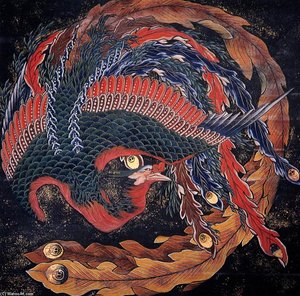
In the pantheon of Ukiyo-e , Katsushika Hokusai’s 'Phoenix' stands as a breathtaking testament to the power of spiritual renewal. More than a mere depiction of myth, this masterpiece captures the very essence of the Edo period’s fascination with the cyclical nature of existence. As you gaze upon the bird’s magnificent wings—a radiant arc of fiery reds, golds, and creams—you are witnessing a profound meditation on resilience that transcends centuries.
Hokusai secures its place among the top masterpieces of the movement through his unparalleled ability to blend meticulous detail with cosmic symbolism. The circular arrangement of foliage and smaller birds creates a sense of eternal motion, inviting us to reflect on our own capacity for transformation and grace. This work does not simply decorate a space; it breathes life into it. For the discerning collector or interior designer, integrating such an iconic symbol of hope into a modern sanctuary creates a timeless dialogue between ancient Japanese heritage and contemporary elegance, turning any curated environment into a soulful retreat.
Kinoe no komatsu - Katsushika Hokusai
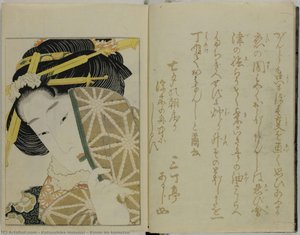 Kinoe no komatsu - Katsushika Hokusai
To observe Kinoe no Komatsu by Katsushika Hokusai is to witness the profound intimacy of the mokuhanga technique. In this 1814 masterpiece, one can almost sense the delicate pressure of the woodblock against the paper, where every fine line and saturated pigment carries the weight of Edo-period passion. The work transcends mere illustration; through its intricate layers of symbolism—from the evocative ōkubi-e portraits to the surreal, fluid textures of his more daring compositions—Hokusai captures a visceral, human vulnerability that defines the very soul of the Ukiyo-e movement.
This trilogy is a testament to the artist's ability to weave folklore and desire into a singular visual narrative. At ArtsDot.com, we believe such historical depth deserves more than a flat digital reproduction. We are dedicated to preserving the tactile, three-dimensional essence of these legendary prints. Through our bespoke hand-painted oil reproductions, we recreate the visible textures and tonal richness of Hokusai’s vision, allowing collectors to bring the profound, sensory legacy of Japanese masterworks into the modern home with unparalleled authenticity.
The Dish Mansion - Katsushika Hokusai
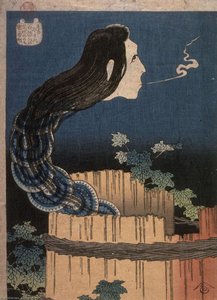 The Dish Mansion - Katsushika Hokusai
In The Dish Mansion by Katsushika Hokusai, one is immediately captivated by the haunting, upward gaze of a solitary figure perched upon jagged coastal rocks. There is a profound, melancholic stillness in her expression as she looks toward the heavens, a moment of quiet contemplation punctuated only by the subtle, ephemeral smoke of her cigarette. This masterpiece serves as a universal mirror of human experience, capturing that delicate intersection between solitude and spiritual longing.
Hokusai masterfully employs the luminous Prussian blue—a hallmark of the Japanese Ukiyo-e art movement —to create a sea of deep, symbolic tones that evoke both the vastness of the ocean and the mystery of the spirit world. The composition, enriched by the movement of a soaring bird and the rhythmic presence of distant boats, invites the viewer into a dreamlike realm of folklore and emotion. For the discerning collector, bringing this powerful emotional resonance into a home can transform a personal sanctuary into a space for profound reflection and calm, offering a window into the beautiful, floating world of the Edo period.
Battle Between Two Warriors - Katsushika Hokusai
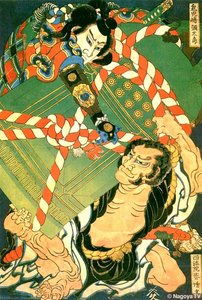 Battle Between Two Warriors - Katsushika Hokusai
In the rhythmic clash of steel and spirit, Battle Between Two Warriors by Katsushika Hokusai captures a moment where time itself seems to hold its breath. This masterpiece is immortalized among the greatest works of the Japanese Ukiyo-e movement not for the brutality of combat, but for its profound meditation on duality—the delicate tension between martial prowess and the serene stillness of nature. Hokusai masterfully orchestrates a vibrant palette of deep reds, verdant greens, and celestial blues, using flattened perspectives that predate Impressionism to heighten the scene's emotional resonance.
As you observe the warriors poised in their ancestral armor, notice how the surrounding elements—a solitary bird and drifting fish—whisper of an underlying cosmic balance. The composition breathes with a life that transcends the Edo period, offering a sophisticated interplay of movement and tranquility. For the modern collector, integrating such a storied piece into a contemporary interior provides more than mere decoration; it introduces a soulful narrative of strength and harmony, inviting a sense of historical depth and refined elegance into the home.
The Phantom of Kohada Koheiji - Katsushika Hokusai
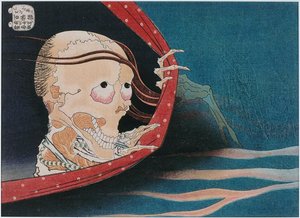 The Phantom of Kohada Koheiji - Katsushika Hokusai
Imagine standing in the dim, flickering light of an Edo-period theater, where the boundary between the living and the spectral begins to dissolve. In 1831, Katsushika Hokusai captured this exact moment of supernatural tension in The Phantom of Kohada Koheiji . This masterpiece does not merely depict a Kabuki performer; it invites us into a world of profound psychological unrest, where the skeletal visage of the protagonist serves as a haunting memento mori against a melancholic, deep blue backdrop.
As one of the definitive works of the Japanese Ukiyo-e movement , this print earns its place among the top ten through its masterful use of symbolism—from the protective yet vulnerable umbrella to the ominous presence of crows. Hokusai utilizes meticulous woodblock techniques to weave a narrative of betrayal and retribution that transcends time. To possess such a piece is to bring a sense of historical depth and dramatic intrigue into a modern interior, transforming a contemporary space into a sanctuary of storytelling and timeless, evocative mystery.
Cherry Blossoms - Katsushika Hokusai
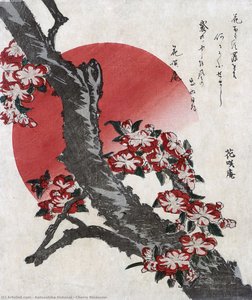 Cherry Blossoms - Katsushika Hokusai
In Cherry Blossoms by Katsushika Hokusai, the interplay of light is not merely a visual element but a profound emotional anchor. The composition is defined by a striking, luminous red circle—evoking a celestial sun or moon—that casts an ethereal glow across the delicate, vibrant pink petals. This masterful command of illumination creates a rhythmic tension between the bold, saturated background and the soft, ephemeral textures of the blossoms, capturing the very essence of the Ukiyo-e movement: the beauty of the floating world.
Hokusai’s ability to manipulate light to suggest both cosmic scale and intimate stillness is precisely what secured this work's place among the top masterpieces of Japanese art history. The way the light seems to radiate from within the paper, highlighting the meticulous woodblock precision, offers a sense of quiet prestige. When reproduced as a fine oil painting or high-quality print, this sophisticated use of contrast and warmth adds an unparalleled layer of depth and luxury to a contemporary interior, inviting a serene, meditative atmosphere into any curated space.
Raiko tormented by the earth spider - Utagawa Kuniyoshi
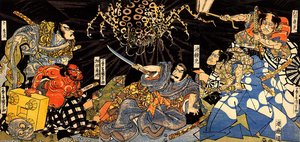 Raiko tormented by the earth spider - Utagawa Kuniyoshi
In the hauntingly beautiful Raiko tormented by the earth spider by Utagawa Kuniyoshi, a moment of supernatural terror is frozen in an eternal dance of shadow and steel. This masterpiece stands as a definitive pillar of the Japanese Ukiyo-e movement, immortalized for its unparalleled ability to blend visceral folklore with breathtaking technical innovation. Kuniyoshi masterfully orchestrates a symphony of dread; the deep, nocturnal tones of the composition are punctuated by the terrifying, textured presence of the monstrous spider, whose sprawling limbs seem to vibrate against the paper.
The visual narrative breathes life into the Edo period's fascination with yōkai , using bold, dynamic lines and a dramatic chiaroscuro effect that predates Western influences. To witness this triptych is to feel the tension of the samurai’s struggle—a sensory experience where the weight of the armor and the looming darkness of the siege are palpable. For the modern collector, such a piece offers more than mere decoration; it brings a profound sense of historical drama and sophisticated intensity, serving as a powerful focal point that commands respect and invites deep contemplation within any curated interior.
Station 36, Goyu; Kyoka Tokaido Series - Utagawa Hiroshige
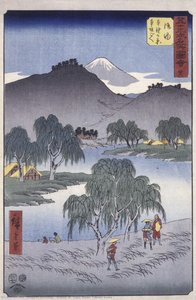 Station 36, Goyu; Kyoka Tokaido Series - Utagawa Hiroshige
Owning Station 36, Goyu from the Kyoka Tokaido Series by Utagawa Hiroshige isn’t merely a purchase; it is an inheritance of the Edo spirit. This masterpiece serves as a poetic echo of a vanished Japan, capturing a profound distillation of tranquility amidst the movement of the legendary Tokaido Road. As you gaze upon the winding path leading toward the snow-capped majesty of Mount Fuji, you experience Hiroshige’s unparalleled mastery of atmospheric perspective.
The palette is a symphony of cool blues, muted greens, and soft grays, evoking the quiet melancholy of an overcast afternoon. Through the delicate bokashi technique, the artist achieves a seamless gradation of light that breathes life into the misty landscape. The subtle warmth of yellow accents on distant buildings provides a gentle contrast to the ethereal, snow-dusted peaks. To bring this piece into your collection is to embrace a lineage of taste; with ArtsDot, this legacy of Japanese Ukiyo-e moves from the museum archives directly to your walls, where every brushstroke invites a moment of timeless contemplation.
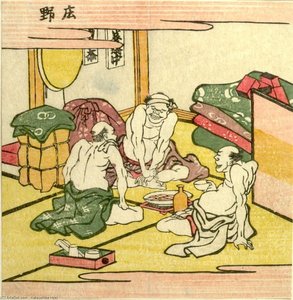
Sakai-chô - Katsushika Hokusai
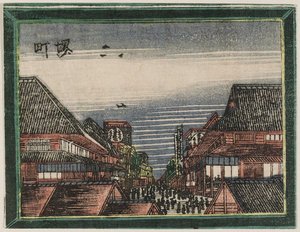 Sakai-chô - Katsushika Hokusai
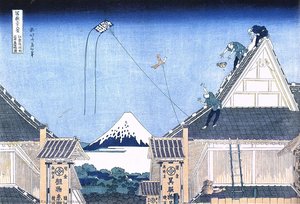
In Sakai-chô by Katsushika Hokusai, we encounter a masterclass in structural harmony that transcends the boundaries of the Edo period. The composition is anchored by a sophisticated use of perspective, where the receding lines of the bustling street and the rhythmic placement of figures create a geometric balance that feels both dynamic and profoundly stable. This meticulous arrangement of shapes—from the verticality of the distant clock tower to the organic movement of pedestrians—achieves a sense of timeless perfection, securing its place among the top 10 masterpieces of the Japanese Ukiyo-e movement .
There is a striking parallel between Hokusai’s disciplined spatial organization and the principles of modern minimalist design . The way he utilizes negative space and clean, decisive contours to ground the urban energy provides a blueprint for contemporary aesthetics, making this print feel remarkably fresh in a modern interior. As you observe the subtle interplay of light and the revolutionary Prussian blue tones, you are not merely looking at a historical document, but experiencing a curated moment of serenity amidst the movement of life.
Two Carp In A Cascade - Katsushika Hokusai
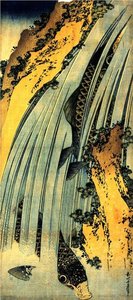 Two Carp In A Cascade - Katsushika Hokusai
In the rhythmic descent of Two Carp In A Cascade by Katsushika Hokusai, time seems to dissolve into a singular, breathless moment of fluid grace. This masterpiece stands as a cornerstone of the Japanese Ukiyo-e movement, immortalized for its profound ability to marry the turbulent energy of nature with an underlying sense of Zen tranquility. Hokusai utilizes the revolutionary Prussian blue to breathe life into the cascading waters, creating a sensory experience where the cool, misted atmosphere and the vibrant scales of the carp feel almost tactile.
The composition is a masterclass in symbolism; the resilient fish navigating the white-water torrent serve as an eternal metaphor for perseverance amidst life's inevitable shifts. Beyond its historical significance, this work offers a sophisticated sanctuary for the modern collector. Its delicate balance of movement and stillness brings a curated sense of calm and organic elegance to any contemporary interior, inviting the viewer to find their own center within the beautiful chaos of the natural world.
Conclusion
As the light fades on our journey through the floating world, we are left with more than just images of crashing waves or quiet landscapes; we carry with us the enduring pulse of a culture that found profound beauty in the ephemeral. These Ukiyo-e masterpieces are far more than historic treasures locked behind museum glass—they are living presences. Each delicate line and vibrant pigment carries a timeless conversation, a bridge spanning centuries to connect the soul of the Edo-period artisan with the modern admirer. When we gaze upon these works today, we find that the emotions they evoke—the awe of nature's power, the serenity of a passing moment, the quiet dignity of daily life—remain as vital and resonant as ever.
To bring these echoes of history into your own sanctuary is to invite a legacy of craftsmanship and wonder into your space. Whether through a meticulously hand-painted oil reproduction that captures the depth of every woodblock stroke or a fine print that illuminates a contemporary room, these works continue to shape interiors and inspire new waves of creativity. We invite you to explore our full collection and discover how the spirit of the floating world can become a permanent part of your personal narrative, reminding us all that true art never truly fades; it simply waits to be rediscovered.