 Preview
 Send
Send Share
Share
 Details

 Download
 Similars
 X-Ray
X-Ray Diaporama
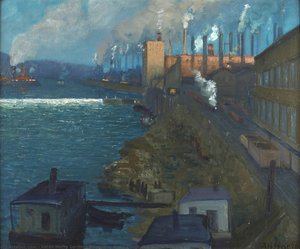
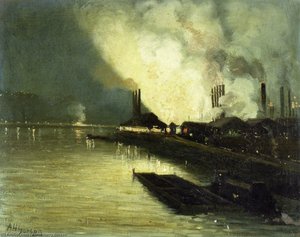
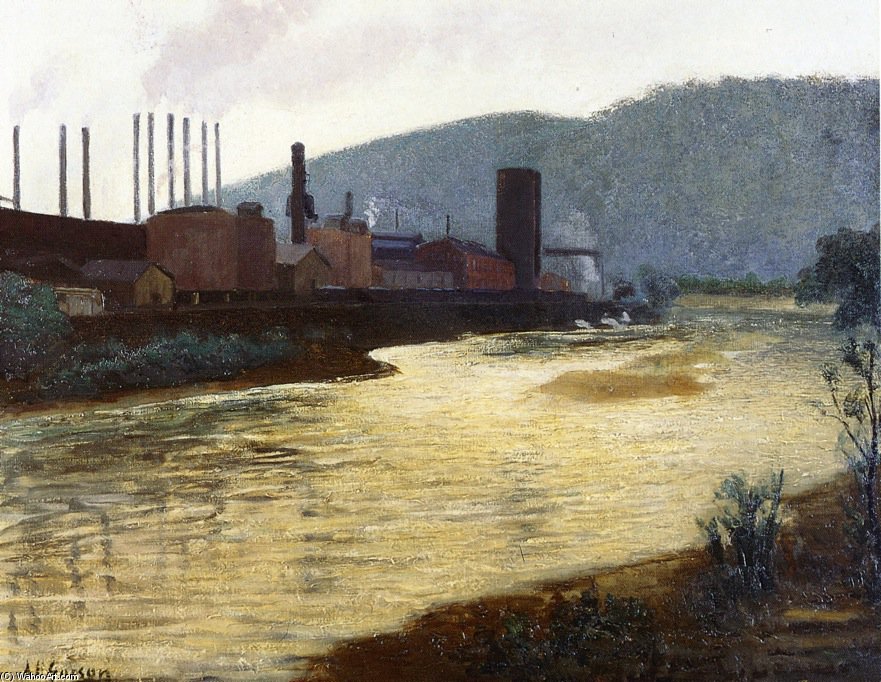
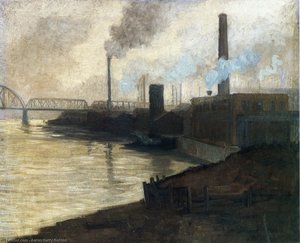
Monongahela River, Pittsburgh, Jones And Laughlin Steel Plant

 Read More
Hand Made Oil Reproduction
Hand-painted oil on canvas in your size and frame, made to order by our artists. ( Buy Print Buy Image)




































Pick from our preset sizes that match the artwork's original proportions.

You may enter your own dimensions to fit a specific frame or space. If your selected size does not match the original image's proportions, we will either crop the artwork or extend the painting with additional hand-painted elements. A digital mockup will be sent for your approval before production begins.
Please note that the on-screen preview does not reflect the actual cropping or extension. Only the mockup will accurately show the final composition.
While custom sizes are available, we recommend selecting a dimension from the predefined list to preserve the original proportions.
After order, ArtsDot.com team will email client for instructions and provide a mockup preview
Worldwide Delivery () in 3/4 weeks instead of standard 5 weeks. (20 August). No compromise on quality.

Free Worldwide Express Shipping

High-Quality Linen Canvas

Full Shipping Insurance

Customs Tax Refund Guarantee

True Color Matching Guarantee

60-Day Return Policy (Defects Only)

100% Money-Back Guarantee

Bulk Discount Offer
 Glass option is only available in size under 110 CM

Monongahela River, Pittsburgh, Jones And Laughlin Steel Plant
Reproduction Medium
Reproduction Size
-


Total Price
$ 263
Related Artworks
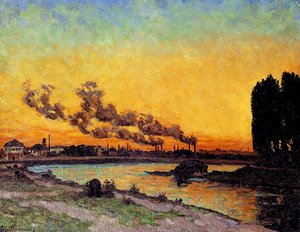
Artist Biography
Piet Mondrian: Architect of Abstraction
Piet Mondrian, a name synonymous with modern art’s radical shift towards abstraction, was far more than just a painter; he was a theorist and philosopher who sought to distill the essence of reality into its purest geometric form. Born Pieter Cornelis Mondriaan in Amersfoort, Netherlands, on March 7, 1872, his artistic journey began within a family steeped in both artistic tradition and conservative religious values – a duality that profoundly shaped his later work. His father, a schoolmaster, instilled a disciplined approach to learning, while his uncle, a landscape painter, provided early guidance in the fundamentals of art. However, it was Mondrian’s own relentless pursuit of universal harmony that ultimately defined his legacy. He wasn't simply creating images; he was constructing a visual language designed to transcend the limitations of representational art and connect with something deeper within the human spirit.Early Influences and Artistic Development
Mondrian’s early artistic explorations were rooted in traditional landscape painting, mirroring the Dutch Hague School movement. He diligently studied at the Amsterdam Academy, honing his skills in drawing and composition. Yet, a growing dissatisfaction with the naturalistic depiction of reality began to surface. This shift was significantly influenced by his encounter with Cubism in 1911, an artistic revolution that challenged conventional perspectives and fragmented forms. While he initially admired Cubism’s innovative approach, Mondrian recognized its inherent limitations – its reliance on recognizable subjects, however abstracted. He sought a more fundamental form of expression, one that would bypass the need for direct representation altogether. This led him to experiment with pointillism, a technique utilizing small dots of color, before ultimately arriving at his own distinctive style: Neo-Plasticism.Neo-Plasticism and the Pursuit of Universal Harmony
The core tenets of Neo-Plasticism emerged from Mondrian’s deeply held philosophical beliefs. He believed that art should be a vehicle for expressing universal harmony, a state of equilibrium between the “concrete” – the tangible world perceived through the senses – and the “universal” – an underlying spiritual truth. To achieve this, he drastically simplified his artistic vocabulary, reducing his palette to just three primary colors: red, blue, and yellow; eliminating black, white, and gray; and restricting himself to straight lines and right angles. This rigorous system wasn’t arbitrary; it was a carefully considered attempt to strip away the distractions of the material world and reveal the essential building blocks of existence. He famously declared in 1914: “Art is higher than reality and has no direct relation to reality. To approach the spiritual in art, one will make as little use as possible of reality, because reality is opposed to the spiritual.”Key Works and Historical Significance
Mondrian’s artistic output during this period is characterized by a remarkable consistency and geometric precision. Paintings like *Composition with Red, Blue and Yellow* (1930) exemplify his mature style – a dynamic interplay of horizontal and vertical lines against a vibrant background of primary colors. Later works, such as *Broadway Boogie Woogie* (1942-43), demonstrate an evolution towards a more rhythmic and syncopated approach, incorporating elements of jazz music into his visual language. These paintings weren’t merely decorative; they were carefully constructed diagrams designed to evoke a sense of order and balance. His influence extended far beyond the realm of painting, impacting architecture, design, and even fashion. The principles of De Stijl, the art movement he co-founded with Theo van Doesburg, sought to apply these geometric ideals to all aspects of life, creating a utopian vision of a harmonious world.Legacy and Enduring Influence
Piet Mondrian died in New York City on February 1, 1944, leaving behind a profound legacy as one of the pioneers of abstract art. His uncompromising commitment to simplicity and his belief in the power of geometric abstraction continue to resonate with artists and designers today. From the minimalist designs of Bauhaus to the vibrant color fields of Mark Rothko, Mondrian’s influence can be seen throughout 20th-century and contemporary art. He wasn't simply a painter; he was an architect of abstraction, laying the groundwork for a new way of seeing and understanding the world. His work remains a testament to the enduring power of artistic vision and the pursuit of universal harmony.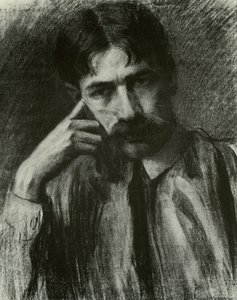
aaron harry gorson
1872 - 1933 , Lithuania
Quick Facts
- Artistic Movement Or Style:
- Neo-Plasticism
- De Stijl
- Abstract art
- Artists Or Movements Influenced By This Artist:
- Vasily Kandinsky
- Kazimir Malevich
- Artists Who Influenced This Artist:
- Simon Mans
- Abraham Kuyper
- Date Of Birth: March 7, 1872
- Date Of Death: February 1, 1944
- Full Name: Pieter Cornelis Mondriaan
- Nationality: Dutch
- Notable Artworks:
- Composition with Red Blue and Yellow
- Broadway Boogie Woogie
- Victory Boogie Woogie
- Place Of Birth: Amersfoort, Netherlands
Related Articles

Beyond the Horizon: 10 Landscape Masterpieces for Your Home Decor
Journey through 10 breathtaking landscape paintings by Monet, Van Gogh & more! Explore iconic artworks, artistic techniques & find inspiration for your home decor. Museum-quality reproductions at ArtsDot.com. Discover all masterpieces on ArtsDot.com

Romantic Landscapes: 10 Masterpieces for Your Home | ArtsDot
Journey through 10 Romantic landscape masterpieces by Friedrich, Turner & Cole. Explore emotional art, sublime nature scenes & iconic 19th-century paintings. Find museum-quality reproductions for your home at ArtsDot.com – discover the full collection online!

John Constable's Masterpieces: Explore 25 Iconic Landscapes for Your Home
Journey through John Constable's 25 most celebrated landscapes. Explore Romanticism, Dedham Vale & his masterful use of light in iconic paintings like 'Hay Wain'. Find museum-quality art reproductions and elevate your home decor on ArtsDot.com.

Evocations of Place: A Historical Journey Through Landscape Art
Explore the rich history of landscape art with ArtsDot. Discover renowned artists, movements like Impressionism & Romanticism, and expert guidance for collecting timeless pieces. Find your perfect serene escape today!
Theodore Clement Steele: American Impressionism's Hoosier Visionary – A Comprehensive Exploration of Life, Art, and Legacy
Explore the life & art of Theodore Clement Steele, a leading American Impressionist painter. Discover his luminous Indiana landscapes, contributions to the Hoosier Group, and enduring legacy. A comprehensive guide for art enthusiasts.