

 Preview
 Send
Send Share
Share
 Details

 Download
 Similars
 X-Ray
X-Ray Diaporama
Educational Zodiac 12 Picture(Album)
 Woodblock Print
- Ukiyo-e
 1908
1908- 19th Century
 24.0 x 17.0 cm
 Keio University Library
 Read More
Purchase a high-resolution, enhanced digital image, far superior to the online preview.
Each file is meticulously prepared by our in-house specialists using advanced tools and expert manual retouching. We ensure every image has exceptional clarity, precise color accuracy, and fine detail.
The final file is delivered via email within 72 hours, optimized for immediate use in professional, editorial, and print environments. This is the same quality trusted by top-tier design studios, publishers, and galleries.
Digital Image
Download a high-resolution file for personal display, printing, and creative projects. ( Buy Print Buy Hand Made Painting)
Included in Every Digital Image Order
Expert Digital Delivery, Guaranteed
When you choose ArtsDot.com, you're not just getting an image - you're receiving a professionally enhanced digital artwork, crafted with precision and backed by a satisfaction guarantee. Here's everything that comes with your order, automatically:

Fast Email Delivery
Your high-resolution digital image file will be emailed to you within 72 hours of ordering - ready for immediate use.

AI-Enhanced Digital File
Your artwork is professionally optimized using advanced AI tools and manual editing, ensuring maximum detail, clarity, and color accuracy.

Free Lifetime Re-Delivery
Accidentally deleted or lost your file? No worries - we'll resend it to you anytime, free of charge.

No Import Fees - Ever
Enjoy your artwork instantly with zero customs, duties, or delivery fees - digital downloads are always tax-free.

Color Accuracy Guarantee
We ensure your digital image reflects the original colors as closely as possible using professional tools and color management.

60-Day Satisfaction Guarantee
If you're not satisfied with your digital image, we'll revise it or refund 100% within 60 days - no questions asked.

100% Money-Back Guarantee
Not satisfied? Get a full refund within 60 days of receiving your digital file - no questions asked.

Bulk Order Discounts
Buy 3 images, save 10% - Buy 5, save 15% - Buy 10+, save 20%. Great for creative projects, galleries, and agencies.
Collectible Description
A Window into Meiji Era Narrative: The Educational Zodiac
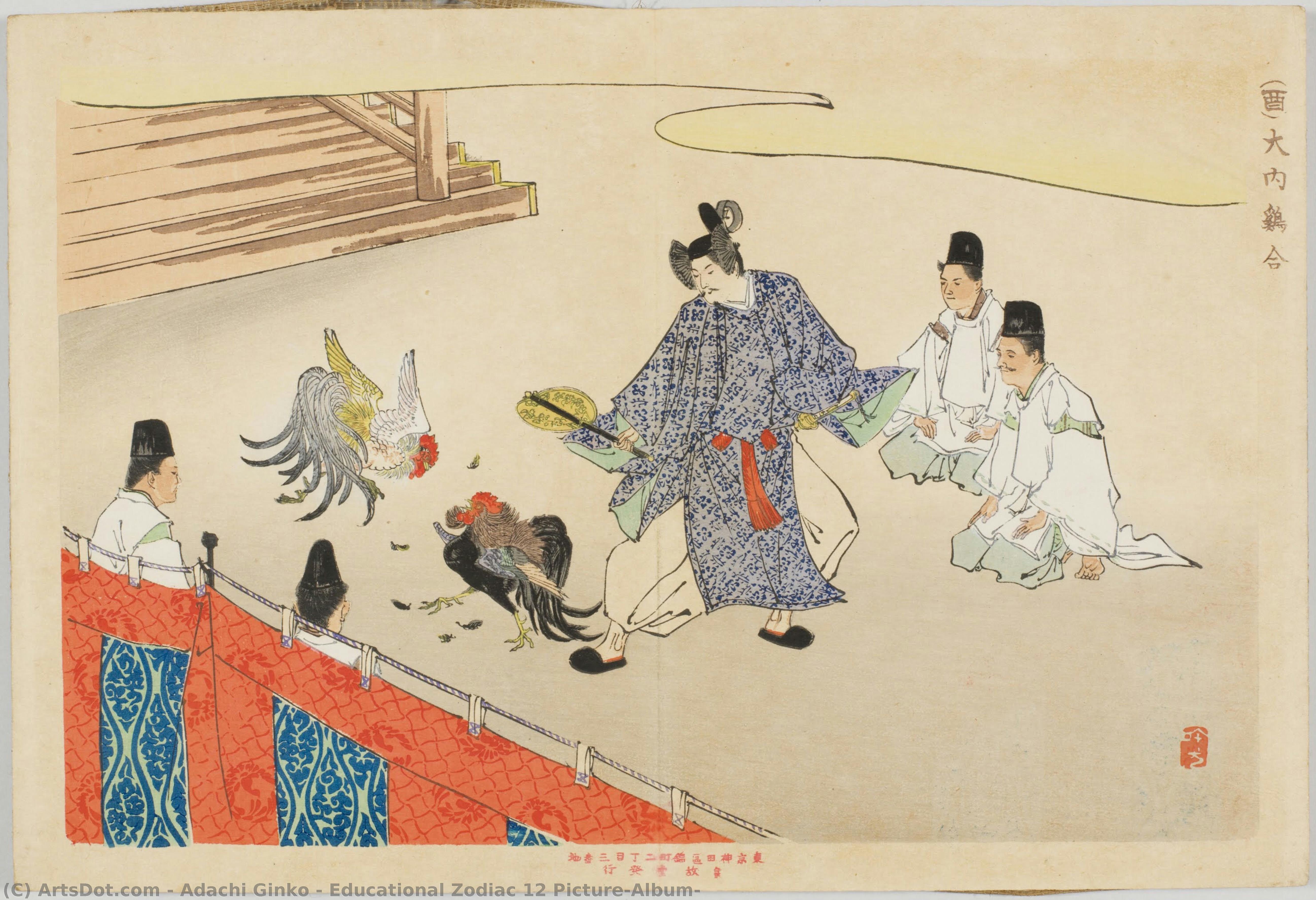
In the delicate interplay of light and shadow found within Adachi Ginkō’s Educational Zodiac 12 Picture Album, we encounter a profound moment of communal connection captured through the masterful lens of late Meiji-era Ukiyo-e. This exquisite work, dating from 1908, transcends mere illustration to become a living tableau of social interaction and pastoral charm. At its heart, the painting presents a captivating scene: a central figure, perhaps a storyteller or a village elder, stands poised before a gathered assembly seated upon the earth. The presence of birds—most notably a spirited rooster or chicken held by the man—serves as a focal point that bridges the gap between the human and natural worlds. Every brushstroke contributes to a sense of quiet intimacy, inviting the viewer to lean in and eavesdrop on the whispered conversations and shared observations of this timeless gathering.
The technique employed by Ginkō reflects his unique position as a pioneer of pictorial narrative. While rooted in the traditional Japanese woodblock printing lineage, there is an unmistakable infusion of watercolor-like softness that suggests a dialogue with Western artistic influences creeping into Japan during this period of modernization. The composition is meticulously balanced; the scattered birds throughout the landscape are not merely decorative but act as rhythmic elements that guide the eye across the 24 x 17 cm surface. This careful arrangement creates a sense of depth and movement, making the small-scale work feel expansive and immersive. For the discerning collector, the level of detail—from the texture of the birds' plumage to the humble bowl resting near the seated figures—offers a rich, tactile experience that rewards prolonged contemplation.
Beyond its aesthetic brilliance, the artwork carries deep symbolic weight, rooted in the educational and zodiac-based themes prevalent in Japanese culture. The zodiac serves as a cosmic clock, a way of organizing time and destiny, and by weaving these elements into a narrative of daily life, Ginkō grounds the celestial in the terrestrial. This piece evokes a sense of nostalgia for a simpler, more interconnected era, making it an emotionally resonant choice for modern interiors. It possesses a quiet strength that can anchor a room, providing a sophisticated point of interest in a gallery wall or as a standalone statement piece in a study.
For interior designers and art enthusiasts alike, a high-quality reproduction of this masterpiece offers more than just decoration; it offers an invitation to storytelling. The warm, earthy tones and the gentle, rhythmic composition make it an ideal addition to spaces designed for reflection and calm. Whether placed in a contemporary setting to provide a historical counterpoint or integrated into a classic, traditional decor, this work from Adachi Ginkō’s legacy brings with it the soul of 1908 Japan—a period of transition, beauty, and enduring human connection.
Related Artworks
Artist Biography
The Radiant Legacy of Adachi Ginkō
In the vibrant, transformative era of the late Meiji period, few artists captured the shifting soul of Japan as vividly as Adachi Ginkō. Born in 1853, a time when the traditional structures of the Edo period were beginning to yield to the rapid modernization of the West, Ginkō emerged as a master of the Ukiyo-e tradition. His life and work represent a profound bridge between the ancient aesthetics of woodblock printing and the burgeoning intellectual curiosity of a nation redefining itself. As a prominent member of the illustrious Utagawa school, Ginkō did not merely replicate the styles of his predecessors; he breathed new life into them, infusing the classical medium with a sense of realism and contemporary urgency that resonated deeply with the people of his time.
Ginkō’s artistic journey was marked by an extraordinary ability to synthesize diverse influences. While his roots were firmly planted in the lineage of masters like Hokusai, his early training likely involved exposure to Western-style watercolor techniques. This unique duality allowed him to develop a signature style characterized by bold, decisive outlines and a breathtakingly vibrant color palette. He was a master of light, often employing gold leaf to imbende his prints with a celestial luminosity, turning a simple piece of paper into a window of grandeur. His work moved beyond the stylized, flat depictions common in earlier eras, instead embracing a dynamic realism that captured the textures of fabric, the depth of landscapes, and the raw emotion of human subjects.
Narrative Mastery and Historical Resonance
What truly set Adachi Ginkō apart was his prowess as a visual storyteller. He possessed an uncanny ability to weave complex narratives into single compositions, making him a pioneer of pictorial narrative. His repertoire was vast, ranging from the delicate bijin-ga (portraits of beautiful women) and dramatic actor prints to sweeping landscapes and intricate book illustrations. However, it was in his large-scale triptychs that his storytelling reached its zenith. These multi-panel masterpieces allowed him to depict contemporary events and historical epics with a cinematic scale, inviting the viewer to step into the unfolding drama.
Perhaps his most significant achievement was the Pictorial Outline of Japanese History series produced in the late 1880s. In this ambitious project, Ginkō utilized the power of the woodblock print to educate and inspire, chronicling the legends and turning points of the Japanese past. Yet, his commitment to truth—or at least his personal interpretation of it—was not without consequence. His fearless approach occasionally led him into political turbulence; in 1889, he famously faced imprisonment and fines for a satirical work that caricatured the Meiji Emperor. This moment of defiance underscores the spirit of an artist who viewed his craft not just as decoration, but as a potent medium for social commentary and reflection.
A Lasting Impression on Japanese Art
The significance of Adachi Ginkō extends far beyond the borders of the Meiji era. He remains a symbol of artistic resilience, demonstrating how traditional crafts can evolve to meet the challenges of a changing world without losing their essential identity. His work serves as a vital historical record, capturing the social hierarchies, pastoral charms, and cultural shifts of a Japan in transition. Through his meticulous craftsmanship and emotive power, Ginkō ensured that the Ukiyo-e tradition would not fade into obscurity but would instead leave an indelible mark on the global art canon.
To study the works of Adachi Ginkō is to encounter the heartbeat of a nation. His legacy lives on through:
- Technical Innovation: The masterful integration of gold leaf and Western-influenced color palettes within traditional woodblock printing.
- Genre Versatility: An unparalleled ability to move between the intimate beauty of portraits and the epic scale of historical triptychs.
- Cultural Documentation: Providing a visual window into the social interactions, folklore, and political tensions of the late 19th century.
adachi ginko
1853 - , Japan
Quick Facts
- Artistic Movement Or Style: Ukiyo-e
- Date Of Birth: 1853
- Date Of Death: Living
- Full Name: Adachi Ginkō
- Nationality: Japanese
- Notable Artworks:
- Educational Zodiac 12 Picture(Album)
- Pictorial Outline of Japanese History
- Place Of Birth: Japan

