Preview
 Send
Send Share
Share
 Details

 Download
 Similars
 X-Ray
X-Ray Diaporama
The Life of the Virgin


 Read More
Hand Made Oil Reproduction
Hand-painted oil on canvas in your size and frame, made to order by our artists. ( Buy Print Buy Image)




P118B $10

P118H $10

P118W $10

P438Z $10

P508JH $12

P508YH $12

P805H $10

P805Z $10

P919BZ $10

P919G $10

P919XJ $10

P959ZH $10

P968JZ $12

W106C $8

W218G $10

W218JH $8

W218Y $10

W307PJ $10

W316G $10

W316PJ $8

W316Y $10

W398PJ $8

W4111J $10

W500HY $15

W500JH $15

W692G $12

W849H $8

W940BG $15

W953PJ $8




Pick from our preset sizes that match the artwork's original proportions.

You may enter your own dimensions to fit a specific frame or space. If your selected size does not match the original image's proportions, we will either crop the artwork or extend the painting with additional hand-painted elements. A digital mockup will be sent for your approval before production begins.
Please note that the on-screen preview does not reflect the actual cropping or extension. Only the mockup will accurately show the final composition.
While custom sizes are available, we recommend selecting a dimension from the predefined list to preserve the original proportions.
After order, ArtsDot.com team will email client for instructions and provide a mockup preview
Worldwide Delivery () in 3/4 weeks instead of standard 5 weeks. (1 September). No compromise on quality.

Free Worldwide Express Shipping

High-Quality Linen Canvas

Full Shipping Insurance

Customs Tax Refund Guarantee

True Color Matching Guarantee

60-Day Return Policy (Defects Only)

100% Money-Back Guarantee

Bulk Discount Offer
 Glass option is only available in size under 110 CM

The Life of the Virgin
Reproduction Medium
Reproduction Size
-


Total Price
$ 488
A Window into Devotion: Adriaen Isenbrant’s “The Life of the Virgin”
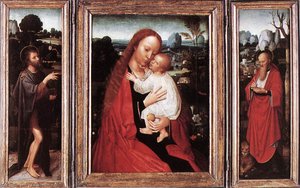
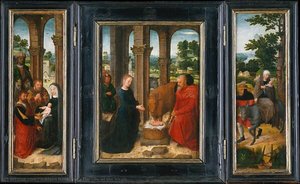
Adriaen Isenbrant's "The Life of the Virgin," painted in 1521, is not merely a depiction of biblical scenes; it’s a carefully constructed invitation to contemplation. This small triptych, now housed within a meticulously carved wooden frame, offers a poignant glimpse into the devotional practices of its intended audience – likely a private individual seeking solace and connection with the Virgin Mary. Isenbrant, a figure shrouded in scholarly debate due to the scarcity of definitively attributed works, masterfully blends elements of Early Netherlandish tradition with emerging Renaissance influences, creating an artwork that is both deeply rooted in the past and subtly forward-looking.
The painting’s genesis lies within the bustling artistic hub of Bruges during a period of significant transition. Bruges, renowned for its thriving trade networks and burgeoning merchant class, was experiencing a surge in wealth and patronage – a perfect environment for artists like Isenbrant to flourish. The work reflects this prosperity through its intricate detail and luxurious materials, yet it also retains the solemnity and spiritual depth characteristic of the Early Netherlandish style. It’s believed that Isenbrant honed his skills within Gerard David's workshop, absorbing the master’s meticulous approach to realism and composition while simultaneously developing a distinctive artistic voice.
A Symphony of Grisaille and Color
The triptych unfolds with a deliberate grace. The exterior wings, executed in grisaille – a monochrome technique utilizing shades of gray – immediately establish a formal and restrained atmosphere. These panels depict the Annunciation, showcasing the Archangel Gabriel presenting Mary with the news of her impending motherhood, and the Visitation, portraying Mary’s visit to Elizabeth. The architectural settings are rendered with impressive precision, incorporating elements reminiscent of Albrecht Dürer's popular engravings – a testament to Isenbrant’s awareness of contemporary artistic trends. The use of grisaille serves not only as a visual anchor but also as a symbolic preparation for the more vibrant and emotionally charged interior scenes.
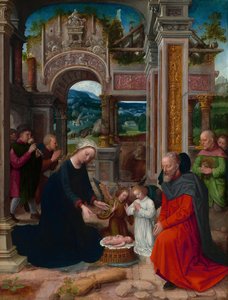
Turning inward, the central panel reveals the Nativity, a scene brimming with carefully orchestrated detail. The figures – Mary, Joseph, the shepherds, and the infant Jesus – are arranged within a modest stable, bathed in a dramatic, single-source light that emphasizes their humanity and vulnerability. The drapery is rendered with exquisite realism, cascading folds revealing intricate textures and suggesting movement. Notice the subtle variations in color—the rich reds of Mary’s robes, the earthy browns of the animals, and the cool blues of the sky – all contributing to a sense of depth and atmosphere.
Symbolism and Narrative Depth
Each panel within the triptych is laden with symbolic meaning. The Annunciation emphasizes Mary's humility and obedience, while the Visitation highlights her close relationship with Elizabeth, representing divine grace and support. The Nativity itself is a powerful meditation on sacrifice and redemption. The carefully chosen objects – the manger, the swaddling clothes, the halo above the infant Jesus – all carry significant religious weight. Beyond these explicit symbols, Isenbrant’s composition invites viewers to engage in empathetic contemplation, prompting them to consider Mary's role as a model of faith, compassion, and maternal love.
Craftsmanship and Technique
“The Life of the Virgin” is executed in oil on panel, a technique that allowed for rich colors, subtle gradations of tone, and meticulous detail. The artist’s mastery of perspective—a hallmark of Early Netherlandish painting—is evident in the carefully constructed space, where objects recede into the distance with convincing realism. The use of layering and glazing creates a luminous quality, enhancing the sense of depth and volume. Close examination reveals the painstaking effort invested in rendering textures – from the smooth skin tones to the rough wool of the animals – demonstrating Isenbrant’s commitment to achieving an unparalleled level of visual fidelity. The dark frames surrounding each panel further accentuate the illuminated scenes, creating a dramatic and visually arresting effect.
A Timeless Testament
Despite the ongoing debate surrounding his oeuvre, Adriaen Isenbrant's “The Life of the Virgin” stands as a testament to the enduring power of devotional art. This small triptych offers a profound meditation on faith, family, and the mysteries of the Christian narrative—a timeless work that continues to resonate with viewers centuries after its creation. Reproductions capture only a fraction of the original’s depth and nuance, but they provide an accessible means of experiencing the beauty and spiritual significance of this remarkable artwork.
Related Artworks
Artist Biography
A Shadowy Master of Bruges: Unraveling the Enigma of Adriaen Isenbrant
Adriaen Isenbrant, or Ysenbrandt as he is sometimes known, remains one of the most elusive figures in Northern Renaissance painting. Born around 1490, likely in either Haarlem or Antwerp, his life unfolded amidst the burgeoning artistic climate of Bruges, yet a definitive body of work attributable solely to his hand continues to tantalize and frustrate art historians. Documentary evidence paints a picture of a successful and respected artist, deeply embedded within the guild system and enjoying patronage from wealthy merchants and traders, but concrete links between this thriving workshop leader and surviving paintings remain stubbornly scarce. This has led to decades of scholarly debate, with Isenbrant variously proposed as the author of works previously attributed to Gerard David and Jan Mostaert – earning him the moniker “Pseudo-Mostaert” – or even dismissed as a convenient label for a collective of anonymous artists.Life and Guild Affiliations in a Flourishing City
Isenbrant’s documented life begins in 1510, when he established himself as a burgher of Bruges. He swiftly ascended within the city's artistic community, becoming a master in both the painters’ guild of St. Luke and the goldsmiths’ guild of St. Elooi that same year. This dual membership speaks to the interconnectedness of crafts during the period and suggests Isenbrant possessed a versatile skillset. Over the following decades, he repeatedly held positions of responsibility within the guilds – serving nine times as a “deacon” (vinder) and twice as governor (treasurer) – demonstrating his standing among his peers. His workshop flourished in the Korte Vlaminckstraat, strategically located near those of Gerard David and Hans Memling, placing him at the heart of Bruges’ artistic activity. The city itself was a magnet for wealth and refinement; its thriving merchant class eager to commission diptychs, portraits, and devotional pieces that reflected their status and piety. Isenbrant catered primarily to this private clientele, though he also produced works without specific commissions, indicating a robust demand for his art. Legal records from 1534 reveal the scale of his operation – a suit brought against Jan van Eyck (not the celebrated Jan van Eyck) for failing to deliver paintings Isenbrant had ordered for completion. He even acted as an agent in Bruges for Adriaan Provoost, further solidifying his position within the artistic network.Artistic Influences and a Conservative Style
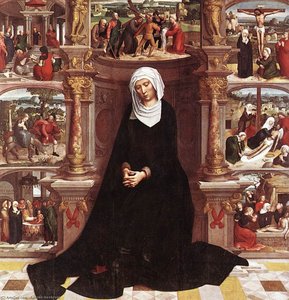
The influence of Gerard David is perhaps the most consistently cited element in discussions surrounding Isenbrant’s style. David's compositional strategies and landscape backgrounds are frequently echoed in works attributed to Isenbrant, suggesting a period of direct or indirect mentorship. However, unlike David’s increasingly refined and expressive approach, Isenbrant’s work – as it is tentatively identified – tends towards a more conservative aesthetic rooted in the traditions of Early Netherlandish painting. This manifests in meticulous detail, a restrained emotional palette, and a focus on precise rendering rather than dramatic innovation. The paintings attributed to him often depict religious subjects—the *Seven Sorrows of the Virgin* being particularly prominent—and devotional scenes intended for private contemplation. While possessing technical skill, these works lack the groundbreaking experimentation seen in some of his contemporaries. Some scholars suggest this deliberate adherence to tradition was a strategic choice, catering to the tastes of a conservative clientele who favored familiarity and piety over stylistic novelty. There is speculation that he may have travelled to Genoa in 1511 alongside Joachim Patinir and Gerard David, potentially exposing him to Italian artistic currents, though the extent of this influence remains unclear.The Problem of Attribution and Lasting Legacy
The core challenge surrounding Isenbrant lies in the absence of securely attributed paintings. Despite being described by contemporary sources as a “famous and well-to-do painter,” no work can be definitively declared his own. Georges Hulin de Loo, a prominent art historian, proposed in 1902 that Isenbrant was responsible for a substantial body of works previously assigned to David and Mostaert, but this attribution remains contentious. Many scholars now view “Isenbrant” as a useful designation for a group of paintings sharing stylistic characteristics rather than the product of a single artist’s hand. Documents reveal that Isenbrant engaged in export trade, sending paintings to Spain, indicating an international reputation, yet these specific works have not been identified with certainty. He died in Bruges in 1551, leaving behind a considerable estate – including four houses – inherited by his children from two marriages and one acknowledged illegitimate daughter. Despite the enduring mystery surrounding his oeuvre, Adriaen Isenbrant’s story serves as a compelling reminder of the complexities inherent in art historical attribution and the often-tenuous connection between documented life and surviving artistic legacy. He remains a shadowy master, a pivotal figure whose true contribution to Northern Renaissance painting continues to beckon further research and reevaluation.Key Characteristics of Works Attributed to Isenbrant
- Conservative Style: A continuation of Early Netherlandish traditions with meticulous detail and restrained emotion.
- Religious Subject Matter: Predominantly devotional scenes, particularly depictions of the Virgin Mary and the Passion of Christ.
- Influence of Gerard David: Evident in compositional arrangements and landscape backgrounds.
- Precise Rendering: A focus on accurate representation rather than dramatic innovation.
- Private Patronage: Primarily commissioned by wealthy merchants and individuals for personal devotion.
Adriaen Isenbrant
1580 - 1551 , Netherlands
Quick Facts
- Artistic Movement Or Style: Northern Renaissance
- Artists Who Influenced This Artist: ['Gerard David']
- Date Of Birth: c. 1490
- Date Of Death: 1551
- Full Name: Adriaen Isenbrant
- Nationality: Dutch
- Place Of Birth: Haarlem, Netherlands
Related Articles

Early Netherlandish Masters: 10 Paintings That Revolutionized Art & Decor
Journey into the world of Early Netherlandish painting! Explore 10 masterpieces by Jan van Eyck, Rogier van der Weyden & more. Discover stunning detail, symbolism & Renaissance art for your home decor. Find museum-quality reproductions on ArtsDot.com
Jan Gossart: Bridging Netherlandish Realism & Renaissance Humanism – A Comprehensive Exploration
Explore the captivating world of Jan Gossart, a pivotal figure bridging Netherlandish realism & Renaissance humanism. Discover his masterpieces, patronage, and lasting influence – an essential guide for discerning art collectors.
Jacob Henricus Maris: A Master of Dutch Atmospheric Realism & the Intimate Landscape
Explore the captivating world of Jacob Henricus Maris, a leading figure of the Dutch Hague School. Discover his atmospheric landscapes, signature brushstrokes & lasting influence on 19th-century art. Learn more at ArtsDot.

Early Netherlandish Masters: 10 Paintings That Revolutionized Art & Decor
Journey into the Early Netherlandish Renaissance! Explore 10 iconic paintings by Jan van Eyck, Rogier van der Weyden & more. Discover stunning detail, symbolism, and oil painting techniques. Find museum-quality art reproductions for your home at ArtsDot.com.
Sacred Narratives Embodied: A Comprehensive Exploration of Religious Iconography in Art History
Explore the rich history of religious iconography in art! Discover symbolism, movements & masterpieces from Byzantine to Renaissance periods. Expert insights for collectors and enthusiasts at ArtsDot.