 Preview
 Send
Send Share
Share
 Details

 Download
 Similars
 X-Ray
X-Ray Diaporama
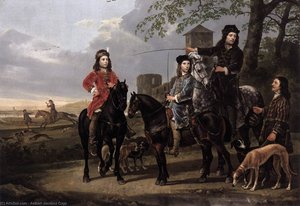
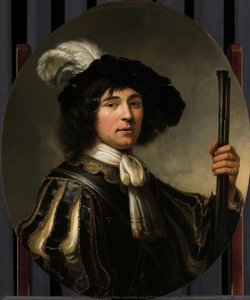
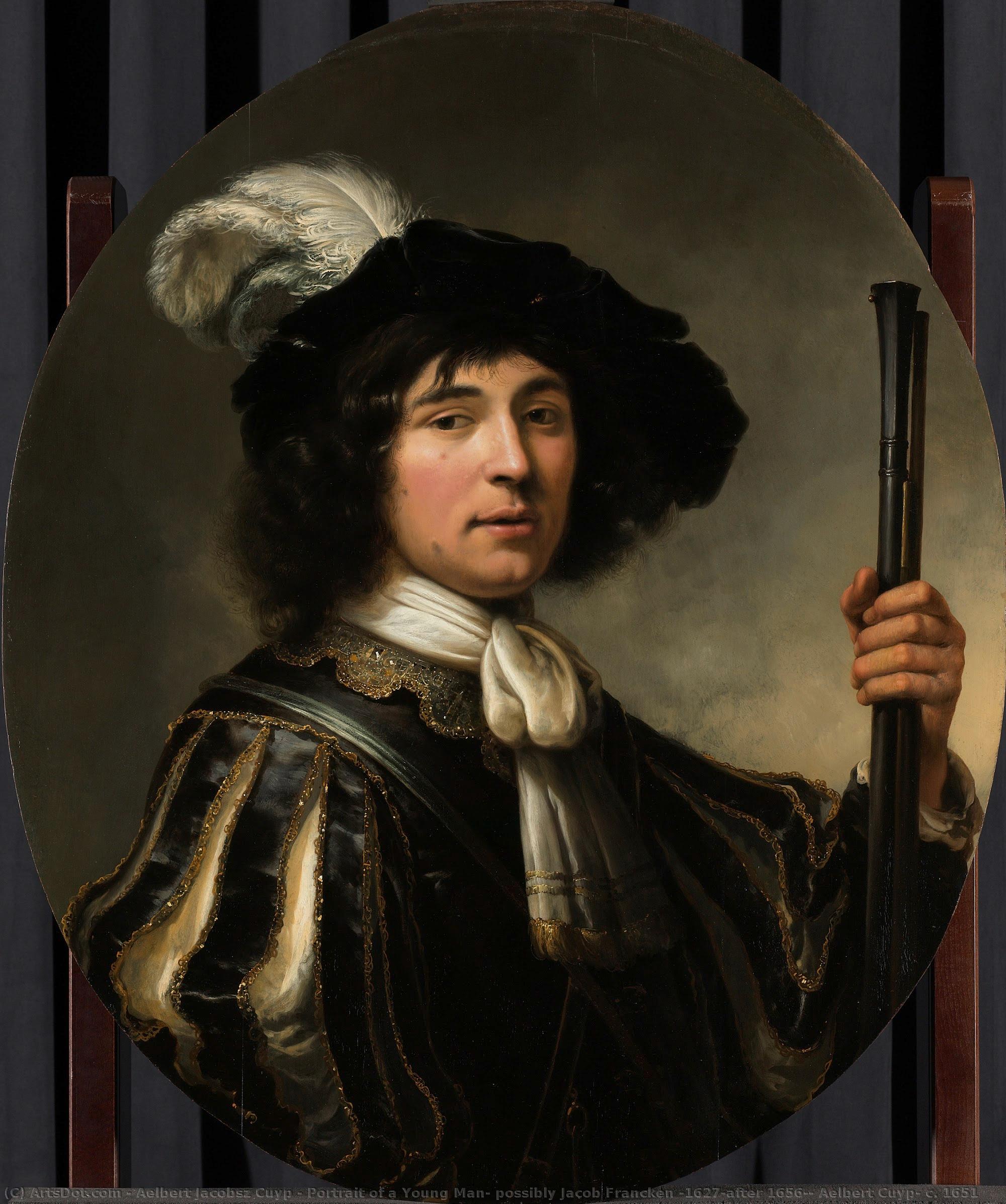
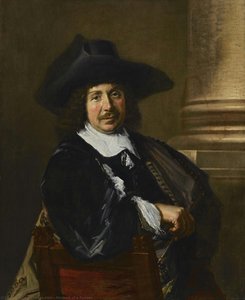
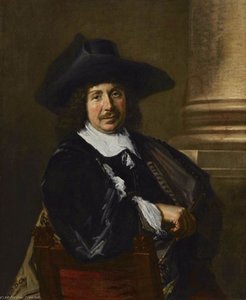
Portrait of a Young Man, possibly Jacob Francken (1627-after 1656), Aelbert Cuyp, c. 1651
 Dutch Golden Age
 1651
1651 83.0 x 69.0 cm
 Read More
Giclée / Art Print
Museum-quality giclée or canvas print with fast production and flexible finish options. ( Buy Hand Made Painting Buy Image)




































Pick from our preset sizes that match the artwork's original proportions.

You may enter your own dimensions to fit a specific frame or space. If your selected size does not match the original image's proportions, we will either crop the artwork or extend the image with a mirrored or solid-fill edge. A digital mockup will be sent for your approval before production begins.
Please note that the on-screen preview does not reflect the actual cropping or extension. Only the mockup will accurately show the final composition.
While custom sizes are available, we recommend selecting a dimension from the predefined list to preserve the original proportions.
Worldwide Delivery () in 2 weeks instead of standard 4/5 weeks. (26 August)

Free Worldwide Express Shipping

High-Quality Linen Canvas

Full Shipping Insurance

Customs Tax Refund Guarantee

True Color Matching Guarantee

60-Day Return Policy (Defects Only)

100% Money-Back Guarantee

Bulk Discount Offer
 Glass option is only available in size under 110 CM

Portrait of a Young Man, possibly Jacob Francken (1627-after 1656), Aelbert Cuyp, c. 1651
Giclée / Art Print
Reproduction Size
-


Total Price
$ 63
Collectible Description
Related Artworks

Artist Biography
A Life Bathed in Golden Light: The World of Aelbert Jacobsz Cuyp
Aelbert Jacobszoon Cuyp, born in Dordrecht on October 20, 1620, and passing away in the same city on November 15, 1691, stands as a quintessential figure of the Dutch Golden Age. More than just a painter, he was an interpreter of light itself, transforming the serene landscapes of the Netherlands into visions of idyllic beauty. While biographical details remain somewhat elusive – even Arnold Houbraken, the era’s foremost art historian, offered only a sparse account of his life – Cuyp's artistic legacy speaks volumes, resonating with a quiet power that continues to captivate audiences centuries later.
Cuyp emerged from a family deeply entrenched in the world of art. His father, Jacob Gerritszoon Cuyp, was a respected portraitist who served as Aelbert’s initial teacher and frequent collaborator. His uncle Benjamin contributed designs for stained glass, and his grandfather Gerrit worked with cartoon designs. This familial artistic heritage provided a nurturing environment for young Aelbert to develop his skills, though it wasn't until the 1640s that he truly began to forge his own distinctive style. He inherited not only talent but also a comfortable fortune, allowing him the freedom to dedicate himself fully to painting without the pressures of financial necessity.
The Evolution of a Landscape Vision
Cuyp’s artistic journey can be understood as a fascinating synthesis of influences, gradually coalescing into a uniquely personal vision. His early works demonstrate the strong impact of Jan van Goyen, whose tonal palette and broken brushwork—a precursor to Impressionism—are clearly visible in paintings from around 1640. He adopted van Goyen’s characteristic straw yellows and light browns, employing a similar technique of short, unblended strokes that created a sense of atmospheric depth. However, Cuyp wasn't merely imitating; he was absorbing these lessons and beginning to infuse them with his own sensibility.
The mid-1640s saw the emergence of Jan Both’s influence on Cuyp’s work. Both, recently returned from a period in Italy, brought with him a heightened awareness of light and composition. Cuyp integrated this newfound understanding into his landscapes, adding a luminosity that distinguished his paintings from those of his predecessors. Crucially, he blended these external influences with the foundational skills imparted by his father, Jacob Gerritszoon Cuyp, who contributed to the form and structure of many early works. This combination – tone from van Goyen, light from Both, and form from his father – laid the groundwork for Cuyp’s mature style.
Riverside Serenity: The Hallmark of Cuyp's Art
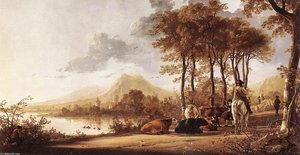
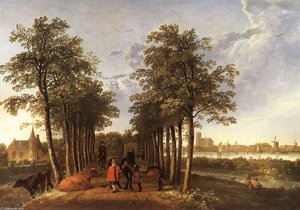
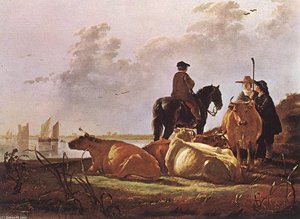
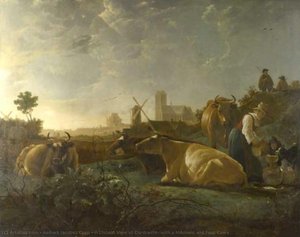
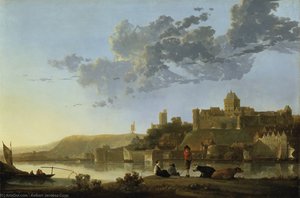
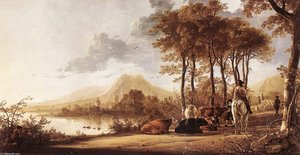
Cuyp is most celebrated for his expansive views of Dutch riverside scenes, bathed in the golden hues of early morning or late afternoon. These are not simply topographical representations; they are imbued with a sense of tranquility and harmony that reflects a deep connection to the natural world. His paintings often feature figures engaged in everyday activities – farmers herding cattle, boats gliding along the water, people conversing on the shore – but these elements are never the primary focus. Instead, they serve as anchors within the broader landscape, enhancing the overall sense of peacefulness and scale.
The artist’s mastery of light is perhaps his most defining characteristic. He captured the subtle nuances of sunlight reflecting off water, illuminating clouds, and casting long shadows across fields with remarkable precision. This ability to evoke atmosphere and mood elevated his landscapes beyond mere depictions of scenery; they became expressions of a particular time of day, a specific emotional state. His paintings are often described as possessing a poetic quality, inviting viewers to immerse themselves in the beauty and serenity of the Dutch countryside.
Legacy and Historical Significance
While Cuyp’s period of active painting was relatively short – generally limited to the two decades between 1639 and 1660 – his impact on Dutch art was profound. He became known as the “Dutch Claude Lorrain,” a testament to the similarities in their atmospheric landscapes, though Cuyp's work possesses a distinctly Dutch character. His influence can be seen in the works of later landscape painters who sought to capture the beauty and tranquility of the natural world.
Beyond his artistic achievements, Cuyp’s life offers a glimpse into the values of the Dutch Golden Age. His devout Calvinism is reflected in the absence of other artists' paintings in his home upon his death, suggesting a focus on personal piety rather than worldly possessions. His marriage to Cornelia Bosman in 1658 coincided with the end of his artistic career, leading some to speculate that domestic life played a role in his decision to retire from painting. Regardless of the specific reasons, Aelbert Jacobsz Cuyp left behind a body of work that continues to inspire and delight, solidifying his place as one of the most beloved masters of the Dutch Golden Age.
Quick Facts
- Artistic Movement Or Style: Dutch Golden Age painting
- Artists Who Influenced This Artist:
- Jan van Goyen
- Jan Both
- Jacob Gerritszoon Cuyp
- Date Of Birth: October 20, 1620
- Date Of Death: November 15, 1691
- Full Name: Aelbert Jacobszoon Cuyp
- Nationality: Dutch
- Place Of Birth: Dordrecht, Netherlands
Related Articles
Aelbert Cuyp: Illuminating the Dutch Golden Age with Light & Landscape
Explore the luminous landscapes of Aelbert Cuyp, a master of the Dutch Golden Age. Discover his unique light, serene riverside scenes & lasting influence on art history. Learn more at ArtsDot.

Dutch Masters: 10 Golden Age Paintings That Still Inspire |
Journey into the Dutch Golden Age! Explore 10 iconic paintings by Rembrandt, Vermeer & Hals. Discover the stories behind these Baroque masterpieces and find museum-quality art reproductions to elevate your home decor on .

Golden Age Reflections: Dutch Baroque Painting & Cultural Innovation
Explore the Dutch Golden Age of painting! Discover key artists like Vermeer & ter Borch, their innovative techniques, and the rich cultural context behind these Baroque masterpieces. Learn about collecting & appreciating this iconic art period.

Illuminating Innovation: Exploring the Dutch Golden Age of Painting
Explore the Dutch Golden Age of painting with ArtsDot. Discover Rembrandt, Vermeer & other Masters. Learn about key characteristics, iconic artworks, and lasting influence. Expert insights for collectors & enthusiasts.

Illuminating Realism: Exploring the Dutch Golden Age of Painting (1600-1700)
Explore the Dutch Golden Age of painting (1600-1700) with ArtsDot. Discover Rembrandt, Vermeer & other masters. Learn about techniques, history & find museum-quality reproductions.