 Preview
 Send
Send Share
Share
 Details

 Download
 Similars
 X-Ray
X-Ray Diaporama
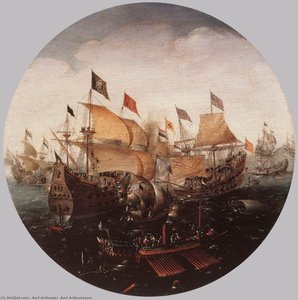
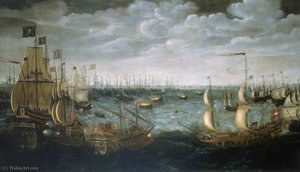
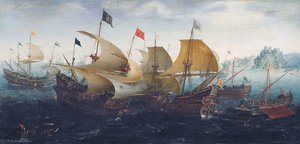
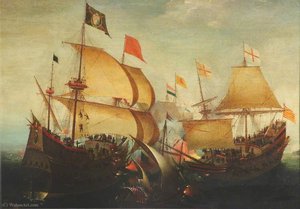
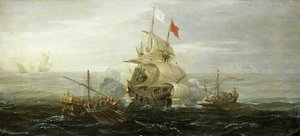
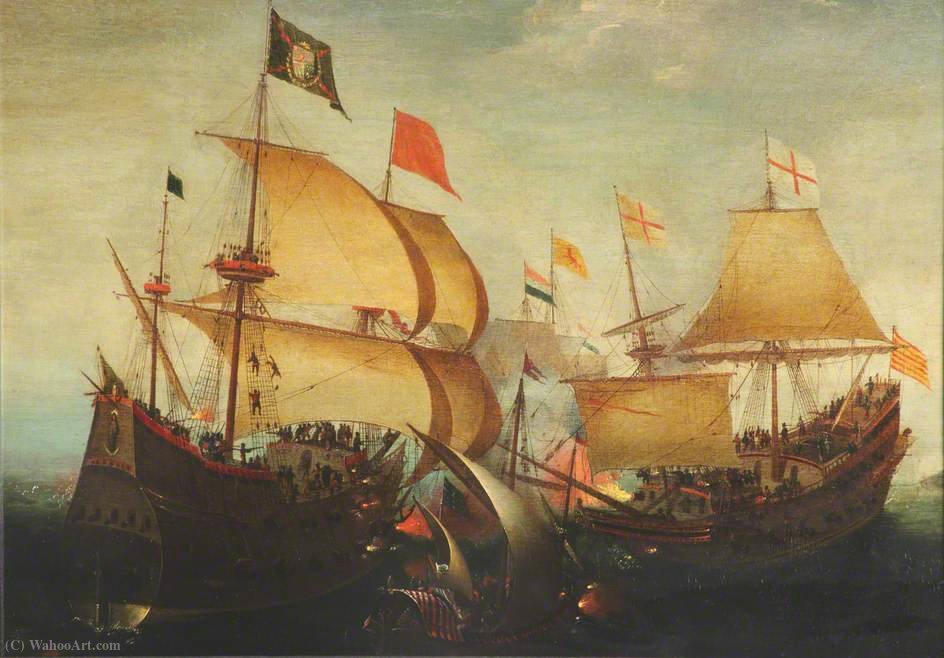
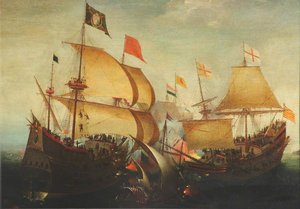
An english and a dutch ship attacking a spaniard - (1610)
 Read More
Giclée / Art Print
Museum-quality giclée or canvas print with fast production and flexible finish options. ( Buy Hand Made Painting Buy Image)




































Pick from our preset sizes that match the artwork's original proportions.

You may enter your own dimensions to fit a specific frame or space. If your selected size does not match the original image's proportions, we will either crop the artwork or extend the image with a mirrored or solid-fill edge. A digital mockup will be sent for your approval before production begins.
Please note that the on-screen preview does not reflect the actual cropping or extension. Only the mockup will accurately show the final composition.
While custom sizes are available, we recommend selecting a dimension from the predefined list to preserve the original proportions.
Worldwide Delivery () in 2 weeks instead of standard 4/5 weeks. (22 August)

Free Worldwide Express Shipping

High-Quality Linen Canvas

Full Shipping Insurance

Customs Tax Refund Guarantee

True Color Matching Guarantee

60-Day Return Policy (Defects Only)

100% Money-Back Guarantee

Bulk Discount Offer
 Glass option is only available in size under 110 CM

An english and a dutch ship attacking a spaniard - (1610)
Giclée / Art Print
Reproduction Size
-


Total Price
$ 63
Related Artworks
Artist Biography
Aert Anthonisz: Master of Dutch Maritime Drama
Aert Anthoniszoon, more commonly known as Aert van Antum or simply Anthonisz., remains a captivating figure in the history of 17th-century Dutch painting. Born around 1579 in Antwerp and tragically dying in Amsterdam in 1620, his life was relatively short but profoundly impactful on the development of maritime art within the Dutch Golden Age. While initially overlooked by many historical accounts, recent scholarship has resurrected Anthonisz.’s importance, revealing a remarkably skilled artist who captured the dynamism and drama of naval encounters with unparalleled realism and emotional intensity.
Anthonisz.’s early life is shrouded in some mystery. He likely received his initial artistic training from Hendrick Cornelisz Vroom, a prominent painter in Amsterdam at the time. This connection suggests an exposure to the prevailing Flemish style, characterized by rich colors, detailed rendering, and a focus on religious or mythological subjects. However, Anthonisz.’s trajectory quickly shifted towards a distinct maritime aesthetic. Around 1603, he married Baycken Coutermans from Mechelen, and soon after began signing his works with the abbreviated “AERT ANT[...]”, reflecting a deliberate effort to establish his own identity within the burgeoning art market.
The Rise of Maritime Painting
The mid-17th century witnessed an unprecedented surge in interest in maritime subjects within Dutch painting. This fascination stemmed from the Netherlands’ position as a global trading power, reliant on a vast network of ships traversing the world's oceans. Artists like Anthonisz., Jan van de Velde the Younger, and Willem van de Velde the Elder responded to this demand by producing a prolific series of paintings depicting naval battles, ship-to-ship engagements, and scenes of maritime commerce. Unlike earlier depictions that often prioritized heroic grandeur, Anthonisz.’s works emphasized the gritty reality of seafaring life – the chaos of battle, the vulnerability of ships, and the sheer power of nature.
Anthonisz.’s style is immediately recognizable. He eschewed idealized compositions in favor of dynamic arrangements filled with movement and detail. His ships are rendered with meticulous accuracy, capturing their rigging, hull shapes, and the effects of wind and waves. He masterfully employed a cool color palette – blues, grays, and greens – to convey the atmosphere of the sea and the overcast skies typical of maritime weather. Crucially, Anthonisz.’s paintings aren’t simply technical exercises; they are infused with a palpable sense of drama and immediacy. He skillfully used light and shadow to heighten the tension of his scenes, drawing the viewer into the heart of the action.
Key Works and Influences
Among Anthonisz.’s most celebrated works is “The Battle of Cadix” (1608), a monumental painting depicting the Dutch victory over the Spanish fleet at Cadiz. This work exemplifies his signature style, showcasing a chaotic yet meticulously rendered naval engagement. Another significant piece is "Ships off IJsselmonde" (1618), which captures a dramatic storm brewing on the North Sea. These paintings demonstrate his ability to convey both the technical complexities of shipbuilding and the raw power of the elements.
While Anthonisz.’s style draws inspiration from Flemish masters, particularly Hendrick Cornelisz Vroom, he developed a uniquely Dutch approach to maritime painting. He was influenced by contemporary accounts of naval battles and the practical knowledge of sailors, incorporating realistic details into his compositions. Furthermore, his work reflects the broader artistic trends of the Dutch Golden Age, characterized by realism, naturalism, and a focus on everyday life.
Legacy and Historical Significance
Despite being largely forgotten for centuries, Aert Anthonisz.’s paintings have recently experienced a resurgence in popularity. His dynamic compositions, realistic details, and emotional intensity continue to captivate viewers today. His work provides invaluable insight into the maritime history of the Dutch Golden Age and offers a compelling glimpse into the lives of sailors and shipbuilders. Anthonisz.’s legacy lies not only in his artistic skill but also in his contribution to the development of a distinctly Dutch style of maritime painting, one that continues to inspire artists and art historians alike.
His paintings are now housed in major museums worldwide, including the Rijksmuseum Amsterdam, the British Museum, and the Hermitage Museum in St. Petersburg, ensuring that this remarkable artist’s dramatic vision will continue to be appreciated for generations to come.
aert anthonisz (aert anthonissen)
1579 - 1620 , Belgium
Quick Facts
- Artistic Movement Or Style: Maritime painting
- Artists Or Movements Influenced By This Artist: ['Hendrick van Anthonissen']
- Artists Who Influenced This Artist: ['Hendrick Cornelisz Vroom']
- Date Of Birth: c. 1579–1580
- Date Of Death: 1620
- Full Name: Aert Anthonisz (Anthonissen)
- Nationality: Dutch
- Notable Artworks:
- Slag bij Cadix
- Sea Battle
- Ships off IJsselmonde
- Place Of Birth: Antwerp, Belgium