 Preview
 Send
Send Share
Share
 Details

 Download
 Similars
 X-Ray
X-Ray Diaporama
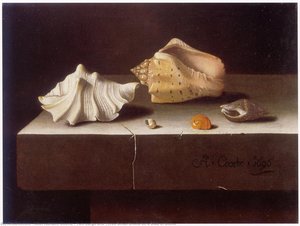
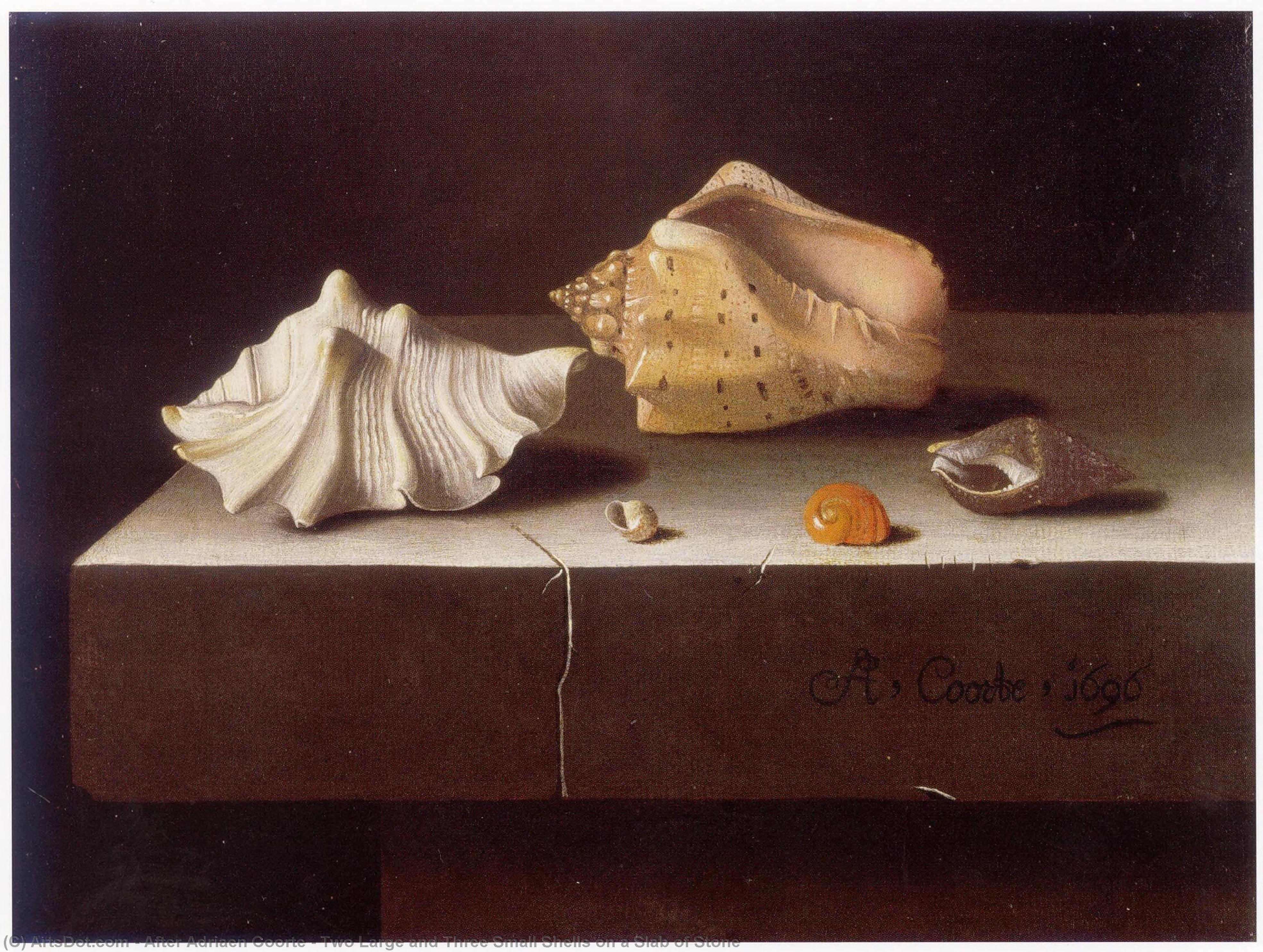
Two Large and Three Small Shells on a Slab of Stone
 Oil
Oil- WallArt
- Baroque
 1696
1696- Early Modern
 15.0 x 22.0 cm
 The Louvre
 Read More
Giclée / Art Print
Museum-quality giclée or canvas print with fast production and flexible finish options. ( Buy Hand Made Painting Buy Image)




P118B $10

P118H $10

P118W $10

P438Z $10

P508JH $12

P508YH $12

P805H $10

P805Z $10

P919BZ $10

P919G $10

P919XJ $10

P959ZH $10

P968JZ $12

W106C $8

W218G $10

W218JH $8

W218Y $10

W307PJ $10

W316G $10

W316PJ $8

W316Y $10

W398PJ $8

W4111J $10

W500HY $15

W500JH $15

W692G $12

W849H $8

W940BG $15

W953PJ $8




Pick from our preset sizes that match the artwork's original proportions.

You may enter your own dimensions to fit a specific frame or space. If your selected size does not match the original image's proportions, we will either crop the artwork or extend the image with a mirrored or solid-fill edge. A digital mockup will be sent for your approval before production begins.
Please note that the on-screen preview does not reflect the actual cropping or extension. Only the mockup will accurately show the final composition.
While custom sizes are available, we recommend selecting a dimension from the predefined list to preserve the original proportions.
Worldwide Delivery () in 2 weeks instead of standard 4/5 weeks. (25 August)

Free Worldwide Express Shipping

High-Quality Linen Canvas

Full Shipping Insurance

Customs Tax Refund Guarantee

True Color Matching Guarantee

60-Day Return Policy (Defects Only)

100% Money-Back Guarantee

Bulk Discount Offer
 Glass option is only available in size under 110 CM

Two Large and Three Small Shells on a Slab of Stone
Giclée / Art Print
Reproduction Size
-


Total Price
$ 63
Collectible Description
A Quiet Symphony of Texture and Light
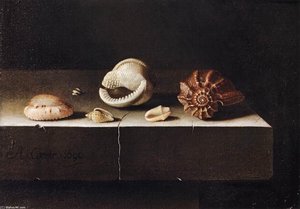
In the hushed corners of the Dutch Golden Age, where the grandeur of maritime conquest often overshadowed the intimate beauty of the natural world, Adriaen Coorte captured a different kind of triumph. His masterpiece, "Two Large and Three Small Shells on a Slab of Stone," is not a boisterous celebration of wealth, but rather a profound meditation on existence itself. Executed around 1696, this painting invites the viewer into a private, almost sacred space. The composition is deceptively simple: two substantial seashells rest upon a weathered stone slab, flanked by three delicate, diminutive shells that seem to nestle within the arrangement. There is a rhythmic balance here, a deliberate hierarchy that guides the eye through a landscape of calcium and grit, evoking a sense of stillness that feels both eternal and fleeting.
To gaze upon this work is to witness the mastery of glazing, a technique where Coorte layered thin, translucent washes of pigment to breathe life into inanimate objects. This meticulous process allows light to penetrate the surface of the paint, reflecting back from the underlayers to create an inner luminosity. The shells do not merely sit upon the stone; they glow with an ethereal quality, their pearlescent surfaces contrasting against the rugged, matte texture of the slab. Coorte’s palette is a masterclass in restraint, utilizing muted ochres, deep browns, and creamy whites to emphasize the tactile reality of his subjects. For the discerning collector or interior designer, this subtle color story offers a sophisticated anchor for any space, providing a sense of organic elegance that complements both classical and contemporary settings.
The Soul of the Dutch Golden Age
Beyond its visual splendor, the painting serves as a window into the intellectual ferment of the late seventeenth-century Dutch Republic. This was an era defined by the rise of humanism—a movement that championed empirical observation and the study of the natural world as a means of understanding the divine. Coorte, influenced by his mentor Melchior d’Hondecoeter, moved away from the grand, theatrical spectacles of his contemporaries to focus on the micro-cosmos. Each shell in this arrangement acts as a specimen of scientific curiosity, a testament to the era's fascination with the wonders brought home by global trade. The stone slab, worn and textured, serves as a memento mori, a subtle reminder of the passage of time and the enduring nature of the earth against the fragile beauty of life.
The emotional resonance of this piece lies in its profound intimacy. It does not demand attention with loud colors or dramatic movement; instead, it earns it through a quiet, persistent magnetism. There is a psychological depth to the arrangement, a sense of a moment frozen in time, preserved for our contemplation. For those seeking to infuse their homes with art that inspires reflection and peace, a high-quality reproduction of this work offers more than mere decoration. It brings into the domestic sphere a piece of history—a fragment of a lost world where beauty was found in the smallest, most overlooked details of the natural landscape.
Related Artworks

Artist Biography
A Rediscovered Intimacy: The Life and Art of Adriaen Coorte
Adriaen Coorte, a name that remained largely obscured for centuries, now resonates as one of the most captivating figures of the Dutch Golden Age. Born around 1665 in Middelburg, Netherlands, his life was shrouded in mystery until relatively recently. Unlike many of his contemporaries who enjoyed widespread recognition during their lifetimes, Coorte’s existence faded into near oblivion after his death sometime after 1707. It wasn't until the mid-20th century that Dutch art historian Laurens J. Bol meticulously pieced together fragments of information, resurrecting Coorte from historical obscurity and revealing a painter of remarkable sensitivity and unique vision. What emerged was not the story of an artist celebrated in grand courts or commissioned for elaborate displays, but rather one of quiet dedication to a profoundly intimate form of still life painting.Early Influences and Artistic Development
Coorte’s artistic journey began around 1680 with an apprenticeship under Melchior d'Hondecoeter in Amsterdam. D'Hondecoeter was renowned for his depictions of birds, often repeating specific poses and compositions—a practice that would subtly shape Coorte’s early style. It appears the master tasked pupils with copying these established motifs, creating a recognizable signature within their work. Indeed, echoes of d'Hondecoeter’s avian subjects can be detected in some of Coorte’s earlier paintings, though he quickly diverged from his teacher’s flamboyant approach. He returned to Middelburg around 1683 and established a modest workshop. This return marked a pivotal shift towards the minimalist aesthetic that would define his oeuvre. He eschewed the elaborate arrangements favored by contemporaries like Jan Davidsz de Heem, instead focusing on small-scale compositions of fruits, vegetables, or shells—subjects rendered with an almost monastic simplicity. His choice of materials was equally unconventional; he frequently painted on paper glued to wooden panels, a practice indicative of his unpretentious approach and perhaps limited resources.A Singular Style: Minimalism and the Study of Light
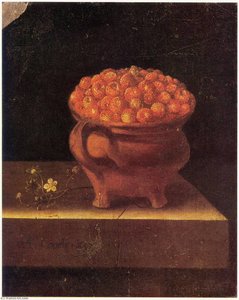
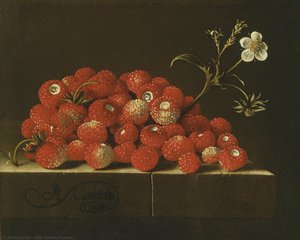
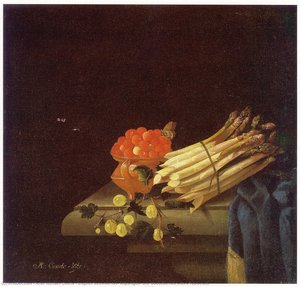
Coorte’s paintings are characterized by their extraordinary restraint. He typically presented arrangements of just a few objects—a bowl of strawberries, a scattering of shells, or a single peach—against dark backgrounds. These were not lavish displays intended to showcase wealth or status; rather, they were intensely focused studies of form, texture, and light. His compositions are remarkably balanced, almost geometric in their precision, yet imbued with a sense of naturalism that transcends mere technical skill. The lighting is particularly noteworthy, often emanating from an unseen source above, casting subtle shadows and highlighting the delicate surfaces of his subjects. He possessed a remarkable ability to capture the transient beauty of perishable objects—the velvety skin of a peach, the glistening dew on a strawberry, the pearlescent sheen of a shell. This focus on ephemerality lends his work a poignant quality, reminding viewers of the fleeting nature of existence. Unlike many still lifes of the period that incorporated opulent silver or Chinese porcelain, Coorte favored simple pottery—a deliberate rejection of ostentation in favor of humble authenticity.Rediscovery and Lasting Significance
For centuries, Adriaen Coorte remained largely unknown outside his native Middelburg. His work appeared sporadically in local tax inventories, but he was not celebrated or widely collected during his lifetime. It wasn’t until the 1950s that art historian Laurens J. Bol embarked on a painstaking investigation into his life and paintings. Bol's monograph and catalogue raisonné, published in 1977, brought Coorte to the attention of a wider audience, sparking a renewed appreciation for his unique style. An exhibition at the Dordrechts Museum in 1958 proved particularly influential, captivating Dutch audiences and inspiring poets like Hans Faverey and Ed Leeflang. Subsequent exhibitions at institutions such as the National Gallery of Art in Washington D.C. (2003) and the Mauritshuis in The Hague (2008) further cemented his reputation as a master of Dutch Baroque painting. Today, Coorte’s paintings are highly sought after by collectors and museums alike. His work stands as a testament to the power of simplicity—a quiet rebellion against the excesses of his time and a profound meditation on the beauty of the everyday. He is now recognized not merely as an anomaly within the Dutch Golden Age but as a singular voice, offering a unique perspective on light, form, and the ephemeral nature of life itself.Themes and Symbolism
While Coorte’s paintings lack the overt moralizing often found in other still lifes of the period, they are not devoid of symbolic meaning. The fruits he depicted—peaches, strawberries, grapes—were frequently associated with themes of temptation, abundance, and the pleasures of earthly life. However, his minimalist approach tempers these traditional interpretations. The single butterfly that appears in many of his compositions is often seen as a symbol of transformation and resurrection, while the dark backgrounds evoke a sense of mystery and contemplation. His paintings are not didactic pronouncements but rather invitations to quiet reflection. The very act of focusing on such humble subjects—a few pieces of fruit or a handful of shells—can be interpreted as a celebration of simplicity and a rejection of materialism. Coorte’s work resonates with a sense of spiritual stillness, inviting viewers to appreciate the beauty of the present moment. The intense study of light itself can also be seen as symbolic, representing divine illumination or the fleeting nature of time. Ultimately, Coorte's paintings are open to multiple interpretations, allowing each viewer to find their own meaning within these exquisitely rendered scenes.
after adriaen coorte
1665 - 1707
Quick Facts
- Artistic Movement Or Style: Dutch Golden Age Still Life
- Artists Or Movements Influenced By This Artist: Rediscovered Dutch Baroque painters
- Artists Who Influenced This Artist: ["Melchior d'Hondecoeter"]
- Date Of Birth: ca. 1665
- Date Of Death: after 1707
- Full Name: Adriaen Coorte
- Nationality: Dutch
- Notable Artworks:
- A Bowl of Strawberries
- Still Life with Shells
- Five Shells on a Slab
- Place Of Birth: Middelburg, Netherlands
Related Articles

Golden Age Reflections: Dutch Baroque Painting & Cultural Innovation
Explore the Dutch Golden Age of painting! Discover key artists like Vermeer & ter Borch, their innovative techniques, and the rich cultural context behind these Baroque masterpieces. Learn about collecting & appreciating this iconic art period.

Dutch Masters: 10 Golden Age Paintings That Still Inspire |
Journey into the Dutch Golden Age! Explore 10 iconic paintings by Rembrandt, Vermeer & Hals. Discover the stories behind these Baroque masterpieces and find museum-quality art reproductions to elevate your home decor on .

Dutch Baroque Masters: 10 Paintings That Shaped an Era | ArtsDot
Journey through the Golden Age with our guide to the Top 10 Dutch Baroque masterpieces! Explore iconic paintings by Rembrandt, Vermeer & Frans Hals. Find museum-quality art reproductions and elevate your home decor at ArtsDot.com.

Illuminating Innovation: Exploring the Dutch Golden Age of Painting
Explore the Dutch Golden Age of painting with ArtsDot. Discover Rembrandt, Vermeer & other Masters. Learn about key characteristics, iconic artworks, and lasting influence. Expert insights for collectors & enthusiasts.
Illuminating Realism: Exploring the Dutch Golden Age of Painting (1600-1700)
Explore the Dutch Golden Age of painting (1600-1700) with ArtsDot. Discover Rembrandt, Vermeer & other masters. Learn about techniques, history & find museum-quality reproductions.